
Blue Bottle Independent Union Wins First Contract
Independent union BBIU pulls contract concessions from the café chain after two years of negotiations.
Independent union BBIU pulls contract concessions from the café chain after two years of negotiations.

In September, the Blue Bottle Independent Union (BBIU) announced that they had won their first contract, concluding two years of negotiations with the coffee chain. Blue Bottle’s self-mythology romanticizes its origin as a single cart at the Old Oakland farmer’s market, but these days it operates more than a hundred stores across the U.S. and East Asia. Nestlé held a controlling stake in the company from 2017 until earlier this year, when they sold Blue Bottle’s retail operations to Beijing private equity firm Centurium Capital for $400 million in March of this year.
Organizers should take note of the fact that the contract was won by a small, independent union unattached to any larger labor federation; the union is composed of employees at just nine cafes, six in Boston and three in the East Bay.
The path to unionization wasn’t a quick one — in Boston, discussions began as early as the summer of 2022, says Rocky Prull, the union’s first president. In the East Bay, whispers about unionizing began as early as 2020, but gathered force in 2024 after workers in Boston went public and successfully voted to unionize. The East Bay cafes went public in June of 2025, and voted for the union around a month later.
For one thing, they had to learn how to organize. “We had to hold a lot of grace for ourselves and each other,” says Prull. Since none of them had much experience organizing, the first months of meeting focused on how to approach conversations about organizing with coworkers, planning social events, and learning what workers’ concerns were. “Things often did not happen as quickly as one would hope. We had to learn to balance the BBIU as a regular and integral part of our lives without letting it take over, we had to learn what we could and could not do and seek out help as needed.”
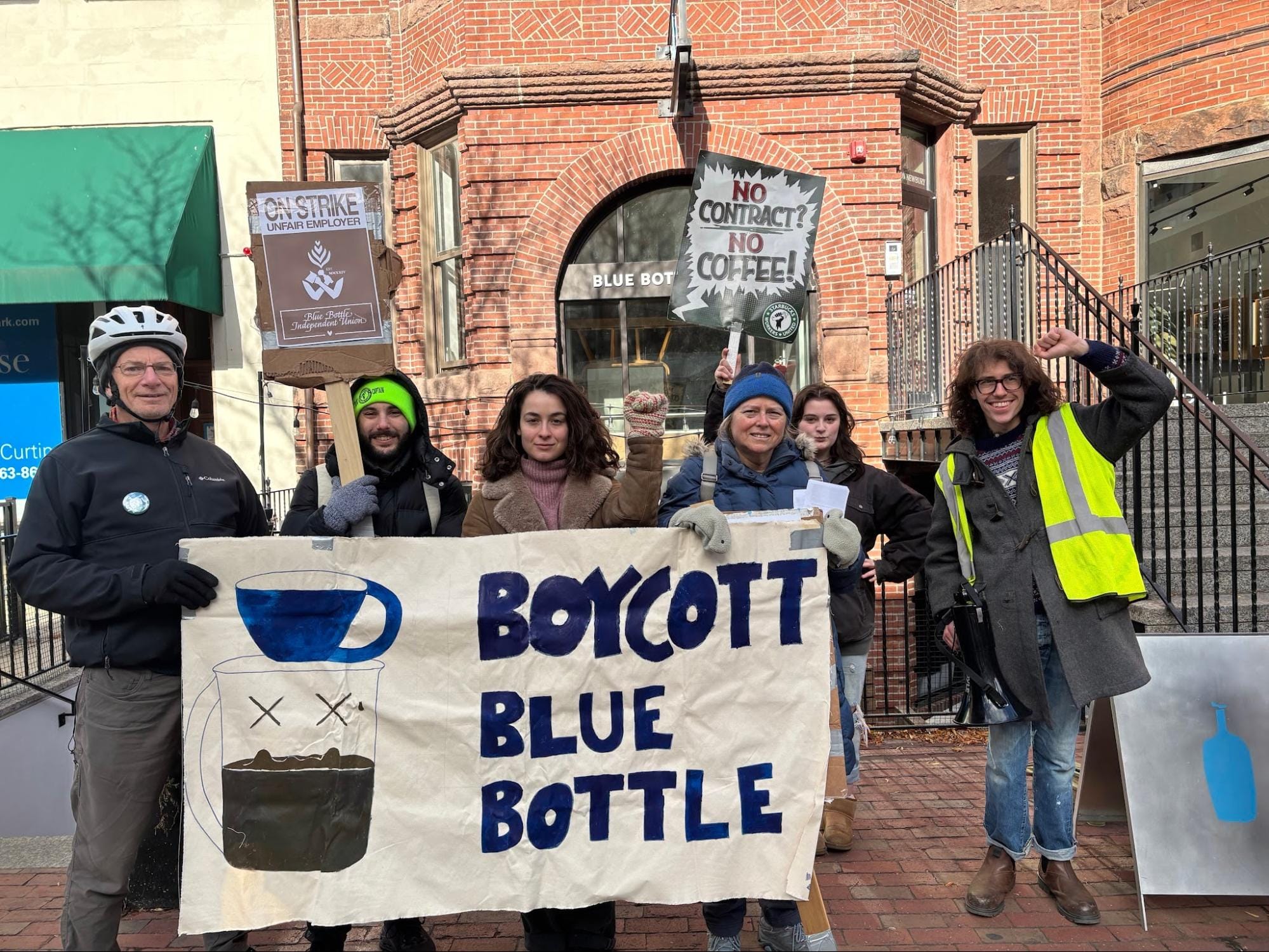
Workers at One of the Boston Locations on Strike. (BBIU/Bay Area Current)
Another obstacle to getting off the ground was turnover. “The yeses I had gotten for the union were leaving the job,” Prull said. “The people I had counted on to support the union left because they were also often the same people who had it the worst. They had the most to gain from a union, but because of that they were living precarious lives of student workers, disabled or chronically ill workers, or those who were living paycheck to paycheck.”
Also time-consuming was the process of union shopping. Alex Reyes, co-president of BBIU in the East Bay, remembers talking to UFCW and IWW, as well as considering joining the BBIU. Reyes was always a proponent of the independent union; he had watched other local unions join larger labor federations and then not be granted permission to strike: “You just run it by the workers themselves. And the government gives us a right to go on strike — we don’t need to ask another union’s permission, we have a right to concerted activity.”
Despite these challenges, both Pyne and Reyes cite an upswing in local organizing, in their respective regions, as compelling their continued organizing. So the organizers persevered, slowly reaching out to workers at different Blue Bottle locations to try to form organizing committees at each one.
In the East Bay, where I was a Blue Bottle barista at the time, we kept a spreadsheet of who worked at each café, color-coded by how easy we thought it might be to approach them. Over the many months that followed, union cards with workers’ signatures were collected, with the goal of having a substantial percentage of cards signed before going public.
A combination of informal conversations and formal surveys served to collect information about what workers’ concerns were, so that the union could strategically agitate around those issues. And the company’s own policies were apt to work for the union. One notable incident in the East Bay, fondly referred to in retrospect as “Brown Bottle,” saw workers being told to work while sewage poured out of the ceiling, resulting in workers reporting the company to OSHA for health code violations. As Reyes put it, with behavior like that, “the company did a good job helping us organize the union.”
Another key to the BBIU’s success was having social time outside of both work and organizing meetings, said Prull; as it grew, the union hosted parties, potlucks, movie nights, and other kinds of events so that workers from different cafes would come face to face. “It’s difficult to measure, but I firmly believe that this built so much trust and commitment throughout our union. Getting workers together outside of work creates a social investment for them that we couldn’t have developed with our other organizing strategies.” In this way, workers were better able to share stories and issues that came up, spread information, and build a sense of community.
In both Boston and the East Bay, once they had strong bases at some cafes, they turned to salts – people posing as regular workers in order to radicalize staff. In the East Bay, a salt was crucial to sealing the deal at the Piedmont location. In Boston, with the addition of the salts’ help, by the time they went public in the spring of 2024, they had organizers at five of the six Boston cafes and enough yeses to unionize all six. “We were able to file as a union regionally and [were] able to bargain regionally,” said Prull, recalling Boston’s efforts. “We got the element of surprise and had the entire Boston market cornered with our union.”
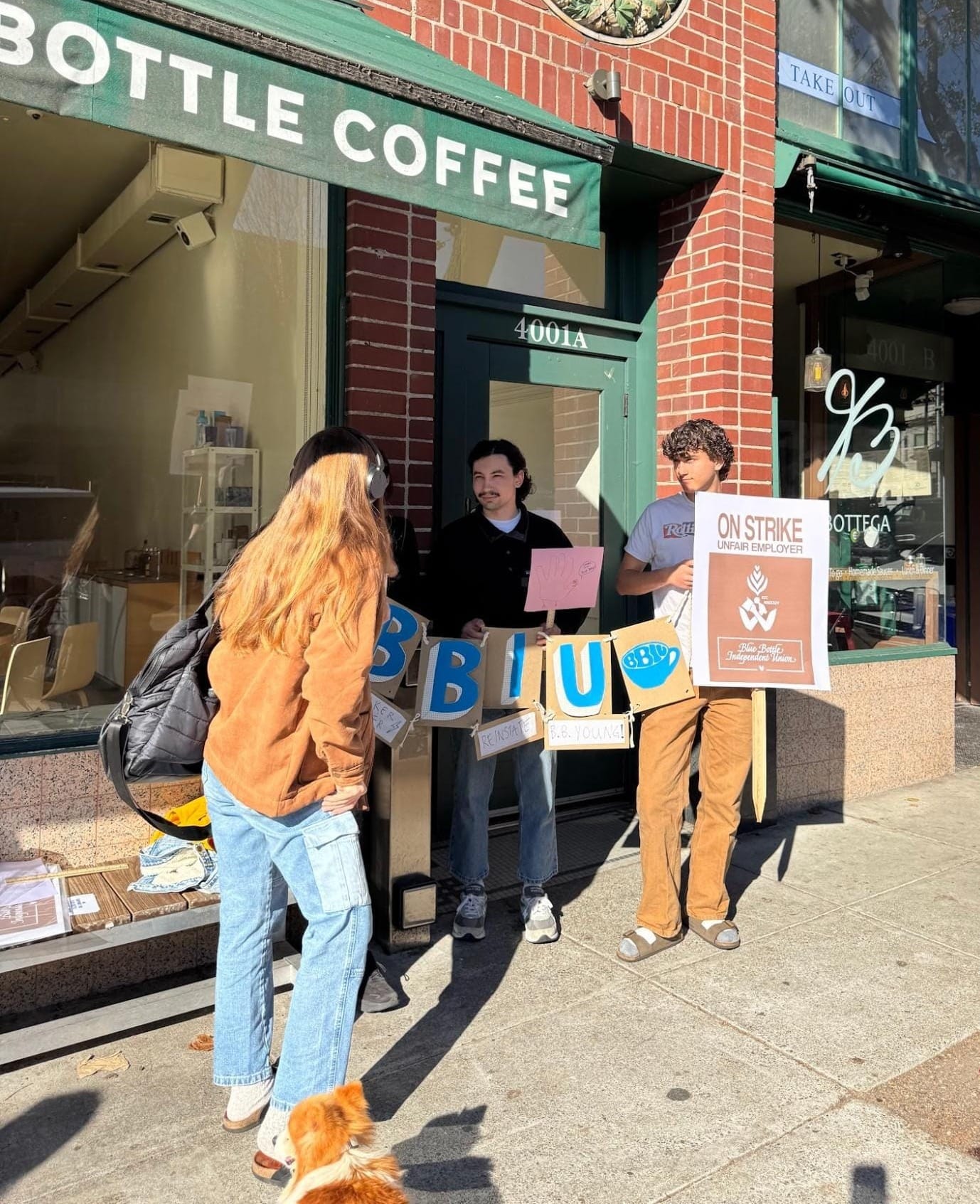
On April 4, 2024, Boston announced their campaign with 50 of 60 possible cards signed across the six cafes. Blue Bottle declined to recognize the union, and because of this level of organization, they were able to demonstrate their coordination by staging a walkout across multiple locations. “If we had more money from the get-go,” says Gonzo Pyne, current president of BBIU in Boston, “some of us would have been interested in trying to strike for longer, as like a recognition strike.” Still, they demonstrated their unity and, a month later, won recognition.
But after voting in the union, it took around six months to even begin negotiations. “One of the initial ways they tried to union bust was they insisted on evenly splitting the costs of a rental space to negotiate the contract,” says Pyne. Bargaining sessions were to happen in two-day blocks each month, eight hours each day. “They took advantage of the fact that we were independent and had no money by really insisting on evenly splitting the costs and negotiating place.” The company refused to meet on Zoom, instead insisting on meeting face-to-face, knowing that finding room for that length of time in Boston would be difficult for the union, and impossible for free.
Once the East Bay joined the fray, this stipulation meant East Bay organizers were unable to join the meetings directly, instead staying involved through conference calls on breaks from negotiating. The bargaining unit and management ended up meeting mostly at a WeWork, paying approximately $800 to $900 even when splitting costs down the middle. Even the library, according to Pyne, would have been more expensive, and they would have had to book it further out.
“The company did a good job helping us organize the union.”
The kicker, Pyne said, was once they got to negotiating “there were a handful of times [the company’s negotiators] insinuated that they didn’t even have the authority to be negotiating with us.” This was just one of the many charges BBIU ended up filing complaints about with the National Labor Relations Board. While management and company representatives claimed neutrality, repeated delays and other anti-union actions, such as tearing down Know Your Rights posters, left a bad taste in organizers’ mouths. The union also claimed, at different junctures, that leadership acted in bad faith towards known organizers: cutting their work hours, writing them up with excessive scrutiny for petty infractions, and firing them without prior discipline.
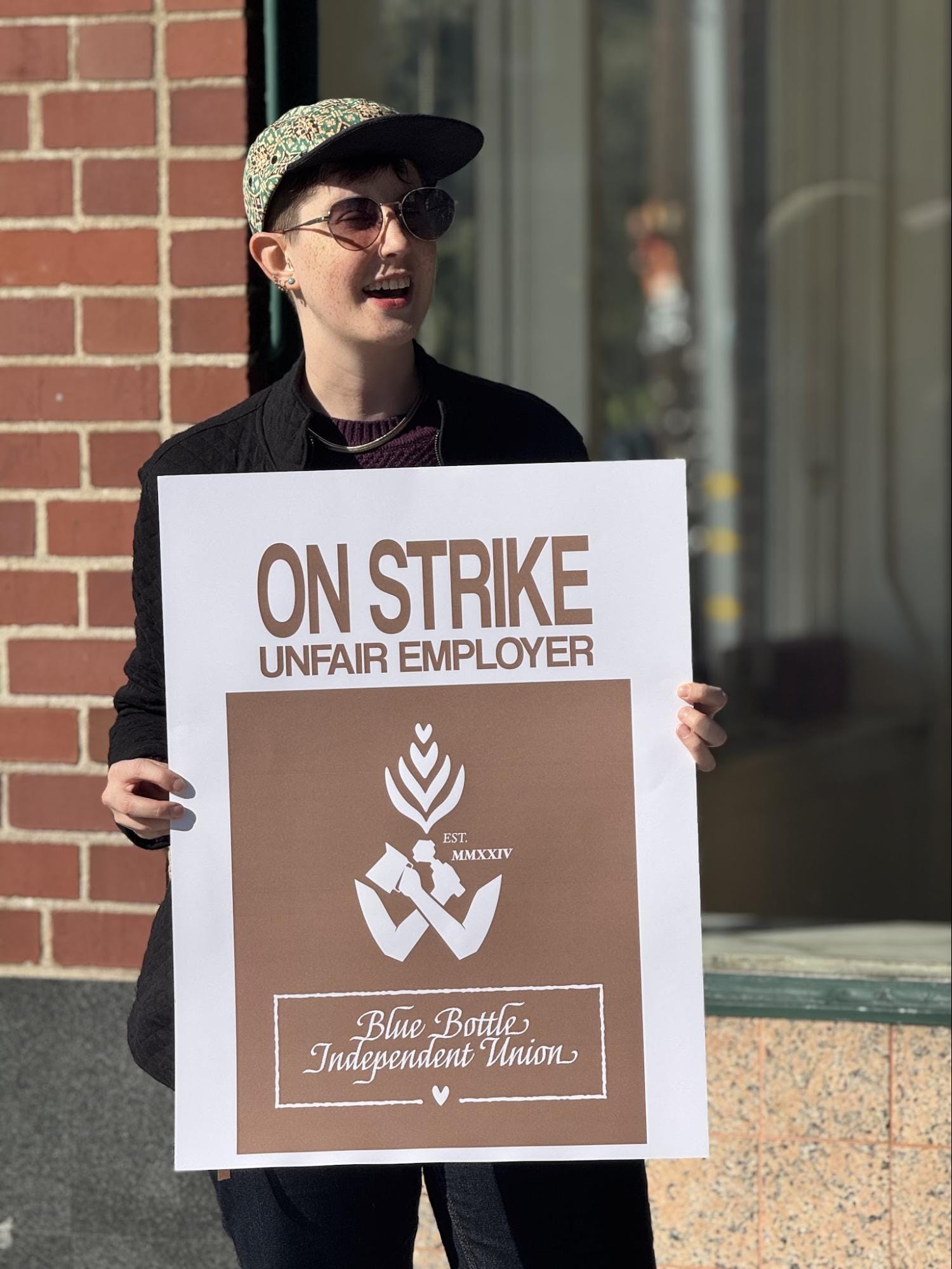
In stalwart union fashion, BBIU protested with a series of walkouts. In 2025, they held one walkout of just eight minutes, and another for a half-day; fundraising helped support their ability to pay back baristas at least the base wage of hours they missed. Later, they enacted a five-day strike that started the day before Thanksgiving, which meant the cafes were closed for the whole Black Friday weekend as well, one of the company’s most lucrative times of the year.
Besides the internal community the baristas built up as they organized for a better future, the BBIU found support from the outside as well. Pyne says the labor world has been very supportive, turning out to picket lines and helping fundraise, connecting them to other supporters. And the Independent Organizing Network, a nonprofit organization of lawyers who provide legal representation to independent unions, provided free legal support across the campaign.
Bargaining went on through August 2026, when the company presented what they called their “last, best, and final offer.” This language is legalese to indicate that the company believes negotiations can go no farther; legally, this means they would be able to implement the contract with or without the union’s approval, and the union would have had to decide whether to raise a legal challenge or push back with more walkouts and strikes. Most disappointing in this final offer was the wage table, which starts at $18.59 in Boston and $20.39 in the East Bay and goes up less than a dollar over the next three years. For comparison, the union had started negotiations arguing for a base rate of $30 for baristas, $35 for shift leads, and $40 for assistant cafe leaders. “Realistically, few people expected to win those base rates,” said Pyne. “But it was important for us to try to get as close as we could to that.”
The underwhelming wage offer was only a little more than the July offer, which the union called “deeply unserious” at the time. But faced with this new obstacle, union negotiators were inclined to accept the three-year offer. Predicting workers’ disappointment in the wage increase of just under 7%, the union’s bargaining update for August made the case that it was comparable to other similar first contracts they had reviewed, and highlighted the wide range of non-economic offers they were able to secure. These included stronger non-discrimination language, higher standards requiring just cause for discipline, stronger union rights (such as allowing union orientation meetings with new hires), and much more. After two information sessions held over Zoom, BBIU workers voted for the contract, which went into effect on October 1 and will remain in effect for three years.
With the implementation of the contract, the union is barred from further strikes or walkouts for the contract’s duration. “Enforcement becomes its own struggle,” said Pyne. “Investigating grievances, filing them, writing defenses for them” all take time. However, attention and energy can also now be turned from negotiation to growth, reaching out to workers at Blue Bottle locations in other regions and inviting them to unionize as well. At least one other Blue Bottle is already showing interest—on October 21, workers at the World Trade Center location in New York City announced their intent to join the union, though Pyne says it isn’t clear yet whether the company will want to include them in the BBIU’s hard-won contract.
And in the years to come, the makeup of the union will no doubt shift as workers involved in the union seek employment elsewhere; so another project is the union’s long-term viability. For Reyes, “The union is as strong as, you know, people knowing the contract, having ways to make it sustainable; the future is going to be continuous organizing, because the contract will expire, and we’ll have to organize around what we want next.”

100,000 SEIU Local 1000 workers strike to force Newsom administration back to the bargaining table.


We spoke to one of the frontline union workers in the climate change fight.


Union workers face cuts amid eye-watering boss pay and refusal to dip into a $270 million endowment

In a city dripping with cash, San Francisco can’t get its kids to school.
