
State Employees Strike for First Time in 25 Years
100,000 SEIU Local 1000 workers strike to force Newsom administration back to the bargaining table.
100,000 SEIU Local 1000 workers strike to force Newsom administration back to the bargaining table.

What electoral candidates’ Chinese names reveal...
100,000 SEIU Local 1000 workers strike to force Newsom administration back to the bargaining table.

In the last few months of his term as California Governor, Gavin Newsom has decided to turn on his own workers — roughly 100,000 of them. On Wednesday October 21, State of California employees represented by SEIU 1000 walked off the job in a one-day strike across California.
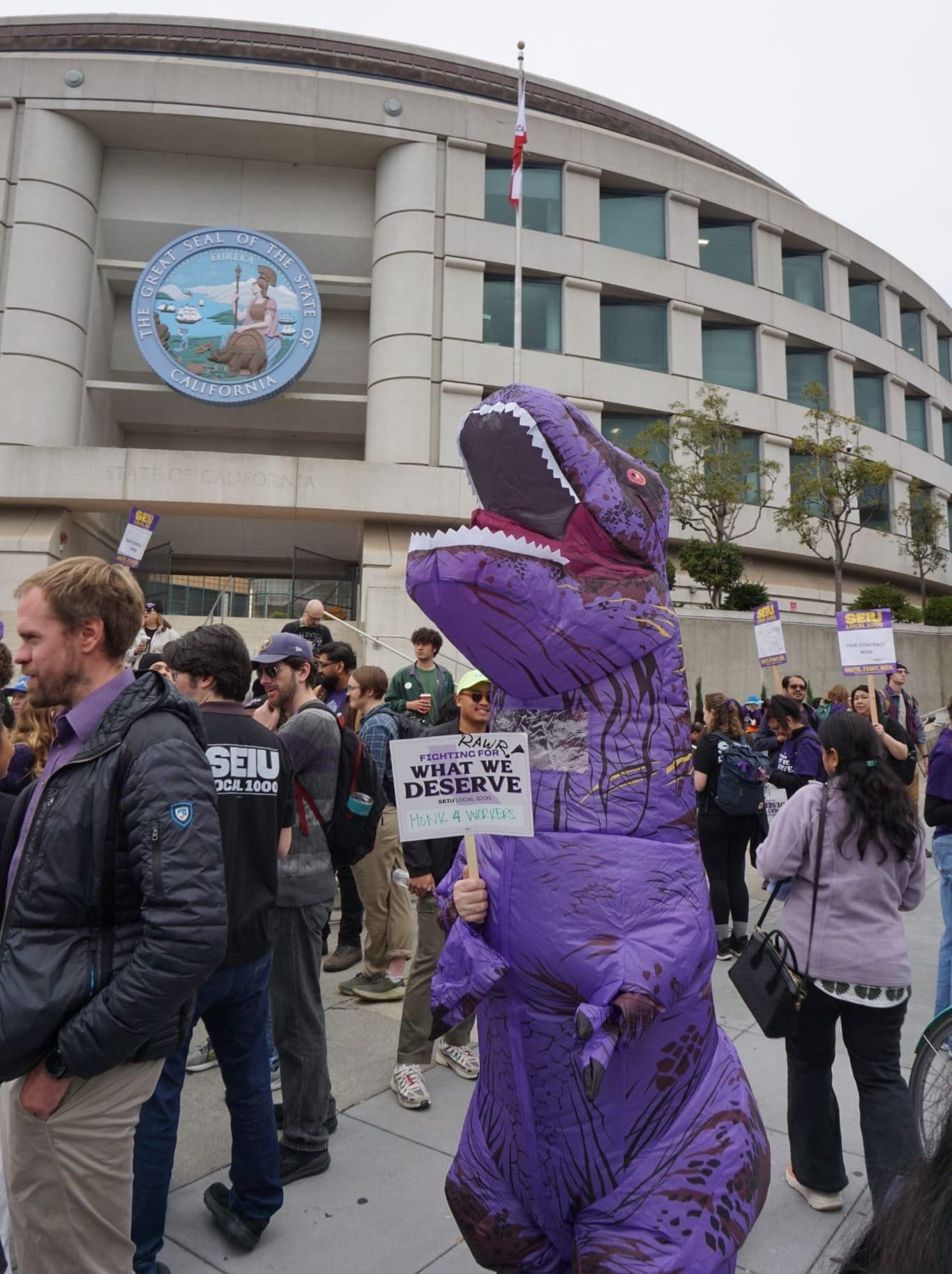
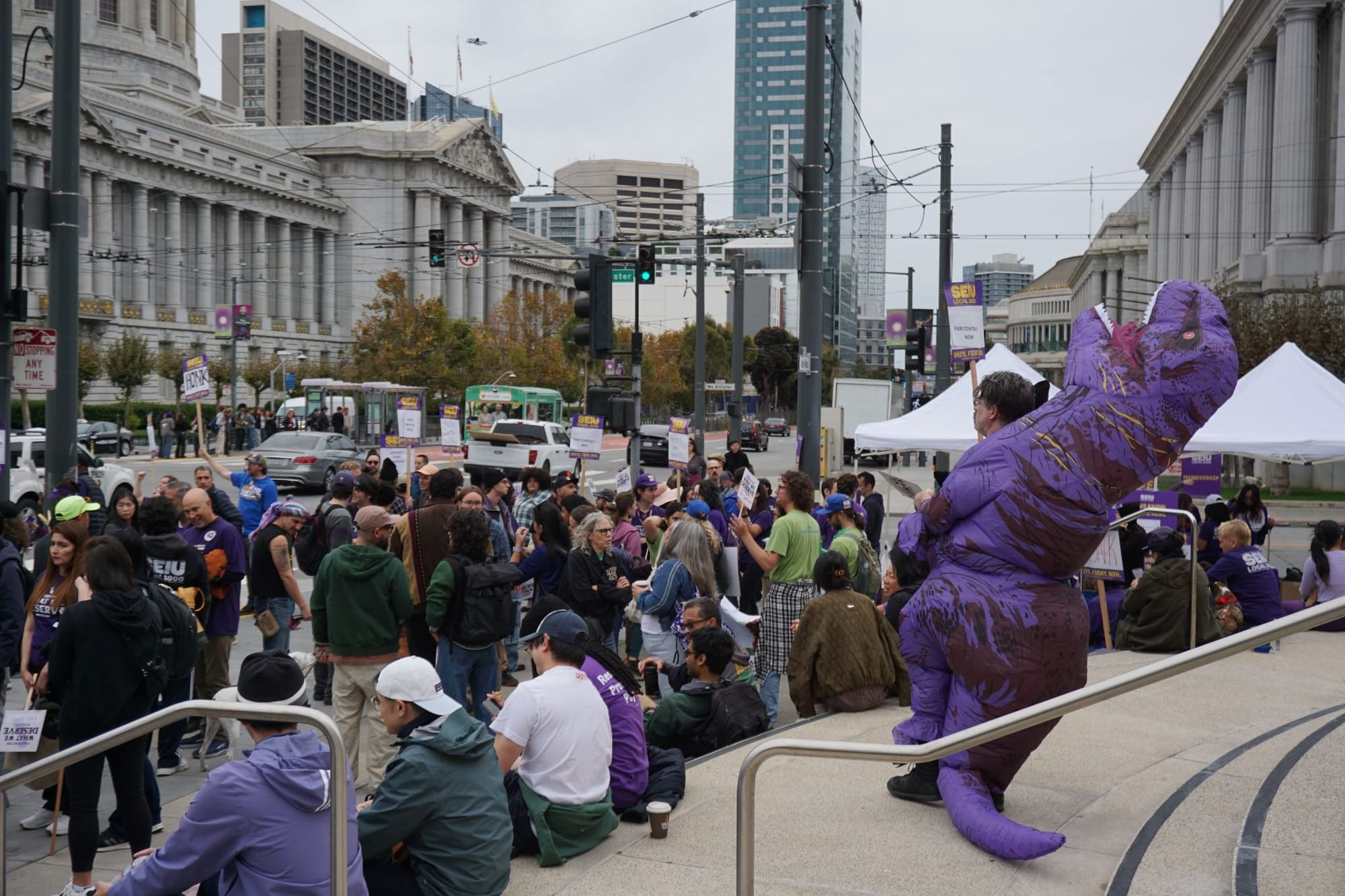
In San Francisco, over 150 California state workers gathered outside of the Public Utilities Commission (PUC) building and in Oakland workers gathered at the Elihu M. Harris State Office Building downtown. These workers drew from across the SEIU Local 1000’s nine bargaining units and thousands of classifications, which collectively represent nearly 100,000 state workers, who have been working without a contract since June.
This is the first time in Local 1000’s twenty-five year history that the union has gone on strike. Spirits ran high as workers, joined by community and labor supporters danced and picketed their way around the PUC building. Cement truck drivers, city workers, and San Francisco residents honked their horns in support as they passed. While most Local 1000 members wore SEIU’s trademark deep purple t-shirts, more than a few wore violet Golden State Valkyries swag in its place. One standout came dressed in a purple inflatable T-Rex costume.
The union filed an Unfair Practice Charge with the Public Employment Relations Board (PERB) in July after CalHR, the entity responsible for bargaining with unions representing state employees, delayed negotiations by months and then came back to the table with no counter proposal and rejected most of the union’s economic proposals in one fell swoop. To rationalize this rather atypical bargaining maneuver, according to SEIU 1000, CalHR cited the side letter that both parties had agreed to in 2025 — a document intended to be temporary through June 2026.
The side letter was negotiated last summer after the state tried to cancel a 3% general salary increase for workers in an attempt to shrink California’s budget deficit. It granted the state the right to defer the salary increase until 2027 and reduce wages by 3%. In exchange, state employees would receive five additional hours of leave each month and Newsom’s return-to-office executive order would be paused through July 2026. Few anticipated that the state might use the agreement as a pretext to avoid bargaining the following year, when their contract would expire.
“We’ve reached an agreement with the state that protects your raise, pauses the return to office order, and gives us a path to bargain again in 2026,” reads a Local 1000 bargaining update from June 29, 2025.
“We had to file a ULP [unfair labor practice] because the state’s not coming to bargain in good faith,” said Terry Gray, a member of the legal division of the PUC for 14 years who has served as a union steward, bargaining team member, and is now the President for the union’s District Labor Council (DLC) 743 in San Francisco. “[Members of the Newsom administration] weren’t coming to the table — they weren’t bargaining with us. We are fighting for the right to work, the right for fairness.”
Even for longtime state workers who were around for numerous contract cycles and the strike authorization vote (that stopped short of an actual strike) in 2016, the Newsom administration’s blatant disregard for good faith negotiating came as a surprise.
“This is my fifth contract,” said Susan Rodriguez, the chair of SEIU 1000 Unit 1 and senior workers' comp claims adjuster for the State Compensation Insurance Fund. “I've done this four times before; this is a different feeling this time around.”
SEIU 1000 workers took a 3% pay cut in 2025 because they believed that once Newsom balanced the state budget, the union would have a clear path to ask for a lot more in the 2026 round of negotiations. SEIU 1000 is asking for a 20% raise spread over three years for all employees in the unit. Now, with the state’s budget indeed looking less precarious, workers are left to wonder why they’ve been boxed out completely. “The state came back and said, ‘How about nothing?’” said Erin Gravely, a shop steward and Program Manager at the California State Coastal Conservancy at the Oakland strike site.
The state’s refusal to bargain added insult to the injury many state workers had already been feeling as the cost of rent and necessities continued to rise — and quite dramatically in many places, including the Bay Area.
“The Bay Area is very expensive and we continue to operate on a statewide salary…There are some counties where the state has authorized GEO pay (geographically-dependent pay scales),” Gravely added, “But for the majority of state workers in unit one, which is the unit that I'm in, there is no GEO pay in the San Francisco Bay area.”
For Kristin Anderson, a Public Records Officer with CAL-OSHA since 2019 and a state employee since 2014, this strike has been a long time coming. “As state workers we’re really behind in wages compared to the City, County and private sector doing comparable work. We have state workers sleeping in their cars. It used to be a state job where you could support a family.”
Workers at all levels across agencies are being squeezed while trying to eke out a living working for the state. These are professions that were once, and to a large extent still are, regarded as stable ways to build a career with good benefits and a pension. “A public sector worker used to be able to raise a family, to buy a house in the Bay Area. Nowadays, that's just not possible,” said Joel Chan, an employee of the California Department of Tax and Fee Administration (CDTFA) at the Oakland picket. Now, many of CalHR’s efforts to help Newsom reduce government spending are dismantling these assumptions and making working for the state look a little more like working for the private sector. “We're just trying to survive like everybody else, and that's what the strike is about. A good middle class life, that’s all we want.”
"We have state workers sleeping in their cars. It used to be a state job where you could support a family."
“We haven’t had a real raise in a long time,” said Anderson in San Francisco. “All the raises we have been getting are clawed back — economically speaking a sacrifice [of a day’s wages] now is worth it, I’m willing to suffer a little bit of pain now. In a way we’re protecting state service — with the low wages and high workload it’s really hard for all our departments to hire and once they do hire people it’s extraordinarily difficult to retain them. The same amount of work is being done by fewer people. Making the state a job that people want to stay in is going to benefit everybody.”
Another key way the state is placing more demands on workers with little benefit is through its return-to-office (RTO) mandate. Drawing inspiration from his friends in Silicon Valley, Newsom implemented an executive order requiring state employees to work in-person a minimum of four days a week, with minimal exceptions. SEIU 1000 sponsored an assembly bill to ease up on the mandate, emphasizing that a more relaxed policy would save taxpayers on the order of 225 million dollars. Newsom vetoed the bill last month.
The RTO policy has been particularly difficult for Jared Choy, a recent graduate who began working at the CDTFA nine months ago. This is his first job out of college. When he accepted the offer, he was told he would be able to work from home, in Oakland, three days a week and commute to his office in Sacramento the other two.
“All of a sudden they tell us to go back four days in person and you have executives being like, ‘I expect everybody to be adults about it,” Choy said. “There was no heads up. It was just, ‘This is how it's going to be now, just deal with it.’ I think it's crazy.”
Beyond forcing CalHR to agree to the 20% wage increases, higher contributions to health insurance premiums, and a telework policy that supports employee retention and cost efficiency, SEIU 1000 workers hope that this strike will increase the visibility of the labor that keeps the state functioning. “A lot of folks just kind of go into DMV and EDD [Employment Development Department] and they get a service back. They just don't understand who's actually doing it. It's state workers,” said Rodriguez.
Still, not every state employee was able to engage in last Wednesday’s show of worker power. Workers in prisons kitchens, state hospitals, transit emergency dispatchers, and others deemed “essential,” were given line passes. Initially, CalHR endeavored to leverage these workers to block the strike, filing an unfair practice charge with PERB. But SEIU 1000 had already provided health- and safety-related exemptions and the board ruled in favor of the union.
“A lot of folks just kind of go into DMV and EDD and they get a service back. They just don't understand who's actually doing it. It's state workers,”
There is also the hope that the strike will signal to the next gubernatorial administration that state workers will not be bullied into submission. California is one of few states where public sector workers are legally able to strike, and they’re eager and primed to take advantage of it. When it came to this strike, “At least in my workplace, it didn't take a lot of convincing,” Gravely said.
“This is the strongest I’ve seen the union in a long time,” said Anderson. “People are just a lot angrier — the organizers have been channeling that into this. I’m hopeful this puts us in a stronger bargaining position.”
“This is our first [strike],” said Gray “like a little tester — and if they don’t come back the table we’re going to go out again and again, we’re preparing and gearing up for the worst but we hope the state comes back to the table and negotiate with us in good faith.”
Though the sabotage of good faith negotiations with SEIU 1000 is a particularly egregious example, it jibes with Newsom’s attitude towards organized labor and the working class more broadly. Using veto power to beat back popular, union-backed legislation has become somewhat of a modus operandi for him. In 2023 alone, he vetoed at least six bills that would have strengthened employee protections, including SB 799, which would have made striking workers eligible for unemployment benefits.
SEIU 1000 and the state met October 30 for mediations, but did not come to an agreement. A few days earlier, over 20 members of SEIU had crashed an annual CalHR conference in Sacramento. The next meeting in their contentious negotiations is scheduled for November 21—and Newsom likely wants to avoid another strike.
With a likely presidential run in 2028, his track record in California has serious implications for workers nationally. “My hope is that it [the strike] makes enough noise that Newsom is asked questions about it as he travels around to other states,” Gravely said. “I hope that it makes the point that the state workers are the ones that make the state run, and that by withholding our labor, we're able to make that point and emphasize that we should be compensated fairly for the work that we do.”

We spoke to one of the frontline union workers in the climate change fight.


Union workers face cuts amid eye-watering boss pay and refusal to dip into a $270 million endowment

In a city dripping with cash, San Francisco can’t get its kids to school.


“I'm just a dad that wants to go back to work.”
