
AI Startup Launches Campaign To Exploit Humans, Ethically
Contrary to what Scale's 7-figure ad campaign claims, the company's ethos is anything but “centering humans.”
Contrary to what Scale's 7-figure ad campaign claims, the company's ethos is anything but “centering humans.”

In Against Tech Oligarchy, two leading labor organizers chronicle the past decade’s tech worker movement.
We spoke to one of the frontline union workers in the climate change fight.

Is it hype or is it Kool-Aid? “Ghost in the Machine” succeeds where “The AI Doc” fails.

Imagine you are making a documentary about AI in 2026 and you have the opportunity to sit down with the CEOs of Anthropic, OpenAI, Google DeepMind, what would you ask them? Would you bring up some of the lawsuits around child safety and teenage suicides? Or maybe alleged theft or copyright? Or energy, water, pollution?
Two documentaries about artificial intelligence came out in the first half of 2026. On the surface, both are 100-ish minute sequences of mostly interviews. But that’s where the similarities end. The first, The AI Doc: Or How I Became an Apocaloptimist, directed by Daniel Roher and Charlie Tyrell, is blessed (cursed?) with access to precisely these AI CEOs; it aspires to say something definitive about AI and wants to rally a social movement to guard against its dangers, but ultimately reflects the industry’s own story: that of a machine that can either bring about utopia or wipe out humanity. The second, Ghost in the Machine, from director Valerie Veatch, places language models, the models propelling the current hype cycle around generative AI, within a history entangled with eugenics, arguing that AI is not really any particular technological artifact, but rather a kind of process that serves the economic interests of a select few.
The AI Doc is narratively structured around Roher’s anxieties over fatherhood. He and his partner are expecting a baby but he is afraid of bringing a child into a world which might soon plunge into an AI apocalypse. The film centers primarily industry insiders and people from the AI safety epistemic culture, who are concerned about rogue AI doomsday. Roher never really pushes them on any of their claims: Why would a language model’s ability to pass the bar exam somehow lead to artificial general intelligence (AGI)? And even if it did, by what mechanism, exactly, would AGI crush us like insects in its path, as his interviewees warn?
The film’s discussion of AI capabilities mixes many different kinds of “AI” into one: image models, predictive algorithms, language models, other kinds of reinforcement learning, all in a single ambiguous bucket of “AI.” Even the term intelligence is never really explored. When Roher presses Connor Leahy (co-founder of AI research lab EleutherAI) that “superintelligence…sounds like sci-fi bullshit,” Leahy exclaims: “intelligence can feel like something magical, something mystical in your mind but it is just computation” — I mean, is it? This is an extraordinary claim, and Leahy is not a psychologist or a neuroscientist, so on what grounds should we evaluate his words? And even if the human brain were shown to be no more than a computer, is intelligence really reducible to the peculiar computational paradigm espoused by the major AI labs in the past handful of years — that of simple reinforcement learning algorithms being thrown massive piles of data? Roher simply accepts all of this and presents it all in a factual unproblematic way. By the end of the film, Roher has mirrored the same talking points as his AI safety interlocutors so that when he eventually sits down with the CEOs, it is almost like an episode of Anthropic’s own podcast — it feels more like friendly banter than a serious interview with some of the world’s most powerful men.
The term criti-hype describes critical writing on tech which mirrors the language of tech boosters and “retain[s] the picture of extraordinary change but focus[es] instead on negative problems and risks.” Consider an earlier, supposedly tech-critical film that also plays into the tech industry’s hype narratives: the 2021 docudrama The Social Dilemma. Made with the heavy involvement of the Center for Humane Technology (CHT), The Social Dilemma tells the story of the awesome persuasive powers of recommender systems (a decades-old category of algorithms now often lumped in with “AI”) which drives a teenage boy to extremist politics and ends with sentient AI being birthed from social media data mines. It was also CHT that helped spawn The AI Doc; CHT co-founders Tristan Harris and Aza Raskin (both prominently featured in the film) reached out to Daniel Kwan and Jonathan Wang to encourage them to make this documentary and played a role in shaping its direction and content.
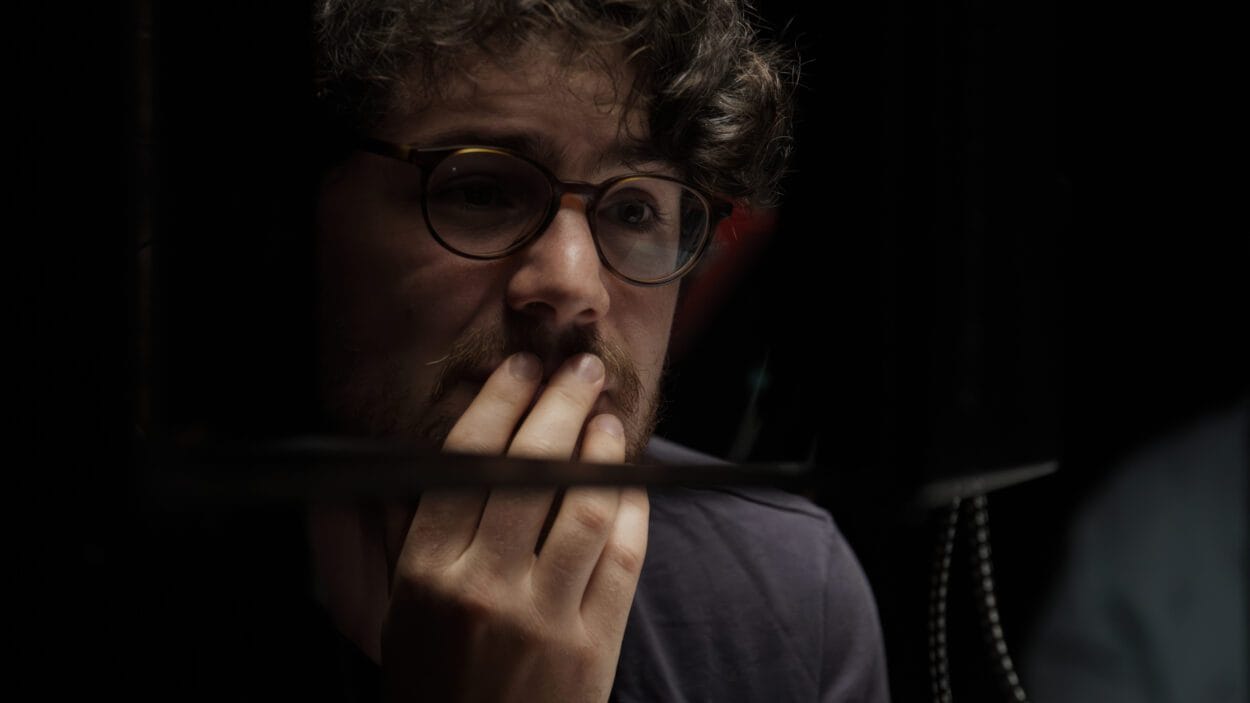
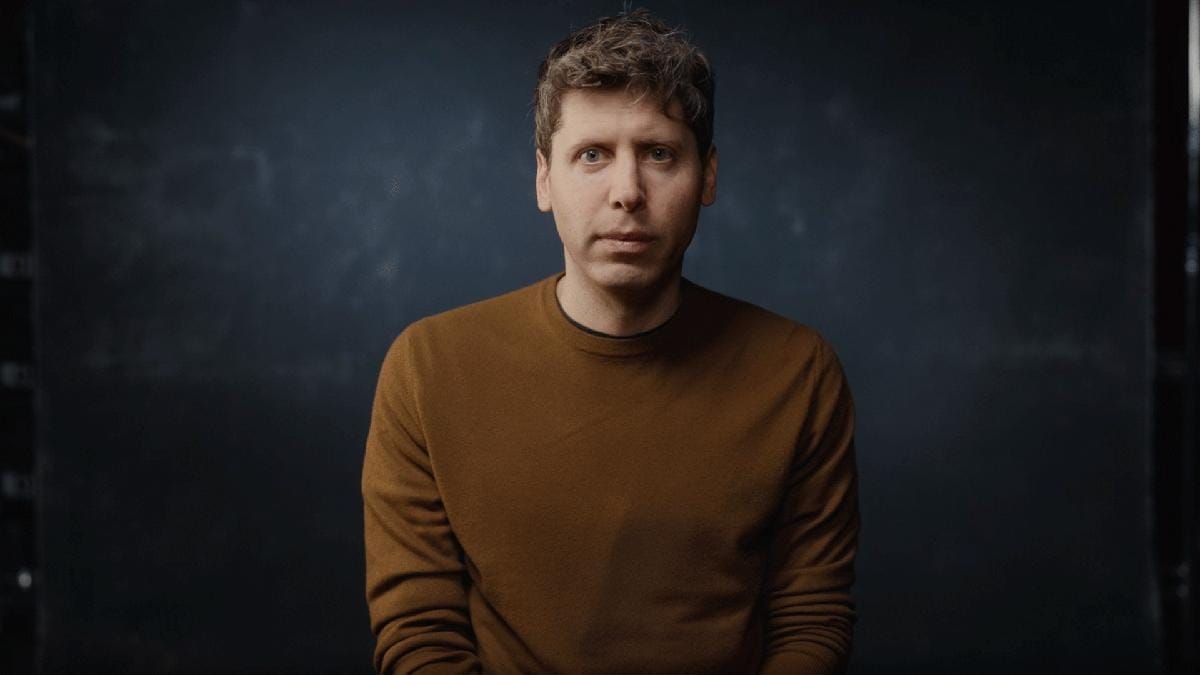
The AI Doc co-director Daniel Roher (left) interviews OpenAI CEO Sam Altman (right) at the climax of the film. (Courtesy of Focus Features.)
So films like The AI Doc, at their worst, serve as industry propaganda. The setup of the film mixes the uncertainty of the future, embodied by the figure of Roher’s future child with AI. The filmmakers have tremendous access here: at the climax of the film, the CEOs of Anthropic, OpenAI, and DeepMind sit down with Roher for a chat. Roher’s very first question to these CEOs is whether he’s making a mistake by bringing a child into the world. Sam Altman assures him that it is a great time to have a kid; after all, he too is expecting one. Roher responds: “mazel tov” and “that is good to hear coming from the guy.” It is in Altman, the face of the current generative AI boom, whose journey to fatherhood and anxiety in some ways mirrors Roher’s own, that we find the definitive answer to the question posed by the title of the documentary. This scene is soon followed by a comforting montage of Roher’s own childhood, with a voiceover of a conversation between Roher and his own father, who tells him that after all, he will be a great dad, that finally, the anxiety around AI too, deflates. With the birth of his son, Roher transforms into a self-proclaimed “apocaloptimist.”
There is a minor detail that is glazed over in this exchange. Altman says “from the raw IQ perspective, our kids will never be smarter than AI.” It is widely reported that Altman and his husband Oliver Mulherin used a surrogate to conceive their child. Altman and Mulherin funds the startup Preventive, which aims to one day use CRISPR to modify embryonic genomes, and (through Hydrazine Capital) also Genomic Prediction, a reproductive technology company that offers polygenic preimplantation genetic testing, an embryo selection technique which is increasingly applied to a broad range of traits from eye color, to risk of cancer, to IQ. These are technologies that some scholars have critiqued as eugenic even as their proponents embrace the label as a new “liberal eugenics.” Altman himself is literally in the business of eugenics in this “liberal” sense.
It is precisely the question of intelligence and its genealogy that is the subject of Ghost in the Machine. Created by Valerie Veatch, the film places artificial intelligence in the entangled history of computation, statistics, racism, and eugenics. The film recruits its own set of experts through interviews with historians, critical theorists, social scientists, and importantly, the data workers that do much of the concealed work that enables AI to function.
I had two key takeaways from Ghost in the Machine. First, by showing how concepts like intelligence and human capability as mobilized by the tech industry today are thrown from a particular history motivated by racism and eugenics, it de-naturalizes “intelligence,” making it something we can call out as objectionable. Second, it aims to deflate the hyperbolic rhetoric circulated by the AI industry about AI’s awesome capabilities and the inevitable coming of AGI. Ways of talking about AI have consequences; as the linguist Justine Zhang recently noted, when we use language that loads AI products with different aspects of personhood like “intelligence,” it serves to commodify those uncommodifiable aspects of personhood.
The AI industry fantasizes about the return of a slave labor class; no wonder they fear a revolt against their human masters.
Rewatching The AI Doc after Ghost in the Machine, there is an undercurrent of eugenics throughout the film in the way Roher’s various interlocutors talk about intelligence. Consider the way The AI Doc talks about AI capabilities and labour. Jan Leike (ex-OpenAI) proclaims that “AGI” is “more than 100x cheaper than humans working at minimum wage.” Since when was “humans working at minimum wage” any yardstick for intelligence? Perhaps it is worth noting that OpenAI’s definition of AGI is about “outperforming humans at most economically valuable work.” This is an imaginary of intelligence integrated with an imaginary of labor, race, and class with a legacy rooted in historical eugenics. Ghost in the Machine establishes historical connections between the founding of Silicon Valley and its early entrepreneurial luminaries like Wickliffe Draper and William Shockley with the eugenicist Pioneer Fund, mirroring the connection between modern day AI CEOs and “liberal eugenics” investments, ultimately coming to shape how intelligence is understood today. The AI industry fantasizes about the return of a slave labor class; no wonder they fear a revolt against their human masters.
In contrast, when Ghost in the Machine brings in or quotes CEOs, it is through caricature. In one scene in which Altman gives a speech with Trump at the White House, Veatch zooms in and enhances the foot stool that an aide places at the base of the podium when Altman gets up to speak, so that his height would appear the same as Trump’s. In another, Veatch reproduces former Microsoft CEO Steve Ballmer’s infamous “Developers!” chant: Ballmer, drenched in sweat, repeatedly screams “Developers!” at a Microsoft conference, as a voice-over explains the “fungal infection” of libertarian entrepreneur worship that belies Silicon Valley. Montages intercut footage of modern-day AI hype discourses, earnings calls, with AI-generated videos of a monstrous conference dinner where attendees alternate between chugging and spewing Kool-Aid. A blinking AI indicator in the top right corner flashes on and off as AI generated and real footage are increasingly blurred. Through what is essentially camp, the film shows that it’s hype all the way down. Nauseating interpellations of real and AI-generated footage circulate and prophesy endless profits, doom, and utopia. The cumulative effect shows the actual “capabilities” of AI are in fact extractive, polluting, and grotesque.
What The AI Doc does is subsume concerns about labor, energy, environment, and power all under the existential risk umbrella. But because it shares the same vision for the technology as those building it (that of an AGI god), it cannot question the lofty claims around AI capabilities and focuses on how society should adapt to minimize the imagined harms of technology. It imagines the role of the public as having a hand (but only a hand) in steering the ship of tech innovation safely through a gauntlet of runaway AI scenarios — from high-tech authoritarianism to full-on human extinction — but does not ask whether this is the right ship to be on at all. Ghost in the Machine ends in a call for refusal as a response to AI. It ends by centering the voices of data workers from Kenya, whose annotation work is what gives chatbots the illusion of fluency and cultural competence, and who are now “building a global alliance of workers.” We should join them.

Contrary to what Scale's 7-figure ad campaign claims, the company's ethos is anything but “centering humans.”

In Against Tech Oligarchy, two leading labor organizers chronicle the past decade’s tech worker movement.


Putrid vibes reigned at SF billionaire-funded Hamilton Society debate.

