
Data Center Frenzy: A Bay Area Primer
AI data centers have arrived in the Bay — and the fight to block them is just getting started.
AI data centers have arrived in the Bay — and the fight to block them is just getting started.

The Bay Area is often depicted as primarily the home of cloud-based software companies, unmoored from any local physical infrastructure. As the breeding ground for contemporary technofascism, and with skyrocketing rents due to looming AI IPOs, our region has plenty of AI-induced problems — but data centers aren’t usually top of mind. Everyone knows the current explosion in generative AI and large language models (LLMs) requires massive computing power provided by data centers, but these facilities are thought of as being “out there” in rural towns far away from tech campuses.
The reality is that the Bay Area is home to over 170 data centers. It is the 9th largest data center market in the United States and, because the U.S. has the highest concentration of data centers of any country, the world.
In the ideology of the AI industry’s leading “frontier” labs, data centers must proliferate in a mad quest to build a hypothetical artificial general intelligence (AGI). Tech oligarchs see negative impacts on actual people — on our jobs, health, and quality of life — as collateral damage. It’s no wonder communities everywhere, from a range of political factions, are pushing back against massive data center projects. Roughly 70% of Americans oppose AI data center construction where they live.
In this guide, we lay out the Bay Area’s unique position in data center history while pointing to emerging site fights and policy responses in the face of AI ascendance. There are several websites that track overall data center development around the world; advocacy organizations, like FracTracker Alliance, that track data center resistance; and research projects collecting data center policy measures. This explainer is not intended to replicate those resources, but to highlight some recent developments and resources for organizing against data centers, and connect Bay Area data centers to a longer history of environmental justice and tech in the region.
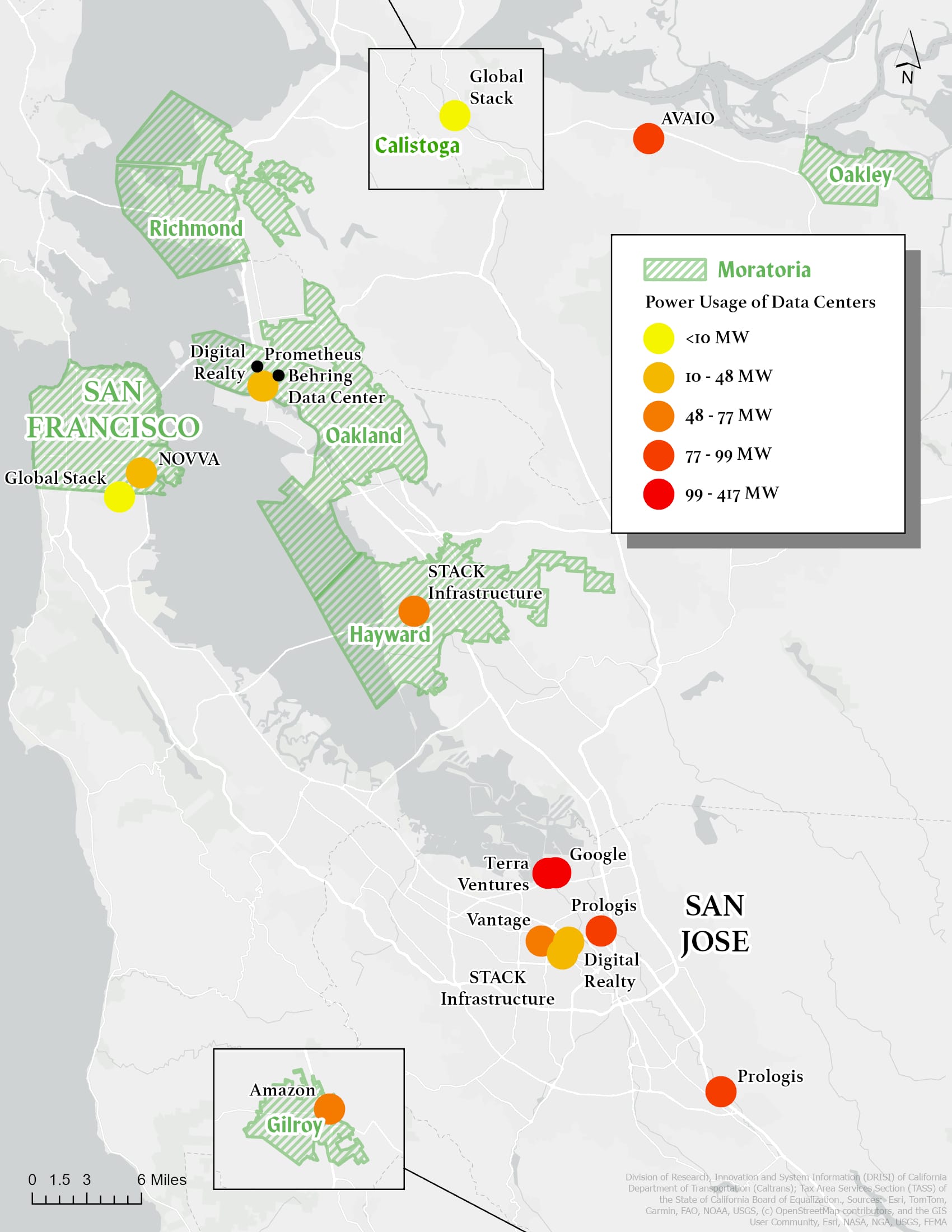
Data center size is measured in both square feet and in megawatts (MW) of peak electrical energy usage; wattage tends to correspond with a data center's capabilities and resource needs. So-called “hyperscale” data centers may draw hundreds of megawatts or even several gigawatts (GW), setting back the transition to renewables and propping up the fossil fuel industry. Many data centers even generate their own power on-site via gas plants or use diesel-fueled backup generators, spewing particulate matter into the air. According to Earthjustice, there are currently 177 GW of gas plant-fueled data centers planned in the U.S., which would raise greenhouse gas emissions by 23% and lead to major public health repercussions.
While newer AI data centers contain many of the same components as other data centers, they also require graphics processing units (GPUs) or other specialized chips, which use even more energy and generate tremendous heat. As a result, data centers can increase utility costs for nearby residents as transmission lines must be renovated to accommodate the massive power needed for data centers. They also require water for both electricity generation and for cooling, a pernicious problem in a state often plagued by drought. Water use varies by data center size and type (for instance, “closed-loop” systems require an initial water fill but do not use water for day-to-day operation), but the largest facilities use roughly one to five million gallons of water a day — in most cases, potable water. After using up that fresh water, data centers can potentially discharge pollutants into local water supplies. Data centers also raise concerns over land use and housing and agriculture displacement.
AI data centers are the material basis of the tech oligarchy's wealth and power.
On a local level, there is an astounding lack of transparency when it comes to data center development. Companies hide behind shell organizations and NDAs, obfuscate their projects by not calling them “data centers,” and make closed-door deals with government officials who may or may not understand what they are agreeing to. Those who must cope with the air, noise, thermal, and light pollution from living or working near data centers, or who contend with the mass surveillance, war crimes, enabled emissions, and labor abuses associated with the applications the data centers run, are not even made aware of construction plans until late in the process. Data centers are one of the most concrete ways we can see the tech oligarchy’s efforts to erode democracy, and organized resistance against them is part of a larger assertion of communities’ rights to control their own resources.
Data centers have been part of computing for decades, but their scale, volume, and intensity is new, along with their relationship to a fundamentally anti-democratic technology — one ideologically aligned with a Silicon Valley-based, far-right class that Gil Durán calls the Nerd Reich. People are disturbed by these oligarchs’ obscene wealth and command over the earth’s resources, the use of AI for authoritarian projects, and bizarre criti-hype from industry-affiliated voices threatening that AI models may kill us all. AI data centers are the material basis of this class’s wealth and power.
The corridor between Santa Clara and San Jose is home to many data centers because of the area’s proximity to chip manufacturers and software companies that predate the AI boom. California’s oldest and largest data centers exist here; Google was first hosted in an Exodus Communications facility in Santa Clara that was built in 1996. Early data centers were just on-site rooms with massive computing systems in them, essentially a very large server room in a corporate office.
In the early 2000s, the rise of social media and e-commerce created a demand for dedicated data centers to run cloud services at scale, as opposed to onsite enterprise data centers. To meet this business need, some companies began to build “hyperscale” data centers — massive facilities often having tens of thousands of servers, hundreds of megawatts of energy consumption, and a modular, expandable design that can be used by other companies for high-energy workloads like streaming and AI. The first hyperscaler was operated by Google in 2006 in The Dalles, Oregon.
AI data centers — those used to support LLMs, computer vision, and other AI applications — are a specific, newer iteration of data centers. While some were built for earlier forms of machine learning in the late 2010s, the number of AI data centers has dramatically increased since generative AI became a major source of corporate and government investment. In the US alone, 180 new data centers were built in 2025 — a 170% increase from 2021.
Bay Area data centers tend to be smaller than the massive hyperscalers in other states or more rural areas. But, as described by AI activist educator Masheika Allgood, the problem is that data centers can beget data centers until they dominate the landscape. There are already over 100 data centers in Silicon Valley, including 47 existing sites in San Jose and 34 projects under review. Allgood, along with collaborators at UC Berkeley’s Human Rights Center, are producing community resources on data center development.
As in many parts of the world, Bay Area data centers are being proposed and built in “sacrifice zones,” or in areas that have already experienced other forms of industrial pollution from the computing industry and beyond.
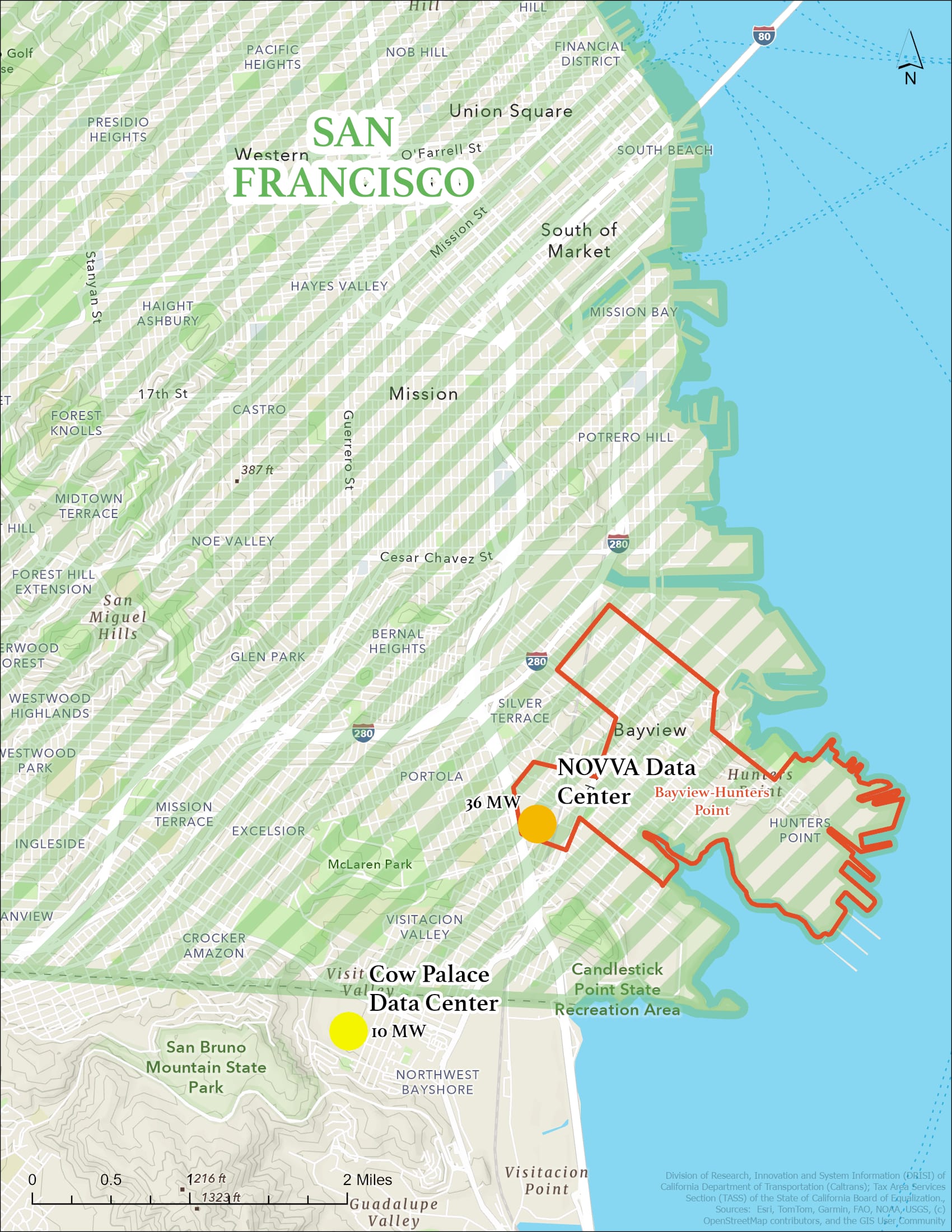
For example, there is an established data center cluster in Bayview-Hunters Point in San Francisco, a historically Black neighborhood plagued with poor air quality and industrial contaminants from the Hunters Point Naval Shipyard, a Superfund site. Cecilia Marrinan has shown how the partially-built NOVVA data center there, which its developer is marketing as “sustainable,” greenwashes the overall industrial impact of constructing and running a large data center in a neighborhood that has long suffered from environmental racism.
In San Jose, data centers are close to tech campuses, where 20th-century electronics manufacturing poisoned both factory workers and local ecologies. The resulting toxic Superfund sites spurred waves of community organizing, including the Silicon Valley Toxics Coalition that formed in 1982 after Fairchild Semiconductor polluted the drinking water of San Jose.
Oakland is not yet a major data center hub, but organizers with West Oakland Environmental Indicators Project see resonances between current data center plans and past waves of industrial air pollution in historically Black neighborhoods, including the proposed West Oakland coal terminal. Tech oligarchs do have their sights set on West Oakland: both Tesla and a Jeff Bezos-backed startup are leasing space in the former American Steel warehouse there for AI hardware and manufacturing purposes, even if they are not building data centers.
Along with several bills at the state level, cities across the Bay Area are considering or passing data center moratoria — usually framed as temporary pauses to give government officials time to study their environmental, public health, and energy and water impacts.
In May, city council members in Oakley voted unanimously to halt the construction of new data centers until mid-2027. Calistoga residents successfully fought back against a planned data center for the fairgrounds there. Despite having no data centers currently planned, Richmond preemptively passed a 45-day moratorium in September.
Activists in San Francisco affiliated with the Party for Socialism and Liberation (PSL) circulated a petition for a data center moratorium in September, and on October 6, the Board of Supervisors unanimously passed a 45-day moratorium. Despite this, an abandoned mall downtown is being considered for a future AI data center site, and the Cow Palace in San Francisco is among at least eight county fairgrounds across the Bay Area that are being targeted by the infrastructure company Global Stack for developing small “edge” data centers.
There are pending moratoria and site fights in other cities around the Bay. In Gilroy, a successful 45-day moratorium was prompted by a massive, 56-acre Amazon AI data center. The community was unaware of the project until late in the development process, so it is already under construction despite widespread local opposition.
In Hayward, community members are organizing against STACK SVY03A, a proposed AI data center that would stand 100 feet tall. Some labor groups, including the Building and Construction Trades Council of Alameda County, supported the project because it would provide temporary construction jobs, and the planning commission approved it without the knowledge or input of the city council. A combination of local community groups, including Hayward Residents Against SVY03A, Hayward Education Association, and national organizations like Honor the Earth, Sierra Club, and the Council on American and Islamic Relations (CAIR), formed a coalition to push for a ban. On October 21, Hayward City Council passed a 45-day moratorium with the option to extend it further.
Perseus, a hyperscaler planned on a former golf course in a residential area of Pittsburg, was originally stopped by a lawsuit calling for an additional environmental review; the case has since been settled. Activists with Stop Pittsburg Data Center and Indivisible Resisters Contra Costa have also been able to slow down the development process, but the fight is ongoing.
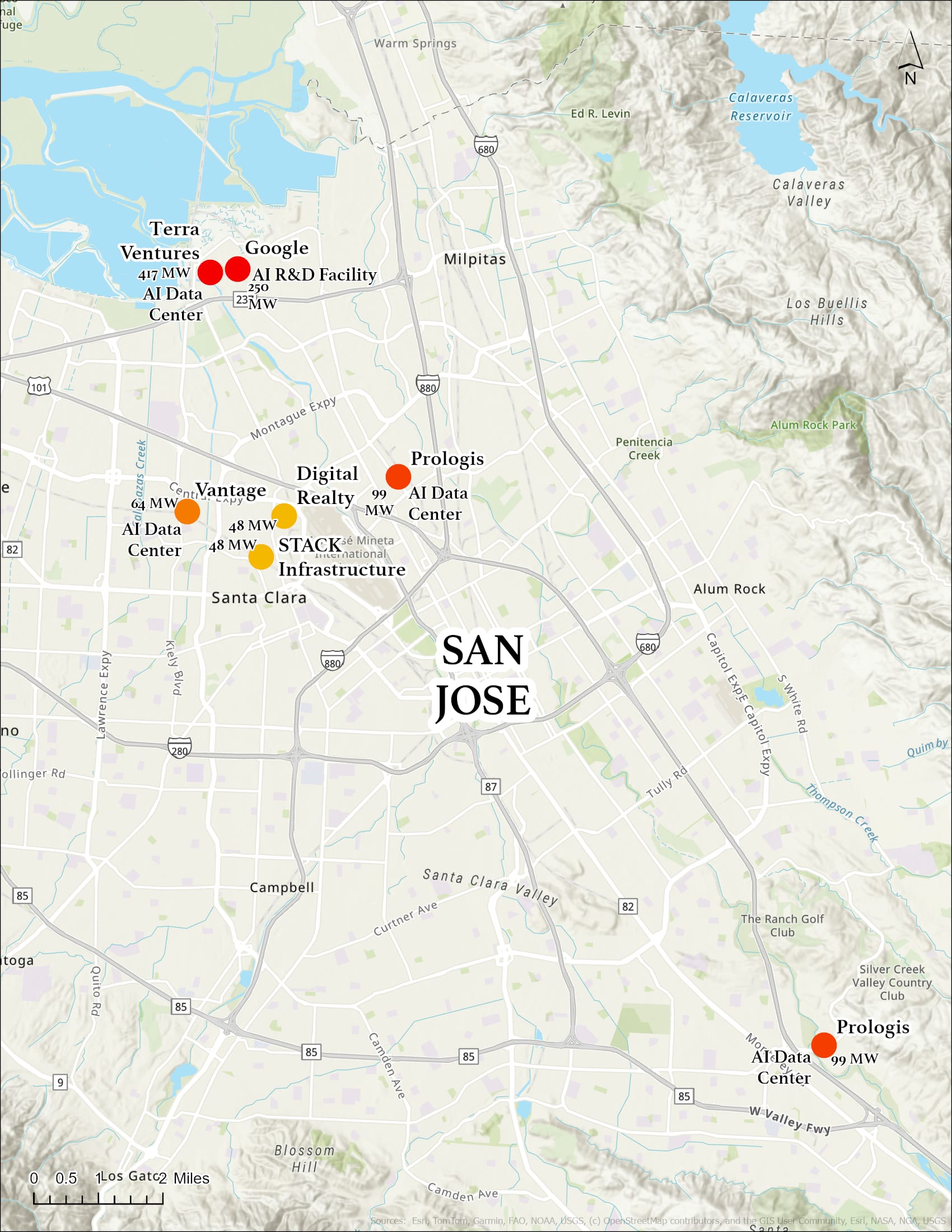
San Jose is home to many existing and planned data centers, especially in the predominantly-Latino Alviso neighborhood. Residents have pushed for a moratorium as city officials create standards for data center development. San Jose leaders, including the explicitly pro-AI mayor Matt Mahan, have invited data center development as a way to increase tax revenue, making a deal with PG&E to provide power to data centers in the city despite opposition from residents. Google has started constructing a 250 MW, 483,000-square foot cluster of “R&D facilities” that advocates say are massive data centers in disguise. The California Public Utilities Commission paused the project over energy concerns. In nearby Santa Clara, several large data centers were recently built but are not currently hooked up to power, as the Bay Area has high energy costs and power shortages. On October 6, Santa Clara’s City Council called for a review of data center policies and stricter air pollution and water use restrictions.
In August, it was reported that a building in downtown Oakland, formerly a supercomputer facility owned by Lawrence Berkeley National Lab in the 2000s, was slated for redevelopment as a 20 MW AI data center by Behring Companies. While the developer is now claiming this is not a true data center, the revelation produced immediate backlash. No Data Center Oakland, a PSL-affiliated group, has emerged as a major opponent of the project, circulating a petition and staging protests. Oakland-based nonprofit MediaJustice made data centers a focus of discussion at this year’s Oakland Tech Week, and previously produced a guide to fighting them. On October 6, Oakland City Council passed a 45-day data center moratorium. As noted in The Oaklandside, the city already has had a small data center since 2007. At 14 MW, it’s no hyperscaler.
Ultimately, the fight over data centers is not just about the specific metrics associated with racks of servers, but about political power. After the data center site fights and moratorium proposals, what comes next? Who will local resources and infrastructure benefit in the near future? Who decides on the direction of this future, and who will profit?

Contrary to what Scale's 7-figure ad campaign claims, the company's ethos is anything but “centering humans.”


In Against Tech Oligarchy, two leading labor organizers chronicle the past decade’s tech worker movement.

Putrid vibes reigned at SF billionaire-funded Hamilton Society debate.


Human feces isn’t even the nastiest thing they’ve found in the backseat.