

UCSF Residents Demand Policy Change for Patient Treatment Amid ICE Surge
Patients in hospitals are being treated like criminals instead of receiving standardized care, thanks to ICE.

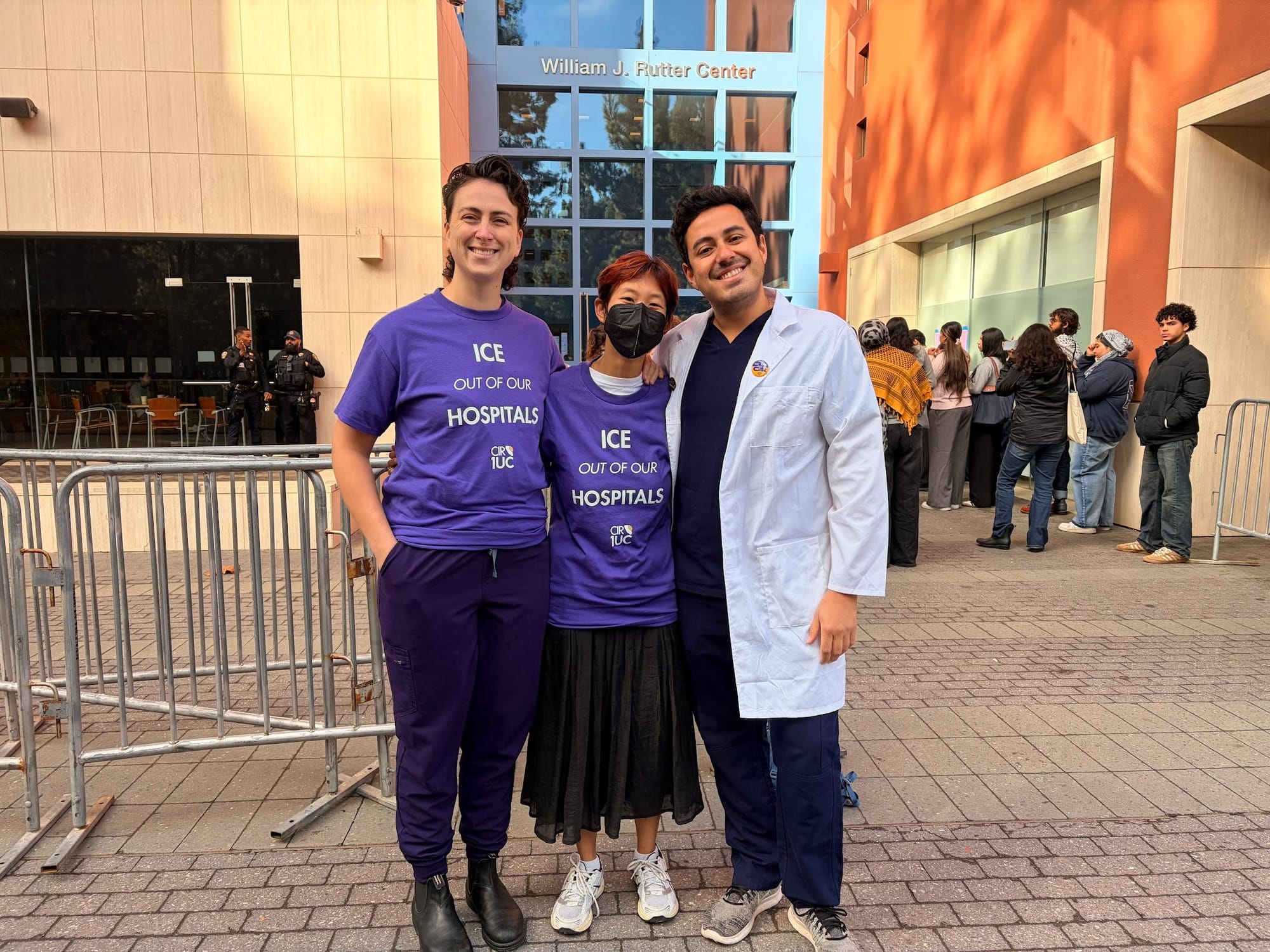
On November 17, the Committee of Interns and Residents (CIR) rallied outside the UC Regents Board at the University of California, San Francisco's Mission Bay campus. The CIR, a local union of the Service Employees International Union (SEIU), is demanding that UCSF implement a model policy with clear protocols addressing Immigration and Customs Enforcement (ICE) presence in hospitals and clinics.
“We're a coalition of resident physicians, nurses, staff, and community members trying to come together to get ICE out of our hospitals,” said AC Fernandez, a resident emergency physician at UCSF Medicine and union delegate for the CIR-SEIU. According to the CIR, UCSF staff are not properly trained to respond to ICE agents in hospitals, specifically when an ICE agent brings a patient under detention for medical treatment.
According to the residents, there is no official protocol at UCSF for treating patients brought in under ICE detention. Jennifer Sugijanto, a resident pediatrician at UCSF Benioff Children’s Hospital in Oakland, says the lack of clear protocol “[causes] a lot of confusion and, as a result, patient rights violations.” Medical staff feel unsure about how to protect patient confidentiality, contact patients’ family members and legal counsel, and provide a full medical plan to patients in detention. Just the presence of ICE agents in the hospital creates an environment of “intimidation and fear,” says Francesco Sergi, a resident emergency physician at UCSF.
Technically, UCSF has a policy in place. The policy is a five-page document focused mostly on judicial warrants. According to the residents, the policy is based on the Attorney General of California’s guidelines regarding ICE in hospitals — from 2018. Sergi says ICE’s approach towards immigration has changed since then. “This policy was created before the rapid increase in ICE presence in emergency departments,” he said. “We didn't know ICE was going to pressure doctors to discharge their patients rapidly or prevent patients from talking to their families or their attorneys, or that they [would] prevent doctors from collecting a confidential history from their patients.” UCSF did not respond to a request for comment regarding their current ICE policy.
Even with a policy in place, the hospital management has not conducted system-wide training for staff. “It’s there, but there [haven’t been] steps to ensure that every single member of the hospital actually knows what to do in these situations,” said Sugijanto. “I imagine if you ask any random person, right now, at UCSF, ‘What do you do when this happens?’ I'm not sure that they would know [sic].”
For public hospitals, an immigration model policy is not just recommended but required by California law. California Senate Bill 81 requires hospitals to implement a model policy — which hospitals in L.A. County and Alameda County have already enacted — by January 1, 2027. When the CIR began negotiating a new contract in August 2025, its proposal included a model policy that adhered to the updated guidelines. The UC declined. When Sugijanto asked the hospital’s risk management team whether they had a policy addressing patient care under ICE detention, the team sent another UCSF policy on treating patients in criminal custody — equating immigrants targeted by ICE with those detained by police — and said the university followed that protocol.
The CIR also noted that UCSF applies the policy inconsistently across hospitals and campuses. “A patient's care shouldn't depend on whether a provider had to go out of their way to educate themselves [on patient rights],” said Sat Kartar Khalsa, resident emergency physician. “The care that we are providing should be standardized across many patients. It shouldn't be just up to luck.”
Initially, residents and medical staff were also concerned about the increased ICE presence, worrying that ICE would raid hospitals. However, the CIR found that ICE is mostly bringing patients already in custody to the hospital to receive treatment. The CIR hopes that with clear, standardized policies that include protocol for treating patients in ICE custody, medical staff can prevent ICE agents from deferring patient care and act as advocates for detained patients. Khalsa recalled cases in California where healthcare providers connected a patient in ICE custody with a lawyer. Their lawyer filed for a writ of habeas corpus, and the patient left the hospital freely.

“Healthcare providers have a really unique opportunity to interface with a population that is not interfacing with anybody else,” said Khalsa. “We have the opportunity to provide them care, to be able to let their family members know where they are, and to be able to connect them to legal resources.”
Most of all, the CIR urged patients not to delay care in fear of potential detention. “I want to emphasize that patients should still go and seek out care…at emergency departments,” said Khalsa. “This shouldn't deter them or make them feel more scared. I hope it empowers patients to know that their community is fighting for them, that healthcare providers care and are prioritizing immigrants.”
Read next

Blue Bottle Independent Union Wins First Contract
Independent union BBIU pulls contract concessions from the café chain after two years of negotiations.

ICE Stalks Santa Rita Jail, County Sends Strongly Worded Letter
ICE disregarded Alameda County’s anti-ICE rules. Will politicians do anything about it?

Judge Orders UC Berkeley Student’s Release After More Than a Week of ICE Detention Without Due Process
Paula Valentina Albornoz Hernandez was held without a warrant at a former prison lacking adequate medical care.


The Vibration of the Streets, in Lula’s Brazil and Beyond
What can the Brazilian elections teach us about the Brazilian Left and the world?
