
This Nonprofit Promised Housing but Left Tenants Homeless Instead
Tenants fight back and plan for the worst: “We’re trying to see where to go for the holidays.”
Tenants fight back and plan for the worst: “We’re trying to see where to go for the holidays.”
When management neglected their building, elderly, majority-Chinese tenants in Downtown Oakland got organized and fought back.
Former tenants of 1770 Broadway fought and won relocation payments after a fire destroyed their homes and displaced them.

Three months after a fire displaced them from their building, the tenants of 1770 Broadway won an appeal this Monday for about $400,000 in relocation payments from their landlord Ted Dang.
After the fire endangered their lives, displaced them from their homes, and damaged much of their property – tenants organized together to push for these relocation payments, which are required under Oakland law. Many remain unhoused to this day, with some now living out of state.
Dang denied responsibility for the fire, but the City of Oakland and now an independent hearing officer agree that Dang’s negligence contributed to the fire, and he now has to pay.
“It can happen to me, it can happen to you, it can happen to anyone. And I think Ted forgot that,” said Dottionna Patton, a student who lived in the building for five years. “It makes me happy to know that justice does happen. You can’t treat people like we’re just about paper.”
Over three months have passed since the fire broke out at 1770 Broadway – a 47 unit apartment complex in Oakland, California – the largest single instance of displacement in the city since 2023.
Ted Dang, who owns at least 16 other properties in the Bay Area, found himself in the spotlight after tenants came forward about his knowledge of potential fire catalysts, as well as what they say were generally inhospitable conditions.
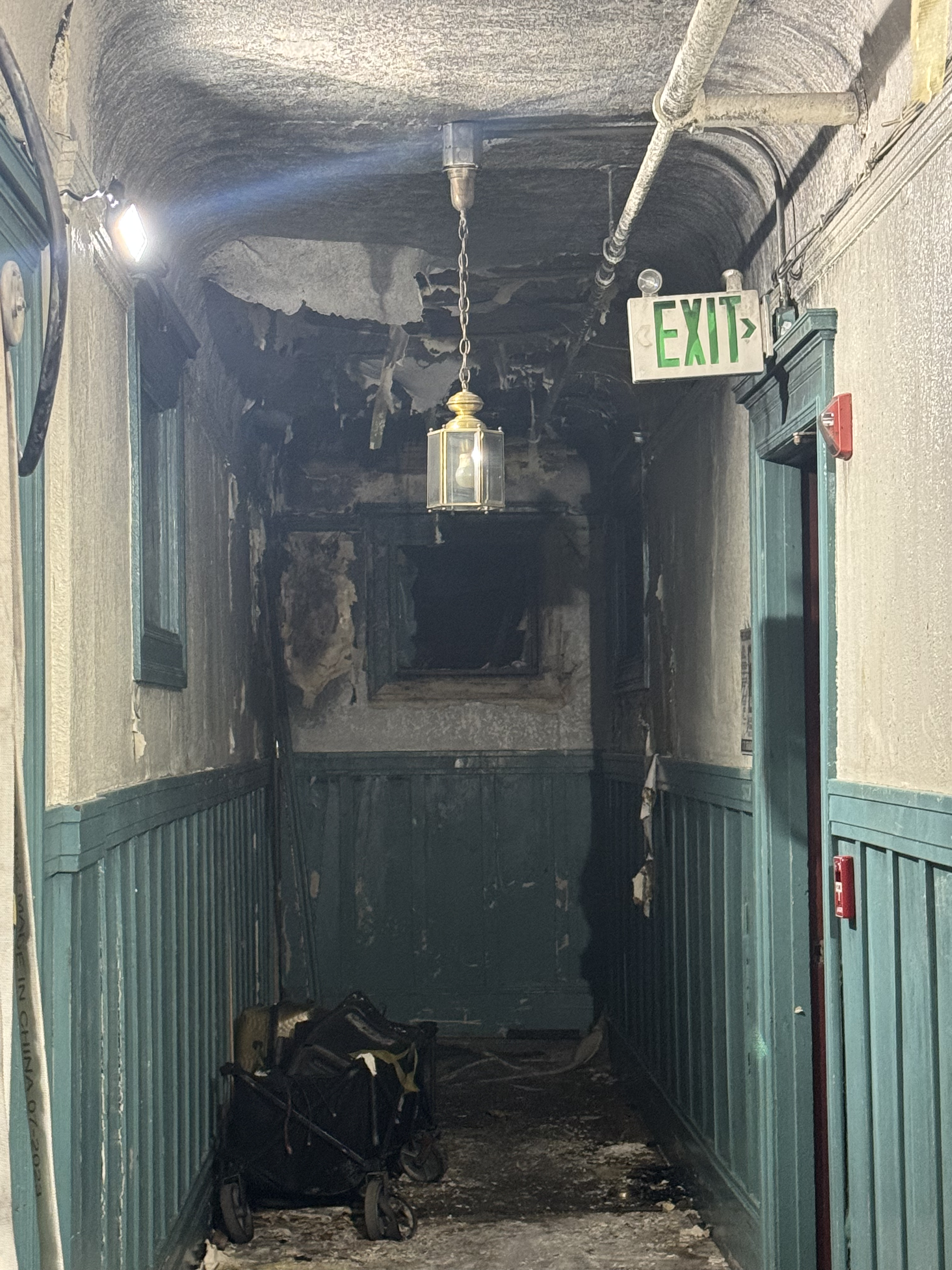
Rachael Thornton, who had been a tenant at 1770 Broadway for about a decade and lived just two doors down from where January’s fire broke out, said she had been reaching out to the property manager about consistent building issues to no avail since November of 2022.
“Instead of things getting better after expressing all of the issues that I was facing, things just continued to get progressively worse,” Thornton said. “Ted Dang was aware of these issues for years and did not take correct measures to ensure tenant safety. And now we’re here today, displaced, without all of our belongings… It’s completely disrupted our lives.”
Many tenants like Thornton claim they talked to Dang, the building manager, and the building handyman over the years about a wide array of issues that were consistently swept under the rug.
Jay Lind, a tenant in the building for 13 years, is still searching for stable housing. “[Dang] knew that it was bad, but because he wasn’t a tenant, he just didn’t know how extraordinarily bad it had gotten,” he said. “It was so evident with break-ins frequently to doors. The mailboxes were frequently torn off the walls, open, laying, and left that way for weeks.”
Multiple tenants complained about the mailboxes alone. However, their complaints were routinely ignored.
“I think that what they were trying to do is just find a bandaid for every situation,” said Carlos Iglesias, another former 1770 Broadway tenant.
In the fall of 2025, Dang alerted the building that he had hired a security guard. Tenants were hopeful to see progress. But the disappointment continued.
Not only was the security guard asked to make just “two walk-throughs a day,” according to Thornton, but tenants doubt that the security guard even completed said walk-throughs.
“I had a dog I’d walk three or four times a day, and I saw him twice since the date he was supposed to start on October 1st of 2025,” noted Iglesias.
In addition to the mailboxes and break-ins – and foreshadowing January’s fire – tenants also noted that they never knew whether the fire alarms were real because they would consistently be set off. And, according to tenants who spoke with Bay Area Current, none of their units were equipped with smoke detectors.
It wasn’t until the fire broke out in January that these issues were forced into the public view.
While the building went up in flames, Dang was nowhere to be seen. Instead, the property manager was outside, passing out flyers while tenants stood in shock.
“There were only 7 or 10 flyers,” noted Patton, who had lived in the building for five years. “We read the flyers and we were like what? He’s evicting us? My heart just sank.”
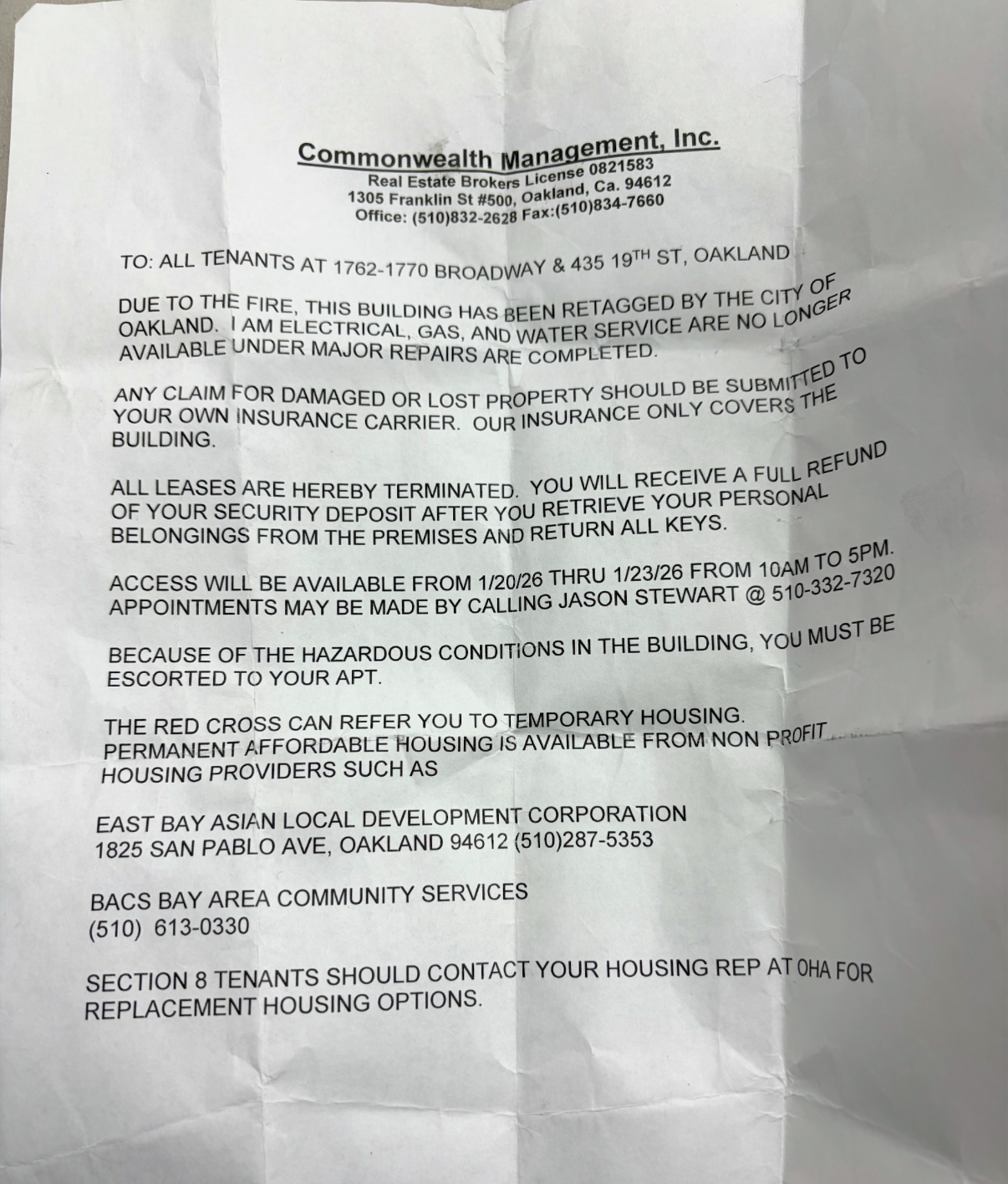
Not only did Dang try to illegally terminate the leases of people living in the 47 units, leaving around 200 people displaced, he also demanded tenants sign a waiver of liability for the fire if they wanted to retrieve their personal belongings. Dang then denied city law-mandated relocation payments following the disaster.
Tenants at 1770 Broadway quickly got together and started organizing. First, they joined a local tenant union meeting on January 21, just days after the fire. Then, tenants formed a group chat and began meeting as a collective.
“A lot of us were really involved,” Dottionna Patton recalled. “We always tried to get together and set up meetings.”
The City of Oakland initially determined that Dang was responsible for relocation payments on February 18. According to the city’s eligibility determination, “Substantial evidence demonstrates that the property owner knew about significant security issues at the property… Multiple tenants made multiple complaints about the activity outside of unit 211 leading up to and immediately prior to the fire. The owner was aware of existing dangers and had control over but failed to take reasonable measures to address the conditions or prevent foreseeable similar activities. Therefore, the CCRP has determined that the conditions leading up to the fire were not “outside the control of the property owner,” and the property owner cannot or has not demonstrated that the damage was not caused by the owner’s negligence and/or preexisting conditions at the property.”
The tenant union Tenant and Neighborhood Councils (TANC), representing the tenants, says the relocation payments would likely be between $8,000 and $15,000 per tenant, with the total amount being about $400,000 for the entire complex.
Yet, rather than following the City of Oakland’s ruling and the displaced tenants’ demands, Dang chose to appeal the decision in early March.
January’s fire was not Dang’s first encounter with legal trouble. In fact, he has been party to a multitude of lawsuits – and property fires – in Alameda County over the decades.
After a fire in one of his Broadway properties in 1993, Dang expressed his desire to keep some of the units vacant – simply to avoid housing certain individuals.
“I will not accept welfare tenants, or people who are not working, or people who have some other problems,” Dang told the San Francisco Chronicle. “I’d rather leave them vacant. I’ve been that route…we end up evicting them.”
Current asked Dang over the phone about issues within the building as well as his refusal to provide relocation payments, to which Dang denied any building problems or the need for relocation payments.
“There were no code violations,” Dang said.
“There were no code violations,” Dang said.
Dang also stated that he already helped out four tenants who reached out to him for assistance, claiming that no other tenants had contacted him. He also denied that his own negligence led to the fire, instead asserting that the city still has not done a proper investigation or looked into the missing individuals who he says set the fire.
“What has the city done to investigate that? What happened to some of the people who were displaced?” Dang asked.
Keisha Bigbie, who was displaced along with her three children, has an answer: “I strongly believe that he is liable for the events that led up to the fire, and he was made aware more than once as to what was going on in the building, how unsafe the building was. My children and I definitely felt unsafe. He really didn’t do his part.”
Dang did not comment on the illegal cancellation of his tenants leases.
For now, tenants await their relocation payments, which are expected to be received within the next few weeks.
“If he does try to stall, we’re definitely going to get set up and prepare before that happens,” says Patton.

When management neglected their building, elderly, majority-Chinese tenants in Downtown Oakland got organized and fought back.

Despite public outcry, Oakland City Council decided to approve the new cop contract and reappoint police commission chair.

In a city dripping with cash, San Francisco can’t get its kids to school.


Ten picketers were arrested on July 21st during the strike at C&H Sugar. Their charges can be filed at any time within the next year.

