
The Book Your Tech Boss Doesn't Want You to Read
In Against Tech Oligarchy, two leading labor organizers chronicle the past decade’s tech worker movement.
In Against Tech Oligarchy, two leading labor organizers chronicle the past decade’s tech worker movement.
We spoke to one of the frontline union workers in the climate change fight.

TUES, SEPT 22 — Surrender yourself to the transformative sounds of Lulu the African Gray Parrot (and some human counterparts). Remember

Thousands of pages of records reveal how the worst mall brands in America sold surveillance tech Flock to California.

In Delano, a suburb of Bakersfield in California's Central Valley, police learned last June that shoppers at a local Ross Dress for Less had filled their carts with clothes and then left without paying. As the suspects drove away with their haul, police tracked them on the highway and pulled them over in the next town. Four people were arrested and $1,500 in clothing was brought back to Ross Dress for Less, where presumably it was safely reunited with a pile on the floor.
The bust was possible courtesy of Flock, one of the major companies that sells Automated License Plate Readers (ALPRs), or technology that stores license plate data and allows police to track vehicles remotely. The arrest, according to Delano Police in a report to California’s Board of State and Community Corrections, "highlights the value of entering known suspect license plates into the grant-funded Flock Safety database."
If this sounds like state-funded asset protection for your depressing local shopping mall, that's probably by design: Cops across California are getting incentivized to arrest more people for stealing from chain stores with the help of millions of dollars in grant money that they can use to buy surveillance technology from companies like Flock. Meanwhile, Flock is facing national backlash for partnering with federal immigration agents, in addition to privacy violations ranging from stalking ex-girlfriends to tracking people seeking abortions out of state.
It all goes back to a collaboration between the retail industry and the California Governor’s office. Under something called the Real Public Safety Plan, unveiled by Governor Gavin Newsom in 2022, around 50 California police agencies were promised $242 million in grant money to dedicate more resources to tackling property crime, with a focus on retail theft.
This is based on the premise that retail theft is linked to organized crime and is enabled by cities that are too easy on offenders, a narrative largely pushed by lobbies like the National Retail Federation and on cable news. But no comprehensive data about “organized retail theft” exists. In reality, many people say that they steal because of the unaffordability of everyday products and the temptations offered by self-checkout machines. Walgreens famously walked-back its complaints about shrinkage three years ago.
The most Flock-happy department appears to be the San Francisco Police Department, which received $15 million in grant money, among the highest in the state.
In a 2023 video from a law enforcement conference, a lobbyist for the retail industry implied that retailers were heavily involved in crafting Newsom's safety policy: "In 2022, the California Retailers Association worked with the governor and his administration to address retail theft that plagues our state which culminated in the governor's Real Public Safety Plan," said Ryan Allain, the director of government affairs for the California Retailers Association.
Governor Newsom’s office responded in a statement: “Public safety is the Governor’s top priority, and the Real Public Safety Plan was developed through broad collaboration with law enforcement, local leaders, community partners, and diverse stakeholders.”
“We gave suggestions from the industry, and then the governor and his team made the decisions on what he wanted to do, and we were very appreciative that he included some of our recommendations,” California Retailers Association’s CEO Rachel Michelin told Current.
Police are required to submit quarterly progress reports to keep receiving the money. Current reviewed those reports to see how the police are spending what Newsom has described as a “historic” investment and has uploaded them for readers here. Cops use the reports to highlight their most ambitious arrests, their goals and what type of technology they are buying. While a few departments make reference to referring suspects to rehab or alternative justice programs, most departments seem to see the issue in black and white terms: Departments calculate the value of stolen merchandise and tally their arrest numbers, acting on the apparent assumption that keeping boosted Ulta Beauty perfume off the streets will make communities safer.
It's undeniable that retailers — through the Real Public Safety Plan — helped unleash ALPRs on California cities. Michelin of the California Retailers Association said the group has “no position” on Flock, and that “we didn’t advocate for any type of certain technology at all.” But the quarterly progress reports that police must submit specifically ask each department about their plans to buy ALPRs. At least two dozen law enforcement agencies, including police in Bakersfield, Irvine and Chula Vista and sheriffs in Los Angeles and Ventura counties, reported using Flock cameras or having access to the Flock database, installing other brands of ALPRs or saying they have plans to.
In the last year, the Santa Rosa Police Department has used its ALPR-equipped Real Time Crime Center to arrest suspects behind softball bat thefts from Dick's Sporting Goods and dietary supplement rings from Whole Foods. The Vacaville Police Department used Flock to track and arrest people who took sneakers from Nike and New Balance stores. The Modesto Police Department placed ALPR cameras at stores that were frequently hit and proudly wrote that "Walgreens and Target have seen an immense decrease in shrinkage.”
The most Flock-happy department appears to be the San Francisco Police Department, which received $15 million in grant money, among the highest in the state. In 2024, the SFPD announced plans to install 400 Flock cameras around the city, and wrote that they were featured at a Flock conference where former Chief Bill Scott gave a speech. So far, 390 of these cameras have been installed.
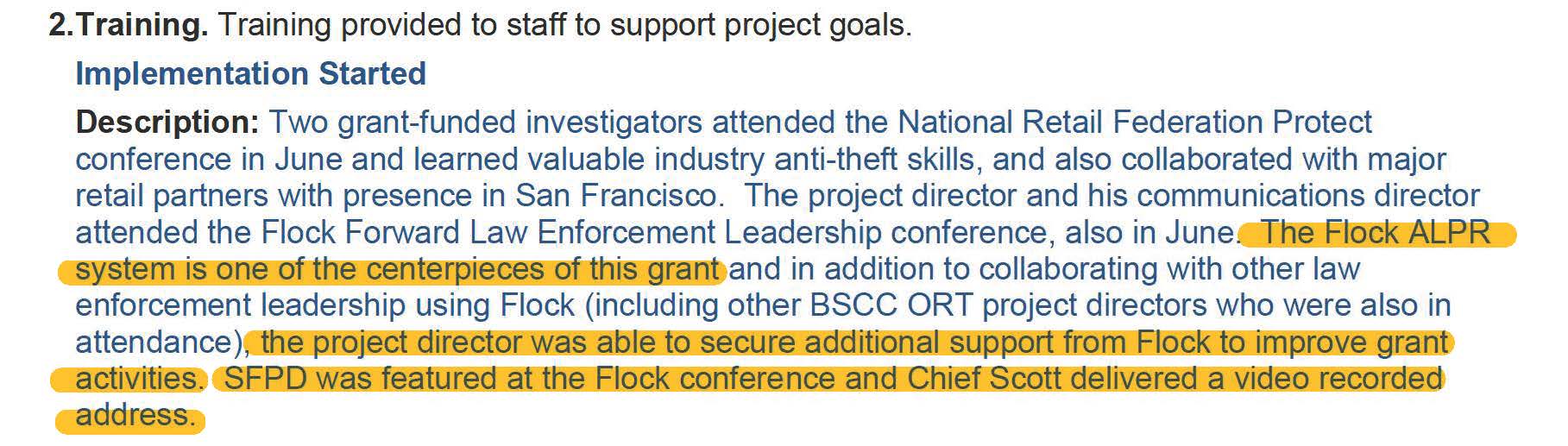
"The Flock ALPR system is one of the centerpieces of this grant," the SFPD wrote in grant paperwork.
More recent paperwork from December 2025 says that the SFPD is now "working with partner agencies to install ALPRs on the Bay Bridge to detect suspect vehicles as they approach or depart the city."
The California Department of Transportation, when asked about if or when ALPRs are going live on the Bay Bridge, wrote, "there are no ALPR system Caltrans has installed, nor any planned for the future."
Flock and other ALPR technology work by scanning license plates and alerting cops if the car is one they are looking for, which makes the technology especially suited for finding stolen cars or a suspect who witnesses were able to identify by license plate. Under the Fourth Amendment of the U.S. Constitution, police are only supposed to surveil or search you if they have probable cause, and if a judge decides that a defendant was illegally searched the whole case can get tossed. It’s unclear where the use of Flock fits into that.
In Beverly Hills, police wrote that ALPRs are "becoming a useful tool for repetitive crimes." In one example, the department said they were alerted through ALPRs about a car involved in "a previous fraud case." By monitoring the car, the police “learned of a new crime" that is not specified. A spokesman for the Beverly Hills PD did not respond to requests for comment.
Flock’s spokesman Paris Lewbel says that “agencies may, consistent with their own policies and local law, add a license plate to a custom hotlist if they believe it is connected to an ongoing investigation or pattern of crime.”
In addition to questions about how and why some vehicles get tracked, there is also little public information about the accuracy of Flock’s readers. Flock’s spokesman claims that “the vast majority of our plate character and state reads are predicted at confidence levels in the high-90s.”
The National City Police Department wrote that in one quarter its Flock cameras sent police 364 Automatic License Plate Reader alerts and that the majority were wrong.
But the National City Police Department wrote that in one quarter its Flock cameras sent police 364 ALPR alerts and that the majority were wrong: "Of these alerts, 293 alerts were ALPR Misreads," the National City Police Department said.
The department is nonetheless happy with Flock because the other 71 alerts resulted in 19 arrests, representing a “27% arrest rate in cases where Flock technology was used.” This thinking reflects a cop philosophy that equates more arrests with more safety. In addition to the grant funding, the appeal of surveillance tech seems to be that it leads police to arrest more people.
National City Police Department spokesman Paul Hernandez said that dispatchers confirm the accuracy of ALPR hits before sending officers out so that people are not wrongfully detained. But Business Insider reported that it found a dozen cases nationwide in which misreads by Flock readers “resulted in people who hadn't committed crimes being stopped at gunpoint, sent to jail, or mauled by a police dog, among other outcomes.”
A contract with Flock is just one option for how police can use their cash. Police also invest in real-time crime centers and other types of surveillance. All of the new technology helps them arrest people they might otherwise overlook — like drones that search for petty theft suspects outside Walmart; facial recognition that finds out-of-town suspects who took $1,300 worth of makeup from Ulta; and a software called Auror that advertises its ability to find people who steal infant formula. Some agencies report buying Fusus, a platform that allows police to tap into private surveillance cameras and has previously been used to spy on protesters.
Police hope that snatching up people for lower-level theft will help them eventually find and stop the leaders of supposed “organized retail theft” crime rings. They pair their new toys with something called a blitz, which is just a term for camping outside stores undercover and catching everyone who decides to steal. The SFPD says it commonly does blitzes outside the Safeway on Mission Street and King Street, the Walgreens on Sloat Boulevard and West Portal and the Salt & Straw on Fillmore. The majority of the people caught in its blitzes are cited and released for shoplifting. But some shoplifting arrests alone can lead to prison time under new tough-on-crime laws that an increasingly reactionary voter base passed. Under Prop 36, which went into effect a little more than a year ago, people can now be charged with felonies on their third shoplifting offense.
The Fresno Police Department said that Prop 36 has resulted in a 171 percent increase in cases. The Sacramento County Sheriff’s office wrote that they were able to arrest seven people during a blitz "who qualified for Proposition 36 felony arrests due to prior theft and/or drug charges...We are consistently encountering repeat offenders and are grateful to be empowered to charge these offenders with a felony charge thanks to Proposition 36."
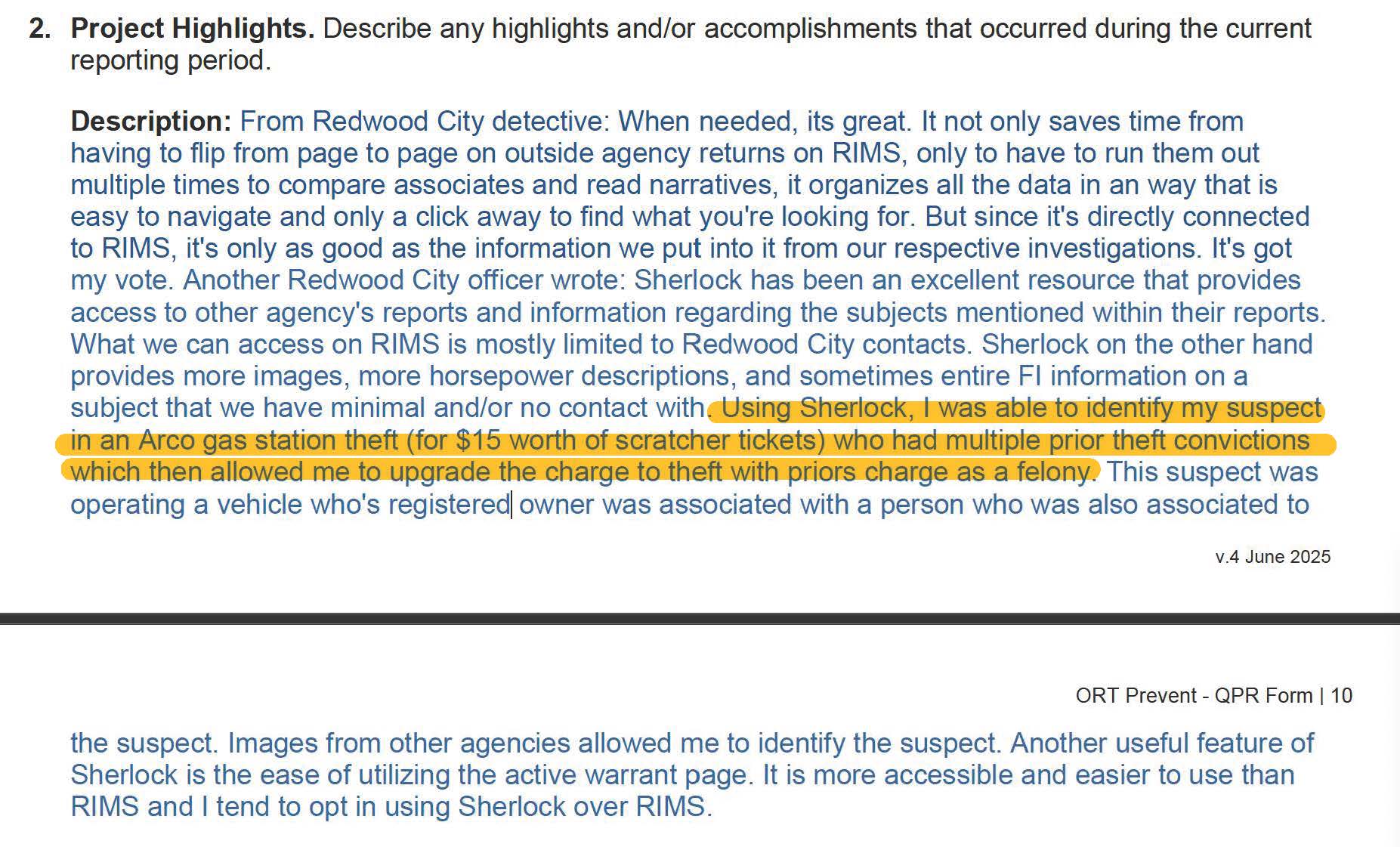
A cop in Redwood City described how a software called Sherlock helped them build a felony case against someone who stole a few lottery tickets: “Using Sherlock, I was able to identify my suspect in an Arco gas station theft (for $15 worth of scratcher tickets) who had multiple prior theft convictions which then allowed me to upgrade the charge to theft with priors [and] charge as a felony.”
Asked to comment on its $15 lottery scratcher felony bust, Redwood City Police Department spokesman Jeffrey Clements sent Current a statement: “In this case, the value of the theft alone does not determine the charge, an individual’s criminal history and applicable statutes do.”
Police mostly wanted to talk about their wins, some of which included a bust of one person in Sacramento who was allegedly hiding expensive vitamins in their cart at check-out, stealing other people’s Sam’s Club points, and running an online store (value: $26,000); a flea market stand in Oakland selling deodorant that two people allegedly stole from Safeway and CVS stores across the Bay ($52,000); and a crime ring that allegedly used stolen EBT data to buy products with welfare funds in Kern County ($600,000).
But the police agencies’ reporting also reveals vulnerabilities in retail theft surveillance. The Santa Clara County Sheriff's Office, which likes to go undercover outside Target stores and a Burlington Coat Factory in San Jose, reported that a sting was ruined last year by activists who confused them for ICE agents and confronted them.
Jurupa Valley sheriff’s deputies reported that three of its Flock cameras were stolen or vandalized in one quarter and now plans to put Airtags on them.
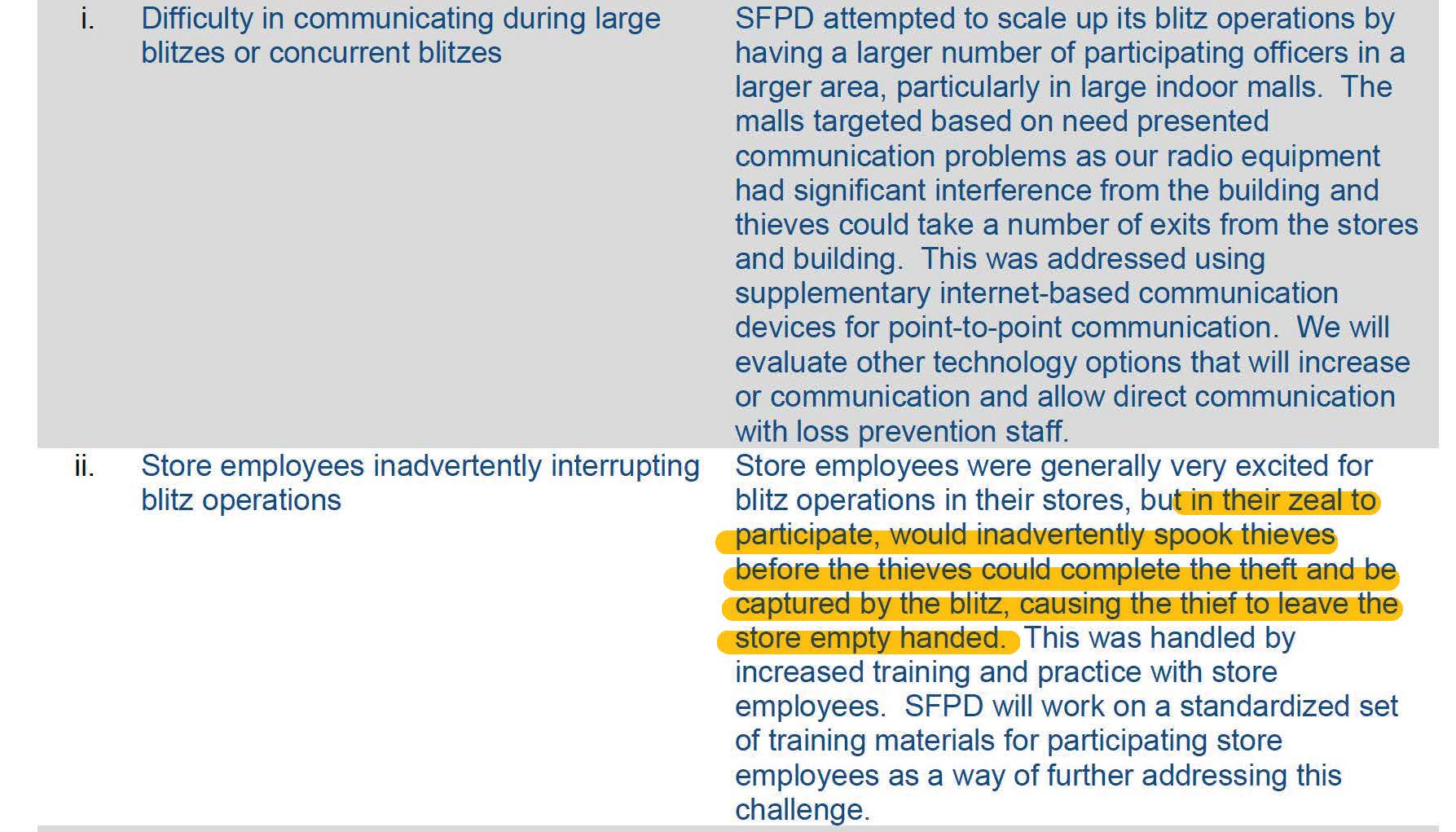
Early in the program, San Francisco police complained that store employees were so excited about police being there, that the workers would "inadvertently spook thieves before the thieves could complete the theft and be captured by the blitz, causing the thief to leave the store empty handed."
Preventing a crime, apparently, is less of a win than catching one after the fact.

Despite public outcry, Oakland City Council decided to approve the new cop contract and reappoint police commission chair.

In a city dripping with cash, San Francisco can’t get its kids to school.


Ten picketers were arrested on July 21st during the strike at C&H Sugar. Their charges can be filed at any time within the next year.


The majority Chinese-speaking tenants at a downtown Oakland building organized to fix hot water, broken doors, and lack of security. Management’s response: shut down their community room.