
This Nonprofit Promised Housing but Left Tenants Homeless Instead
Tenants fight back and plan for the worst: “We’re trying to see where to go for the holidays.”
Tenants fight back and plan for the worst: “We’re trying to see where to go for the holidays.”
When management neglected their building, elderly, majority-Chinese tenants in Downtown Oakland got organized and fought back.
The definitive take on Boots Riley's ‘I Love Boosters’, courtesy of your socialist Bay Area outlet.

One decade before Boots Riley’s irreverent fashion satire and socialist comedy about a crew of stylish women of color who steal and resell luxury clothing hit theaters this summer, a real life collective of flashy young shoplifters — “boosters” who had been selling their stolen wares back to the Bay Area for cheap — strategically overwhelmed and pilfered San Francisco luxury retail outlets for the last time before getting caught.
In I Love Boosters (2026), Riley plays with the local legend of the now lovingly monikered “Rainbow Crew” (and other boosters from the Bay), loosely outfitting his Bay Area bande à part, the Velvet Gang, in their eye-poppingly vibrant fashions. Steal from the rich, give to the poor — it’s Fashion Forward Filanthropy.
Riley’s socialist vehicle pulls up to a popular culture that is ready to ride. Inflation continues to drive up our cost of living. The state of California and the retail industry are conspiring to use Flock cameras to sell you out to ICE while you shop. And there is a song by Yung Miami trending literally right this moment asking “...Boostin bitches where y’all at? / Stuffin that shit in y’all bag / Just to flip it, pop some tags (hustlers) / Girl, go in that Goyard bag”. If you’re reading this, you’re likely only a few paychecks away from the kind of housing insecurity that finds Boosters’ protagonist, Corvette (Keke Palmer), squatting in an abandoned chicken shop in Oakland (sounds extreme, but it’s not not true).
Aspiring fashion designer Corvette boosts from local clothing outlets in the Bay Area with the help of her best friends Sade (a quirky yet headstrong Naomi Ackie) and Mariah (lovably off-kilter accent piece Taylour Paige rounds out the ensemble). They heist their way through the Bay playing elaborate games of subterfuge and deception. Finessing her way into a meeting with her favorite fashion icon Christie Smith (a flagrantly cocky Demi Moore), Corvette learns of Smith’s plan to unveil her retail brand Metro Designers’ upcoming line of $100,000 suits. Looking to nab them before they hit the market, Corvette rallies Sade and Mariah to start jobs at Metro Designers to get close enough to boost the bounty. From atop her tilted Millennium Tower spoof nestled in the streets of San Francisco, Christie Smith pieces together Corvette’s identity (or at least, enough if it) as the booster hitting her stores, and sends petty obstacles Corvette’s way. The Velvet Gang fight back, and anti-capitalist hijinks ensue.
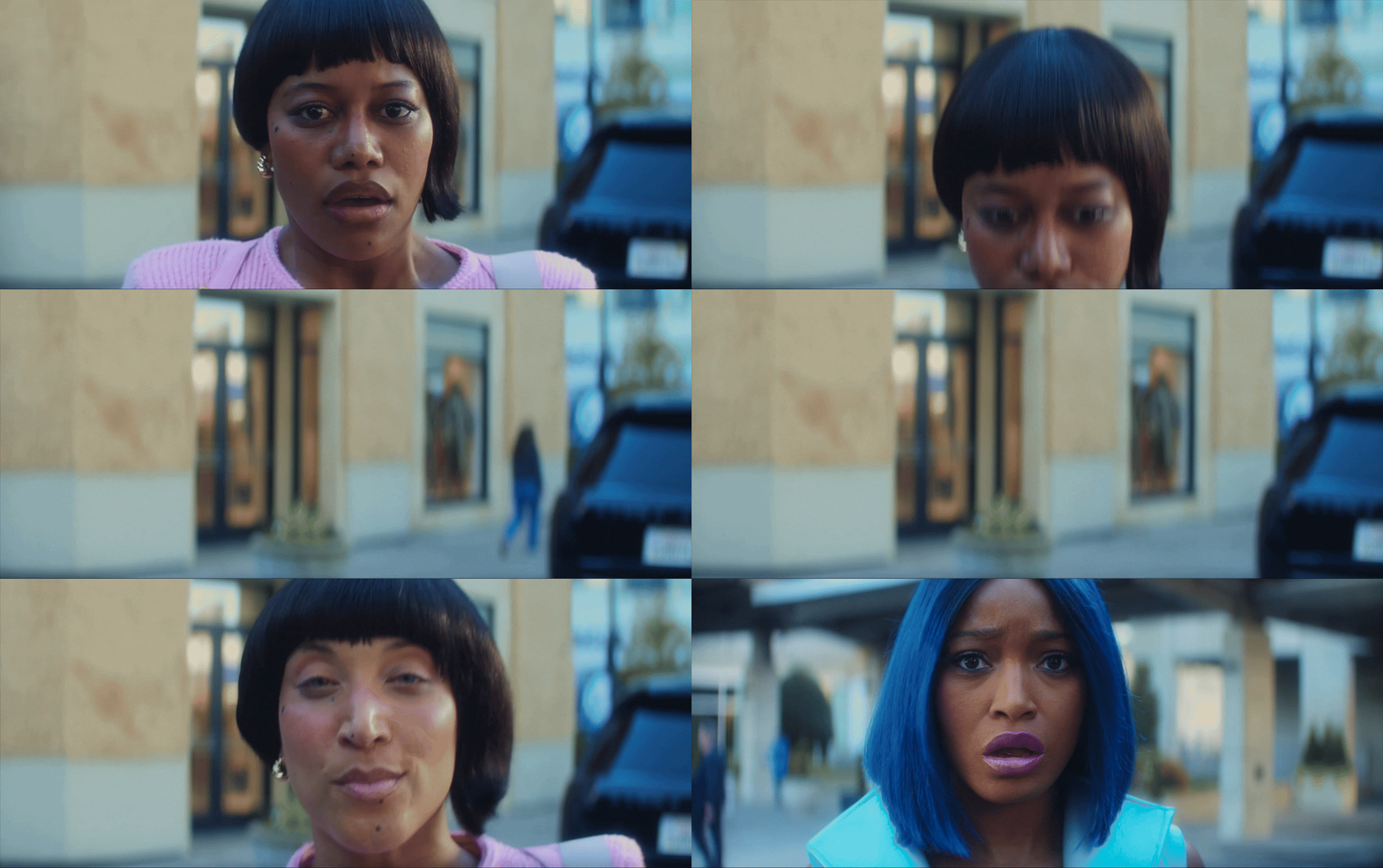
The world of fashion is the perfect playground for Riley to let his creativity as a filmmaker flourish. Even ignoring Riley’s instantly recognizable and eccentric style, all of the hallmarks of Riley’s social cinema lend themselves to a narrative involving fashion.
The production of clothing involves labor. Cue the feel-good labor organizing romp of the year.
As a moviegoer in 2026, it is a treat to be able to go to the movies and enjoy a comedy that trusts you’re paying attention. Boosters layers jokes across planes highbrow and low, physical and metaphorical, within dialogue and through visually inventive sight-gags, oftentimes all within the same scene. It’s one of those movies I argue is worth watching at least a second time.
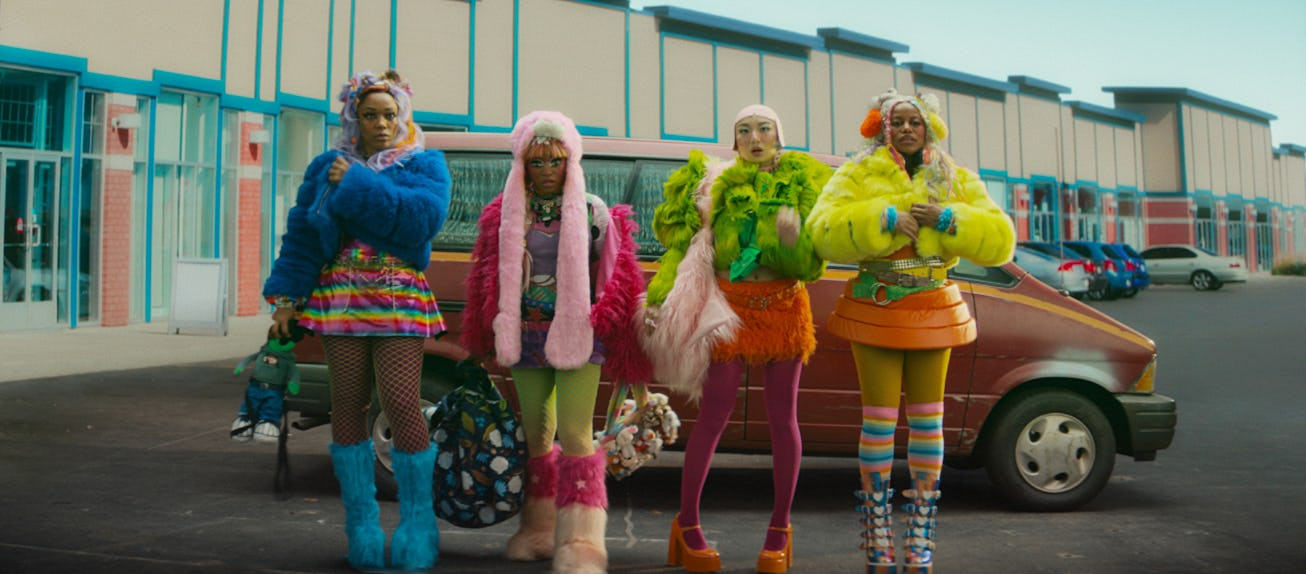
Boosters revels in deploying almost the entire spectrum of filmmaking to get its many points across. Imaginative transitions, cut-away passages that reference film history, bespoke lensing techniques, stop motion animation — it’s overflowing with as many visual ideas as it is ideological ones. A friend and I like to call this “Bootsmaxxing.” Creativity is required across all aspects of the production to pull this off, and Riley wears the bandleader hat well, assembling a crew of technicians eager to surprise and delight. They play with thrilling abandon. This band has a few standouts — the MVP has to be costume designer Shirley Kurata. An eclectic blend of vintage and custom designs adorn the Velvet Crew, popping off the screen in a fantasia of color and swag. Cinematographer Natasha Braier and production designer Christopher Glass beautifully house Kurata’s sartorial vision within the vibrant landscape of the Bay Area, feeding into the film’s maximalism by finding fun ways to heighten and distort reality.
Shoutout Oakland’s very own tUnE-yArDs, returning players in the Riley Cinematic Universe (see their music for Sorry to Bother You and I’m A Virgo). Their jaunty score is the glue that holds the picture together, balancing a carnivalesque intensity when madness is the mode (that twangy jaw harp lives in my subconscious now).
“Hi Ho” is a standout, with tUnE-yArDs continuing Riley’s run of soundtrack fare inspired by the tradition of work songs, this time playfully twisting “Heigh-ho” from Snow White into an anti-capitalist theme song that I hope makes Disney’s head spin in his cryo-tank.
Riley’s knack for comedic shorthand only gets better with each project he helms — moments like Corvette and Mariah lining up at a starting block mid-conversation at Metro Designers to immediately take off into a full-blown sprint for their 30 second lunch break come to mind. It’s cathartic to laugh through the absurd indignities forced upon our working class by the wealthy and greedy through Riley’s lens. It feels less like a lecture when rendered in the surreal.
But mere identification isn’t Riley’s endgame. Provocation in and of itself isn’t enough to inspire the type of change that Boosters has on its mind. And Riley wants his art to inspire mass movements.
If you follow Riley online or in person, you have definitely heard him repeat this mantra that animates all of his cinematic works, "We need a mass, militant, radical labor movement." Mass because there is strength in numbers, militant because the ruling class will only respond to power, and radical labor movement because effective worker organizing like a general strike requires radical commitment.
Strategy is Boosters’ modus operandi; it takes a few circuitous routes to get there. After a mysterious new booster nabs their Metro Designers before they do, the Velvet Gang investigate. A new member, Metro Designers factory worker Jianhu (an ecstatic Poppy Liu) from Qingdao, China who ends up in the Bay Area in a way no one could really expect given the established reality of the film up to that point, joins the boosters’ ranks.
Jianhu’s arrival introduces a new tool in Riley’s belt: manifesting lefty theory into the physical realm. Bridging the Marxist theoretical into the material by crafting a functional form for it in a “device” that our characters can manipulate. The Marxist theory itself is dialectical materialism.
The rest of this review is best enjoyed having seen the entirety of I Love Boosters — don’t say we didn’t warn you!
Jianhu’s device offers a convenient way to move people and clothes across the world — teleportation. Corvette’s original scheme here is to hoover literally all of Christie Smith’s clothes from her Metro Designers retail outlets and reunite them with their workers, meaningfully denting the big bad’s bottom line. The international cast of characters relate across racial and cultural lines to game the system, but the value in the clothing is still tied to a system that ultimately exploited workers. This is the future that liberals want.
Thankfully, the film insists on taking things a step further, outfitting the device with levers actualizing dialectical materialism through acceleration and deconstruction. There are centuries of discourse on dialectical materialism, so in the interest of time we’ll keep things simple as they relate to the film. What exactly is dialectical materialism? Well, it’s mostly a way of interpreting life as we live it. Change (synthesis) happens when opposing forces (thesis and antithesis) conflict: contradiction. There is contradiction inherent in everything, because everything is a product of opposing forces. The movie cooks up a way to imagine this phenomenon of time on a slider, one that can be moved backwards and forwards producing different states of being according to how heightened your contradiction gets. Social change results from contradictions inherent in economic systems like capitalism; class struggle between the working class and the owners of production are in constant conflict with each other. With a healthy amount of galaxy-brained thinking, Jianhu’s device is now a tool that can deconstruct the harm caused to workers’ bodies by the ruling class, and accelerate the contradictions necessary for successful global worker solidarity through organizing. This is the future that leftists want.
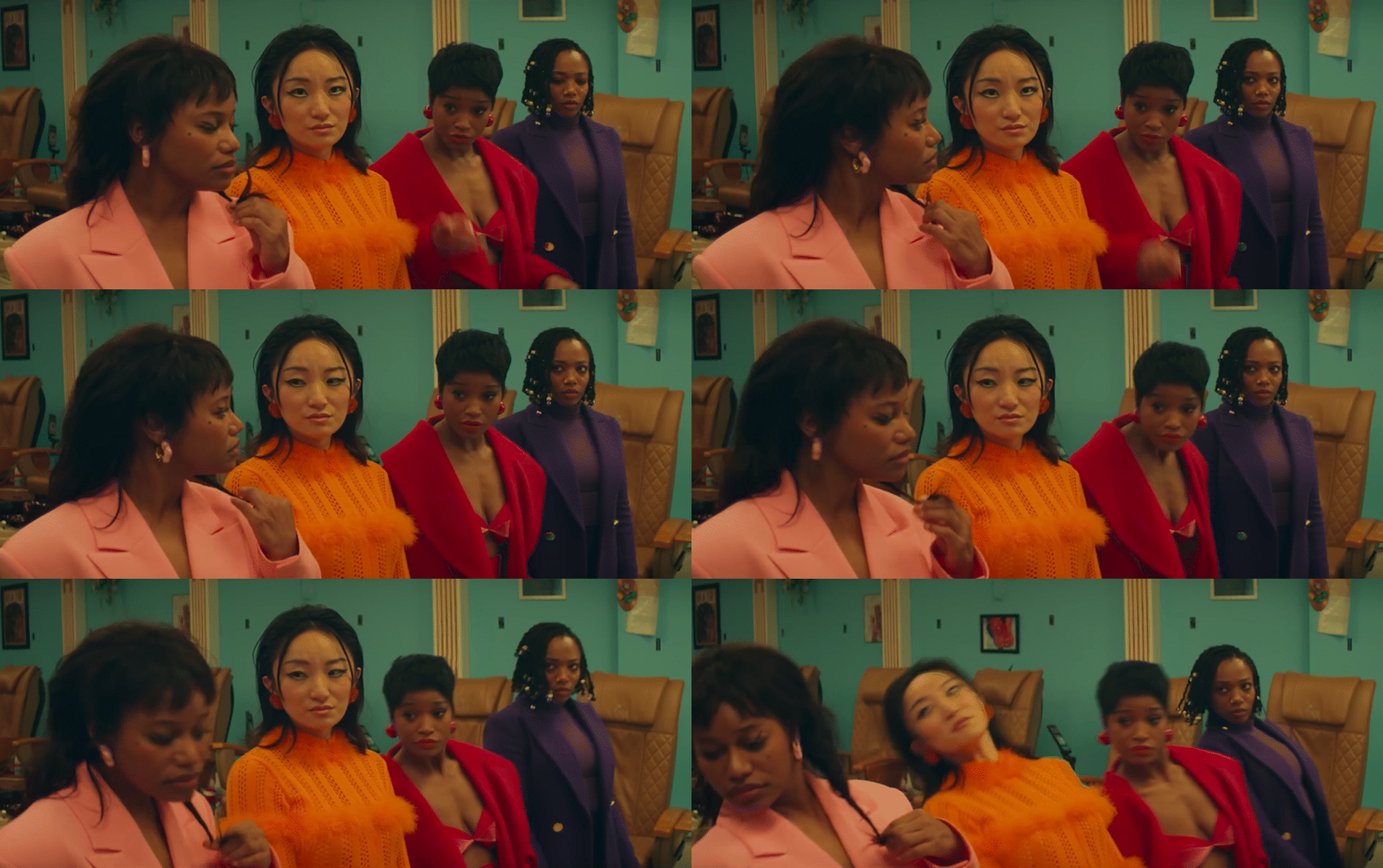
It’s fresh, innovative, and genuinely something that I haven’t seen attempted in popular cinema quite like this before. With this added element though, some of the dramatic clarity that made his earlier works so direct in their pathos is slightly diminished in the pursuit of theoretical education. In my theater, when Eiza González’s Violeta (another Metro Designers employee with salty tendencies) describes the situational acceleration that motivates the plot from that point on, theatergoers around me (including some of my friends) pumped our fists with light grins. It's fascinating to watch Riley balance his desire to connect the heady theoretical nature of dialectical materialism that animates his agenda with the dramatic stakes needed to make it matter. And it's cool to sneak the fundamentals of Marxism into populist fare. But how can we square away Boosters’ fantastical deus-ex-doohickey with our less than fantastical real life? In real life, these victories are much harder fought and earned – a challenge to depict in film without succumbing to misery or didacticism.
While heist films are a dime a dozen, there aren’t many that feature an all-woman cast of thieves, and even less featuring all women of color. Filmmaker F. Gary Gray’s Set It Off (1996) is a notable entry into this canon, and a film that I kept coming back to during my second watch of Boosters. It similarly follows a group of four black women in their quest not to steal clothes but rob banks. They do so in order to climb out of poverty and get back at a racist and misogynist system of wealth and value that otherwise exploits them for their worth and dignity. Set It Off is so good at giving you what you want in an ensemble heist: challenges unique to each character, rich interplay between them, and a lived-in sense of struggle motivating each of the four women. Spending more time building this out than Boosters, it mines melodrama to make you feel the pain of their losses, and offers meaningful glimpses into a peaceful quality of life they are constantly denied.
This kind of character specificity is there if you look for it in Boosters. As a single Bay Area mother, Sade’s kids can often be seen playing around in the backgrounds of scenes she seemingly has no choice but to bring them to, like the predatory multi-level marketing workshops she attends with Corvette.
Most of Boosters’ characterization is afforded to Corvette. In her second California working class comedy in two years (something must be in the air, see One Of Them Days, 2025), Keke Palmer trades her trademark buoyancy for a wittier humor in a lower key, finding laughs just as big in subdued ways we’re not used to seeing from her. She also struggles to feel seen, and her loneliness estranges her from her friendships. In this mode, Palmer is an excellent vessel for the film’s social messaging, grounding the audience in a relatable avatar while still conveying her compelling interiority and the contradictions therein. She idolizes Christie Smith, but grows to hate her for her smug elitism. She has high fashion dreams, but can’t escape a mountain of bills and eviction notices chasing her down hills Katamari Damacy-style. Interviewing for Metro Designers, she says “I shop here a lot. And I just feel like I should have it all? I just feel like, give it to me. It’s mine, anyway.” She recognizes that there is something inherently wrong with the capitalist way, but, like most of us, cannot afford to stop and “theory” her way into a better future, and so resorts to capitalist schemes that irritate the man but still perpetuate the norm. It’s a way of thinking that Riley is eager to expose.
It’s not easy to do. While I Love Boosters and Set It Off both correctly identify the acute pains of a life in the margins as working class women of color, Set It Off uses the heist genre to dramatize how the pressures of systemic marginalization and the desperate pursuit of capital can rend the bonds that hold us together. Boosters eschews the importance of the heist altogether, arguing that what’s worth taking is the system of labor and production itself. There cannot be an “exploited” without an “exploiter.”
John Sayles’ searing Matewan (1987), a film Riley has cited as one of his favorites, dramatizes union organizing and struggle to tremendous effect, offering a sobering climax that is powerful but not exactly galvanizing. Boosters cheekily references (in)famous leftist filmmaker “Jean Luc Dogard”, whose similarly China-centric La Chinoise (1967) veers further into the didactic in its Maoist-Marxist essayism; Riley is aiming rather for a populism of hope.
Even so, when Riley’s wholesome, heart-on-his-sleeve vision of factory workers taking back the system of production is magicked out of thin air by an accelerator, it’s hard to connect with their journey and extrapolate it to real life. Riley’s work shines when it’s able to communicate that victory is ultimately possible even without high concept macguffins or escapist genre fixtures (entertaining as they may be).
Where Boosters works most is in the interpersonal, where the victory is more grounded and attainable. Corvette’s journey from individualist, capitalist thinking to collectivist, socialist action is so compelling, and only occurs when she stops trying to battle her demons the Christie Smith way. Her community was always there, she just needed to look beyond herself to become a part of something bigger.
While Boosters sweats in some of its pursuit to effectively translate its headier theory into the same visual storytelling that Riley is so good at, it still dreams up a thrilling and novel engine to do so in its genre ambition. Riley attempts his own synthesis of heist and social drama, using comedy as his trojan horse to hide the medicine in the ice cream. The sweetest payoffs come in its most human moments.
There is a genuinely touching scene involving Jianhu’s mother that made me feel more alive than anything in theaters this summer. When the garments that Jianhu’s mother worked on are deconstructed, not only are the threads undone but so is the cancer that befell her due to the unsafe working conditions of the Qingdao factory. The man-hours needed to produce goods and services can never be forgotten — there is a toll on the body. As it stands, this scene is a beautiful demonstration of dialectical materialism in motion, simplified just enough to accommodate the genre trappings of sci-fi while paying off emotional beats laid earlier in the film. Do the more intimate, human moments like these do more for an audience than the actual visions of a mass, militant, radical labor movement borne through union organizing forming on Christie Smith’s rainbow runway? I prefer the former, but in speaking to many, I’ve heard both.
Walking out of my screening of Boosters with my friends opening weekend underneath the neon marquee of the Grand Lake Theater, we were greeted by a massive crowd of people decked out in stylish, technicolor fits. We thought the movie had ended, but it was coming to life in the real world right before our very eyes. Turns out Bay Area Film Night had organized a screening of I Love Boosters (with Cinemama, The Town Experience and Trapxart) and a Q&A featuring real boosters of Bay Area legend. If you’re a fan of Riley’s work, you know that he loves to expand our horizons of what is possible with his heightened cinema; his trick is to leave enough for us to reach up to and grab. In his eyes, the “low class, urban bitches” of Christie Smith’s ire are of course much more than that — they are reflections of economic pressures that force people into crime, and markers of class struggle with enough pizzazz to inspire hope through their contradictions. Maybe the lift from the screen to the streets isn’t so far-fetched.
No comprehensive data about “organized retail theft” exists. This makes the Bay Area Rainbow Crew an exception, and not the “gotcha” criminals that the ruling class love to scapegoat as the Bay’s prevailing narrative. When employers make their profits paying workers less than the true value of their labor, that is the real organized theft. The desire to take back what’s ours is clearly there. Boosters hopes we collectively transform that desire into demands.
Follow Bay Area Current on Letterboxd.

Contrary to what Scale's 7-figure ad campaign claims, the company's ethos is anything but “centering humans.”


In Against Tech Oligarchy, two leading labor organizers chronicle the past decade’s tech worker movement.


In a city dripping with cash, San Francisco can’t get its kids to school.


