
This Nonprofit Promised Housing but Left Tenants Homeless Instead
Tenants fight back and plan for the worst: “We’re trying to see where to go for the holidays.”
Tenants fight back and plan for the worst: “We’re trying to see where to go for the holidays.”
When management neglected their building, elderly, majority-Chinese tenants in Downtown Oakland got organized and fought back.
"We are the frogs realizing the pot has been boiling the whole time": Google workers talk job security, internal culture shift, and building the union.


As veteran Google employees — or Googlers, as they refer to themselves — will tell you, the company used to at least appear to care. Whether about “innovation,” public access to information, tools to create art or express new ideas, Google was, for the better part of its history, invested in self-mythologizing.
When Dan Freedman joined the company fourteen years ago, “the corporate culture was: ‘We’re taking the world's information and empowering users to do something with it.’ That was a cool mission to be part of.”
Freedman doesn’t pinpoint a specific moment when Google consciously shook off these ideals — maybe because there wasn’t a single definitive moment, but rather, a gradual erosion of what he calls “our credo of ‘Don't be evil.’”
Amid the recent proliferation of “AI-native” startups that are brazenly anti-social in their rhetoric, Google feels like a relic of an older, more mild-mannered Silicon Valley. Its workers aren’t sure that’s true.
A major indicator that Google was becoming a less hospitable workplace was a particularly brutal round of layoffs in 2023 affecting some 12,000 workers. Freedman says he woke up and found his manager and their manager had both been laid off. “I was like, ‘Oh shit, what do I do today?’ That was tens of thousands of people overnight,” Freedman said.
“I think [it was] a traumatic experience even for people who were not laid off,” said Jim Laskey, a software engineer who took a voluntary severance package in April after working at the company for nearly a decade. “There were people that I had interacted with on a daily basis, had ongoing projects with, and that I liked [and] I was friends with… I had no way to reach out to them. They effectively disappeared from my life.”
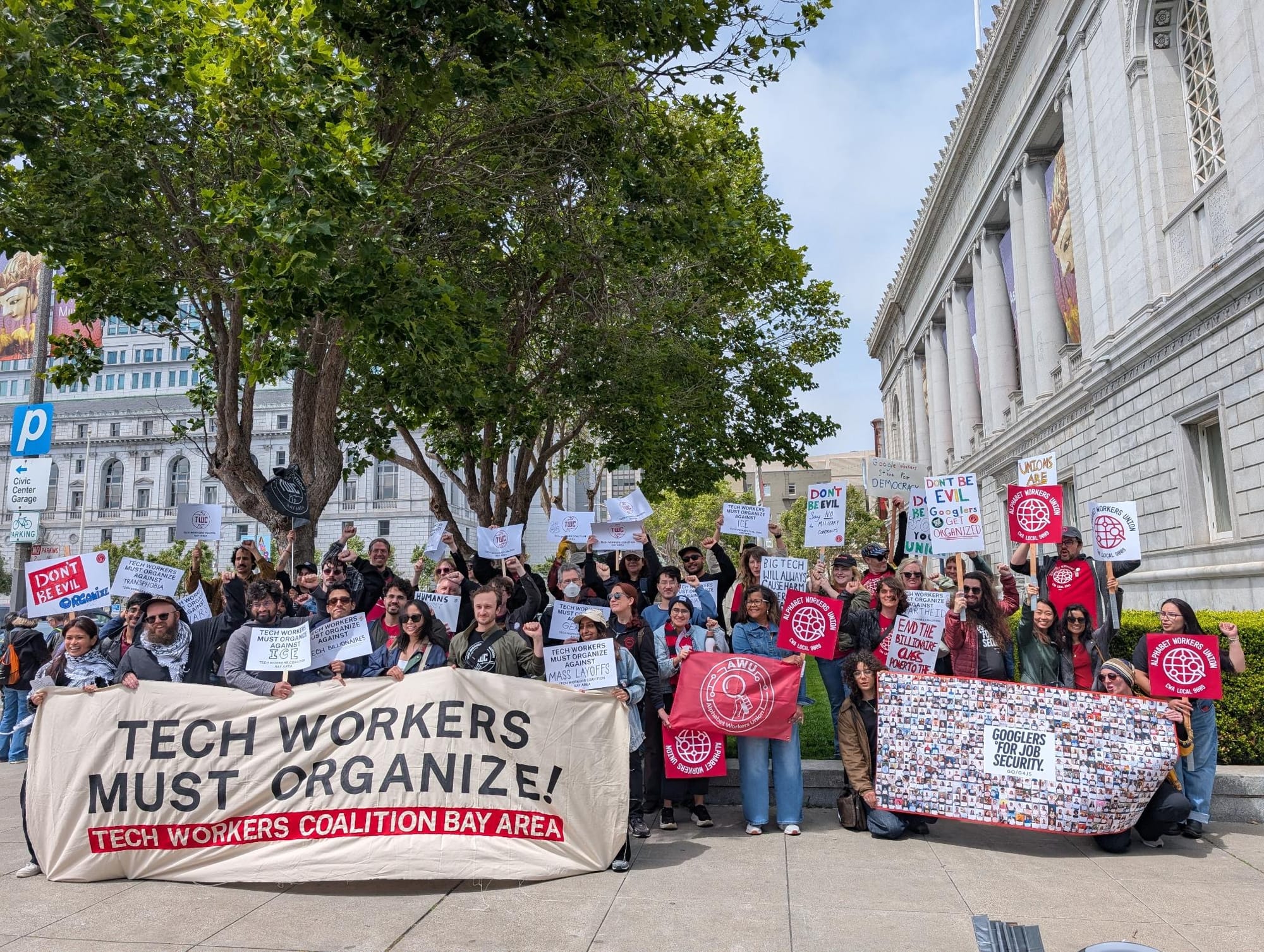
This layoff event was a galvanizing moment for Alphabet Workers Union (AWU), the union representing employees and contractors at Google and its parent company Alphabet. While workers at Google have organized for causes like salary transparency, rejection of military contracts, and better handling of sexual harassment cases since the 2010s, they have only recently started coming down hard on bread-and-butter issues, like job security for full-time white-collar workers.
“Leaders in the company have said…they've rolled this [voluntary exit packages] out everywhere because they've listened to employee feedback. Guess what employees were asking for it? The union!”
This is the focus of AWU’s largest current campaign, a response to layoff cycles that have become more common since the one in 2023, but not any more predictable. The union is collecting signatures on a petition to be delivered to Google CEO Sundar Pichai demanding guaranteed severance pay, voluntary exit packages (VEPs) offered before involuntary layoffs, severance as leave, and reforms to the company’s employee performance evaluation system.
AWU is currently a minority union, meaning it is not formally recognized by the National Labor Relations Board and Google is not legally required to negotiate a contract with its members. Nevertheless, the union has already seen success on the voluntary exit package (VEP) front, with Google offering 70,000 employees VEPs since AWU made it an official demand.
“Leaders in the company have said from their own mouths that they've rolled this out everywhere because they've listened to employee feedback,” Freedman said. “Guess what employees were asking for it? The union!”
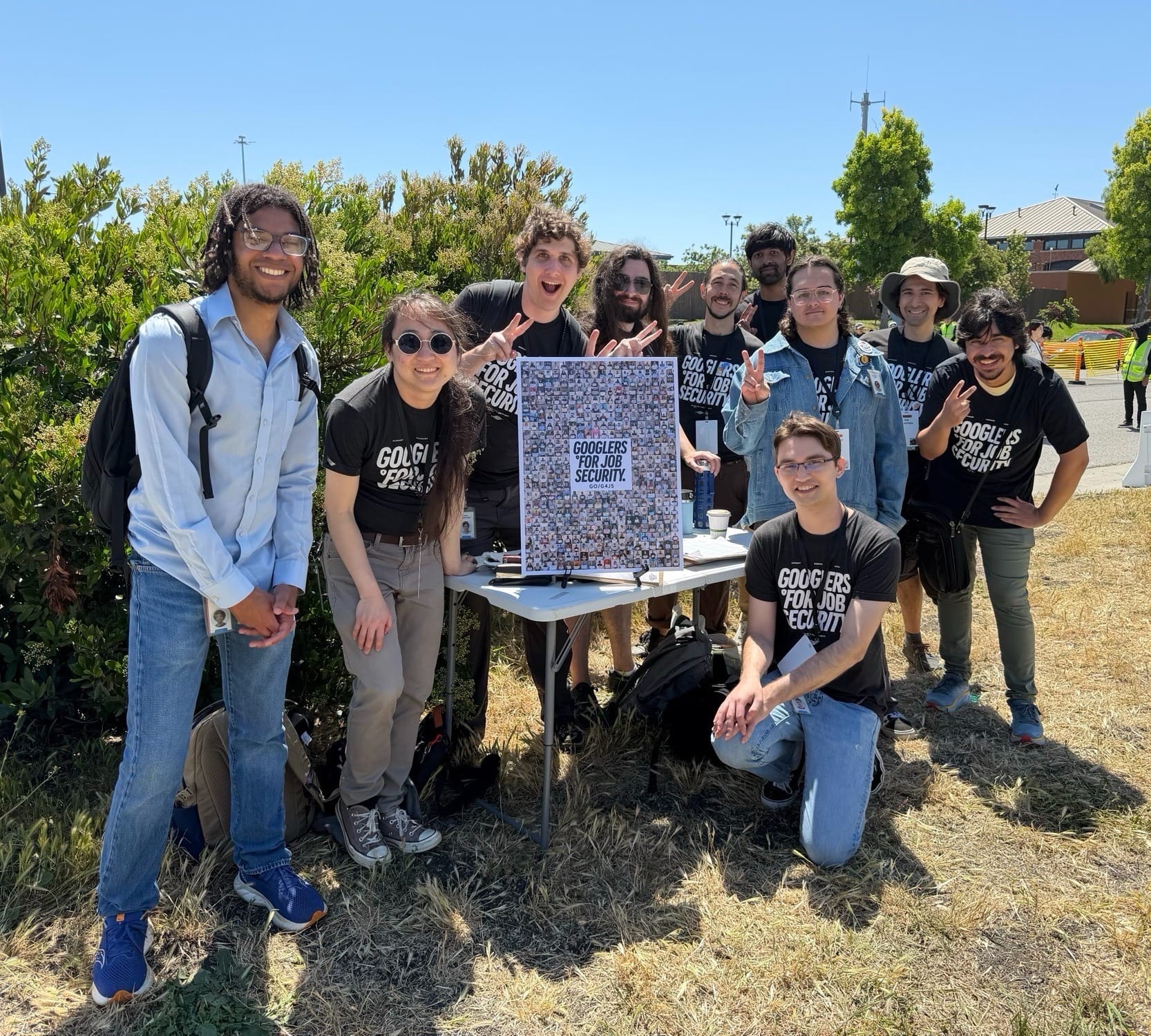
In addition to collecting signatures on the petition, AWU organizers have mobilized their colleagues to participate in a “pic and quote” campaign, where workers contribute a photo of themselves, generally holding a sign explaining why they support the union’s demands.
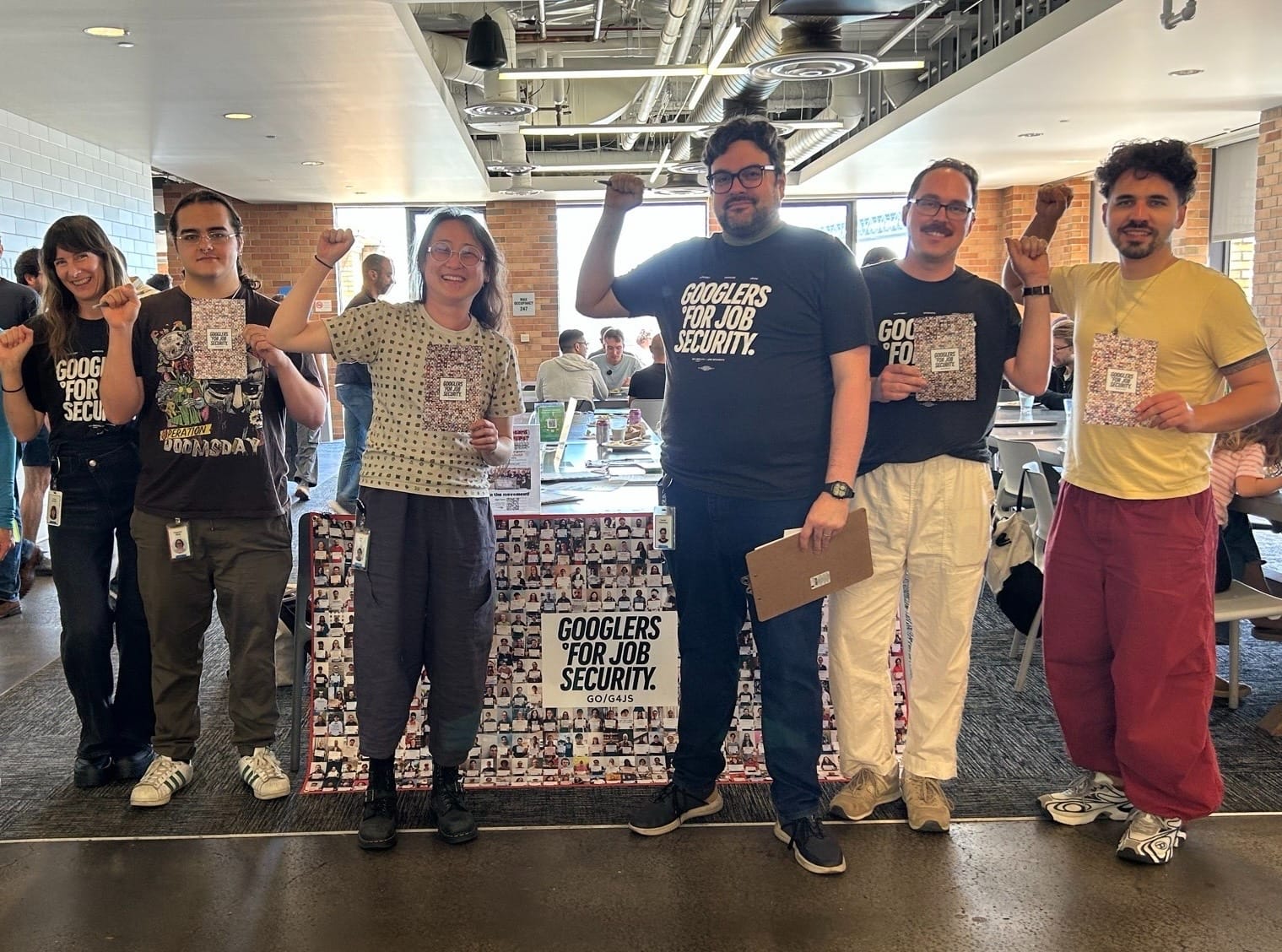
“Since I got involved with the union and the campaign last summer, I have definitely seen momentum growing in San Francisco,” said Joshua Carroll, a product manager in Google’s Cloud Division and organizer with AWU.
Carroll has also been helping organize “days of visibility” where AWU members wear union-branded shirts or participate in other activities designed to draw attention to the union. In an effort to deepen workers’ understanding of what it means to organize, AWU has coordinated events with other labor unions in the Bay Area — most recently the United Educators of San Francisco, who won an ambitious contract after a historic week-long strike in February.
While VEPs can afford workers a sense of stability and control, it's often not enough to counter the stress and uncertainty inherent to working in a sector of the economy that has rapidly come to see its skilled labor force as expendable. Laskey, the software engineer who took a VEP in April, had been offered one a year earlier. Immediately after those offers expired, Google hit his team with involuntary layoffs. Laksey said this “threw a lot of people into a bit of a panic because there were people who, if they had known that there were involuntary layoffs coming afterwards, they might've taken a voluntary package instead.”
When he took the VEP in April, Laksey’s broader team was working on AI security for Chrome. He’s not sure why it was targeted by the company as an area to reduce headcount. “As far as I'm aware, there was no single set of criteria,” he said, referring to how Google decides who is next on the chopping block. At least initially, “it was just directors and VPs putting together a list of people based on some variety of factors.”
Company-wide emails about “reorganizing” and “restructuring,” which had been commonplace at Google for years, began to include brief acknowledgements of the new layoffs they resulted in. Still, a lot was left up to Googlers to piece together.
“I never saw an ‘on the record’ reason [why these corporate restructurings happened], I only ever heard through the grapevine various ad hoc reasons,” Laksey said.
Google seems to have placed a new emphasis on employee performance and productivity as they look to manage the PR fallout caused by slashing personnel. In a June 2025 memo shared with media outlets regarding VEPs, Google executive Nick Fox wrote: “I want to be very clear: If you’re excited about your work, energized by the opportunity ahead, and performing well, I really (really!) hope you don’t take this! We have ambitious plans and tons to get done.”
Fox’s statement gives the impression that vulnerability in an oversaturated and dwindling job market might be remedied by simply grinding harder. Workers tell a different story. Of all the Google employees offered VEPs, “I never knew anybody who they were like, ‘no, you can't actually leave,’” Laksey said.
Many Googlers have started to view this focus on employee performance as a pretext for the company to make the kinds of sweeping cuts the current AI-driven economy encourages, regardless of whether it makes a meaningful impact on their bottom line. “It is tied up a bit with, I think, how you signal confidence to your investors,” Freedman said.
Earlier this year, Google pledged to spend $185 billion on capital expenditures by the end of the fiscal year, with most of this money going towards data centers. This makes Alphabet the third biggest spender behind Amazon and Microsoft in total capital expenditures. With this acceleration of the AI arms race, companies seek to legitimize themselves by cutting costs elsewhere — the easiest area to do so is labor.
Google has managed to utilize an existing framework called GRAD (Googler Reviews and Development) for employee performance evaluation to fit this new demand for lean, AI-dependent workforces.
“GRAD is Google's annual performance process. There is some degree of stack ranking” — referring to the practice of sorting employees by their job performance relative to one another — “and needing to have a certain distribution, then people that are below the cut are on the path to potentially being fired,” said Carroll. “There are folks that have been involved in our campaign that had gotten totally fine reviews from their managers…then ended up getting a low rating and were fired out of the blue.”
Management has also introduced requirements that employees use AI in their work, further contributing to anxiety about layoffs. Google has told employees that they will be adding “AI fluency” or “AI impact” criteria to job performance metrics, meaning employees will be evaluated on how effectively and frequently they use AI. Carroll said Google has “definitely underspecified exactly what that means or how that's going to be measured.”
“I certainly have an idea that if I use lots of AI, talk a lot about how I'm using it and advertise that to my team or my managers, that's probably going to go well,” he continued. “But beyond that, it's not super clear.”
This full-steam-ahead approach to AI adoption in tech workplaces has already started to create problems at other companies. Earlier this month, following a mass 8,000-person layoff at Meta, The Information reported on a memo circulated to employees which warned that internal AI usage is on track to cost the company billions by the end of the year. Meta — whose employees have been “tokenmaxxing,” or racing to increase the amount of work AI coding tools do for them — plans to curb this internal use by imposing token “budgets” on employees and mandating usage of their in-house coding assistant, MetaCode, instead of the more capable Claude Code sold by Anthropic.
These degradations in the quality of work life have had an unintended consequence for Google: transforming tech workers’ relationship to class.
Googlers agree that a semblance of dignity that they were once afforded as high-wage workers at a company perceived as more worker-friendly, has all but disappeared.
“When I joined Google, I was truly impressed by the access individual workers had to upper management,” Laksey said. “Every week there was a forum that random Googlers could show up to and ask questions directly to Larry and Sergey,” referring to the two founders of Google. “This was a truly radical level of transparency.”
A spirit of experimentation also seems to have been replaced by layoff threats. Ten years ago, “you could have a lot of latitude to do things that might not pan out,” Laksey said.
These degradations in the quality of work life have had an unintended consequence for Google: transforming tech workers’ relationship to class.
“Especially recently, this all-in focus on AI and reduction of costs inside the company and headcount and ramping up of metrics that decide your job performance put more and more [pressure] on the worker to produce something of value.” Freedman said. “It has really shifted the tone to feel like we are the frog, realizing perhaps that the pot has been boiling the whole time and we are the frogs and starting to feel it.”
Still, greater consciousness isn’t arrived at through circumstance alone. AWU organizers agree that dire circumstances at the company have cracked open a window of opportunity for the union to make real headway — but the path forward may be challenging for unions representing tech workers that, in many cases, have only recently come to understand themselves as workers at all.
“There are a lot of educational barriers that need to be worked through with tech workers,” Laksey said. “I think many of us still in our heads believe we exist in an era that no longer exists, and that is a mental hurdle that needs to be worked through.”

Contrary to what Scale's 7-figure ad campaign claims, the company's ethos is anything but “centering humans.”


In Against Tech Oligarchy, two leading labor organizers chronicle the past decade’s tech worker movement.

We spoke to one of the frontline union workers in the climate change fight.


Union workers face cuts amid eye-watering boss pay and refusal to dip into a $270 million endowment
