
French Students Proclaim “the End of the Contemporary Era”
A report from Current’s foreign correspondents in Paris and Marseille.
A report from Current’s foreign correspondents in Paris and Marseille.
Our advice columnist Pretty Good Advice works through a breakup problem.
Tenant fights have become a mainstay in the political landscape.

There’s a difference between art made from deep introspection and art which is merely inoffensive, capitalist decoration.

As an artist, I have known of Enrique Chagoya’s astonishing painted work from reputation and experience for many years — so long that it seems I have always known his work.
Every day we’re blinded by a literal blizzard of images that we cannot easily parse what is good. But there’s a difference between art made from deep introspection and the experience and awareness of injustice and exploitation, and the vast majority of art which is merely well-made, inoffensive, capitalist decoration for a market of rich collectors.
Enrique Chagoya was born in Mexico City in 1953. He studied economics at the National Autonomous University of Mexico in Mexico City, and while there, worked on rural development projects, which strengthened his interest in political and social activism. He emigrated to the United States in 1979 and now teaches at Stanford University.
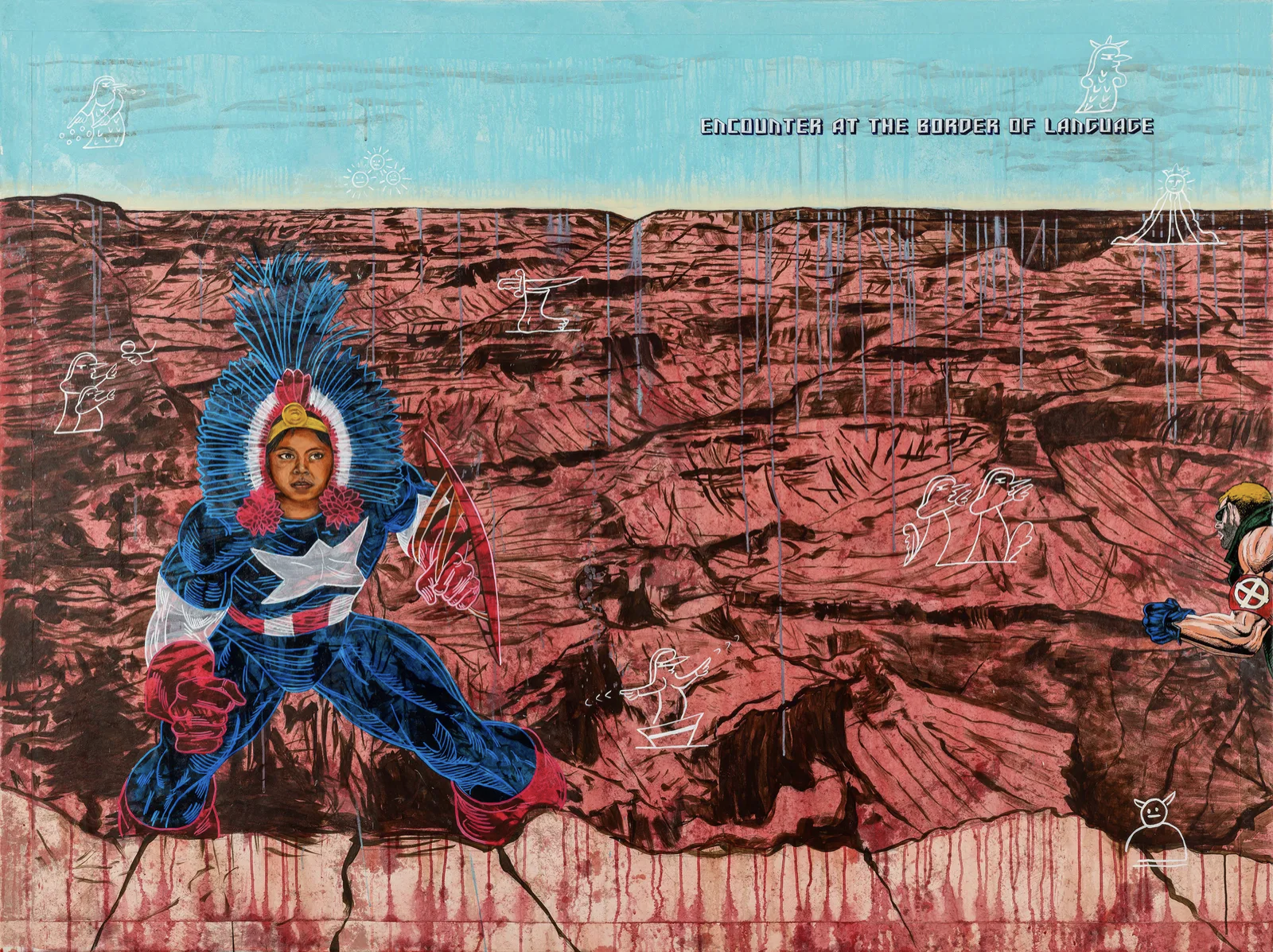
Chagoya’s work spans ancient and contemporary cultures, overlapping and projecting time and space. I contacted the artist in order to talk with him about a piece of his work and he selected Encounter at the Border of Language, 2024. Encounter, a challenging painting that shows the Grand Canyon, now “owned” by the United States, is set beneath a sky that appears to weep about the very long history and the more recent fate of the land.
JOHN SHERIDAN: Can you tell us more about the painting Encounter at the Border of Language, 2024 and the great impetus behind it?
ENRIQUE CHAGOYA: Encounter at the Border of Language, 2024 is the encounter of a Pan-American Indigenous character (with an Aztec headdress on a 6 year old Mayan girl) with the body of Capt. America, as Capitana America, confronting a White supremacist with the logo of the KKK on his arm. The painting questions who is the "illegal alien"?
It is a critical perspective of the xenophobic policies coming from white Christian nationalists/supremacists currently empowered in the White House. They would like to hide the history of being descendants of undocumented immigrants themselves, such as Spanish conquistadors, and about 50 years later the Pilgrims landing at Plymouth Rock, followed by the French and other subsequent European settlers that acted against the law of the land of hundreds of Indigenous Nations not only in North America, but in all of the Americas. They didn’t have passports. The Native American figure is a mix of transcontinental symbols in the Grand Canyon as a background to make emphasis on the US’s current anti-constitutional, illegal deportation policies.
The work offers a central question: Who is American? How many cultures create the American culture? How the policies of non-diversity, exclusion, and inequality are imposed on all types of institutions, from public to private. For the benefit of whom?
SHERIDAN: In the current cultural environment we find ourselves in, who do you think is now, and who do you want your audience to be?
CHAGOYA: My audience is open, unlike the audience of a book writer or a journalist since often I don’t have much control over where my work [is] being shown (private galleries, museums, academic galleries, and community spaces). I try to present an imaginary perspective of a non-dominant culture, but it is only my privilege of exercising my own freedom of expression. I am not trying to convince anyone of my opinions.
SHERIDAN: Given the possible diversity of eyes seeing your work, what effect do you think it has on that diversity of perception? And how do you think and wish to be thought of as a creator?
CHAGOYA: It is impossible to control how anybody would perceive the work. Everyone has a different life experience than me, different biases, different political leanings.
Art does not change the world. We change it with our civic actions, and hopefully when democracy is available to our lives (a very rare experience these days).
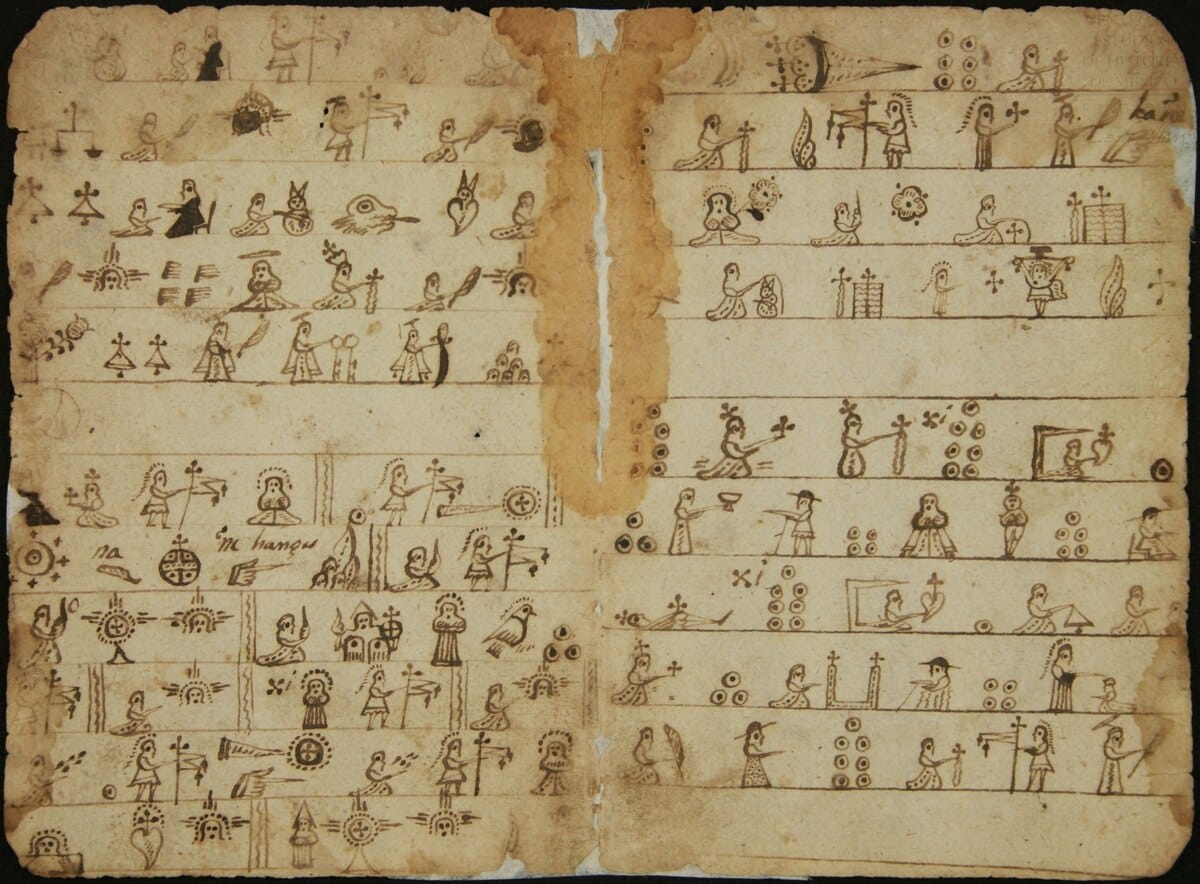
However, art in my experience is a great way to open a dialog with thought-provoking imagery or purposes. Art is one of the best practices to express non-phonetic non-linear narratives to open up a door for multiple conversations between diverse opinions. It is always a challenge though, because it is harder to create than to destroy. Somehow this thinking seems subversive to the current administration and censorship runs rampant everywhere, not only in the arts, like in the Smithsonian, Kennedy Center, late TV shows, but also in media conglomerates and news outlets, in academia, sciences, and legal firms.
SHERIDAN: How has the (omni)presence of ICE affected you personally and how has it affected — or how might it affect — your art?
CHAGOYA: Migration has existed since the origins of humanity in Africa. Immigration was born with the emergence of borders, tribes, and national states, and we can write volumes about it. Besides Native American, I regard many communities as originally non-immigrants to this country such as early Mexicans living in what is now the South West when overnight it became part of the U.S. in 1849, or African Americans descending from former slaves who were kidnapped and brought to this country against their will, or Indigenous Hawaiians, Puerto Ricans, and people from other territories. This country moved to them not the other way around.
Regarding ICE, that is just a euphemism for secret police that is not detaining and deporting the worst of the worst (those are the ones running the agency and they should start by deporting themselves). As most people have seen recently in social media and in the mainstream news, they are detaining and deporting both hard-working immigrants with legal status, and citizens alike, kidnapping them from their workplaces, from their homes, without due process, often as punishment for their opinions, or for their looks, against their constitutional rights, and their human rights.
It is the arm of a totalitarian political class using violence against the people of this country. A political, elitist class, pushing the country into another forever war, to serve their own narrow interests, distracting from the internal corruption practiced by some of their leaders and powerful figures that so far are unaccountable for sexual abuse. It is symptomatic of a privileged elite that is willing to destroy this country and the world to stay in power.
Our only hope is to organize peacefully beyond party affiliations, staying united, and following the example of the heroic people of many places like in Minneapolis, Chicago, Los Angeles, and Portland. It may be an up-the-hill resistance, but the current pace of affairs is unsustainable.


Is it hype or is it Kool-Aid? “Ghost in the Machine” succeeds where “The AI Doc” fails.


