
AI Startup Launches Campaign To Exploit Humans, Ethically
Contrary to what Scale's 7-figure ad campaign claims, the company's ethos is anything but “centering humans.”
Contrary to what Scale's 7-figure ad campaign claims, the company's ethos is anything but “centering humans.”

In Against Tech Oligarchy, two leading labor organizers chronicle the past decade’s tech worker movement.
We spoke to one of the frontline union workers in the climate change fight.

Contrary to what Scale's 7-figure ad campaign claims, the company's ethos is anything but “centering humans.”

When the email appeared in my inbox in early June, I initially thought someone was playing a joke on me. “Scale AI brings 7 figure campaign - "The humans stay" to San Francisco.” It would be hard to imagine a subject line more perfectly designed to upset me specifically.
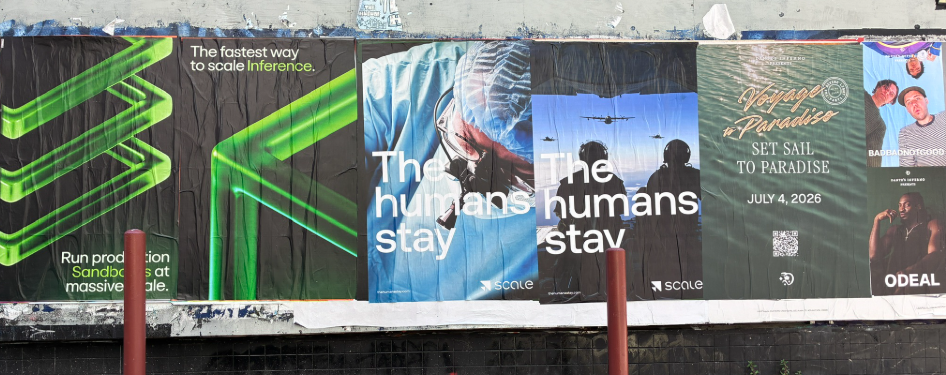
The email came from Tusk Strategies, a PR firm founded by political strategist Bradley Tusk, and its purpose was to inform me of a marketing campaign by AI startup Scale, which included wild postings (street-level poster blocks) throughout San Francisco, a website, and digital billboards in New York City. A quote from Scale’s VP of Marketing began, “This campaign felt necessary because no one else is saying it.”
I did not understand why I had received this email. I do write a column for this very publication, Bay Area Current about SF’s tech billboards, but my perspective is generally not a favorable one. I do not know why a PR firm would feed its own campaign to the wolves, unless the idea is that any publicity is good publicity. Perhaps someone simply asked ChatGPT for a list of people who write about billboards.
Whatever the case may be, I am taking the bait. I will use this email as an excuse to write about Scale. I have been waiting for this opportunity for a long time.
Scale, also known as Scale AI, has become a key player in the AI world without ever becoming a household name. Everyone knows OpenAI, founded in 2015 by a consortium of tech figures and now valued at $852b, and Anthropic, founded in 2021 by OpenAI defectors and now valued at $965b. Only those who pay attention know Scale, founded in 2016 by two Thiel fellows and valued at a comparatively paltry $29b. Scale does not build consumer-facing AI; it’s more of a middleman. Its customers are other organizations that build AI tools.
To understand Scale’s success, you need to know that every generative AI model is built atop a mountain of human-generated data. A product like OpenAI’s ChatGPT, Google’s Gemini or Anthropic’s Claude can only exist through ingesting terabytes of data: text, images, videos, whatever it can find. In the early days of building AI models, data was scraped from all over the internet, including Reddit threads, published books, and newspaper articles, often without permission or payment. (Lately, as the technology has matured, the companies have turned to licensing deals and settling lawsuits.)
But ingesting pre-existing data isn’t enough to make a good product. Domain-specific knowledge can be useful, as well as a certain amount of manual correction and annotation.
Say you wanted to start your own AI company. Theoretically, you could hire humans the old-fashioned way to supplement and correct training data, with decent wages, benefits, and a certain degree of autonomy. It could be a decent job. But if you were to try to raise money based on that plan, you would be laughed out of the room. Why spend more on labor when less will do? Think of the margins! Think of the shareholders!
Enter Scale. Scale takes the gig economy model and applies it toward AI data work. Their key innovation is to outsource this labor, distributing it as piecework, all over the world. Some of these jobs can be done by anyone with an internet connection and basic literacy, so they don’t need to pay much. Some need specialized training, so they can pay a little more, at least at first. The key insight is that these jobs aren’t framed as jobs, per se. Instead, they’re billed as merely one-off tasks for extra money, thus sidestepping onerous labor laws.
Scale wasn’t the first to come up with the idea of gigifying data work, but it succeeded where its competitors, like Amazon Mechanical Turk, could not. Launched at the right time to catch the wave of advances in LLM technology, Scale was nimble enough to adapt, while sufficiently well-resourced to become a dominant player in the space. It helped that they had the patronage of powerful figures like Peter Thiel, whose fellowship program paid both founders to drop out of university, and whose investment firm later led a major fundraising round. Scale also went through the startup accelerator Y Combinator, which described the fledgling company as an ‘API for human labor.’
That’s one way of describing their business model. A more critical description would be ‘digital sweatshop’. A Washington Post investigation from 2023 looked into the operations of Scale subsidiary Remotasks in the Philippines, finding that many workers were paid far below minimum wage, with conditions worsening after the company expanded to India and Venezuela in a global “race to the bottom.” In addition to poor pay, the work itself is often tedious, with confusing and sometimes nonsensical instructions. Scale’s other subsidiary, Outlier, targeted at workers in wealthy countries, offers higher pay — e.g., $25 to $40 per hour for “teaching AI models how to write” — but is similarly beset with issues, with workers complaining about arduous unpaid onboarding processes and difficulty receiving payment.
Meanwhile, what of the founders? One actually left in 2018, citing ‘a difference of opinion.’ Still, she kept a small stake; last year, when the company was valued at $25B, she dethroned Taylor Swift as the world’s “youngest self-made female billionaire.” The other founder, even wealthier, is now Chief AI Officer of Meta, which spent $14B in a deal that was widely considered an acqui-hire. He now leads their ‘superintelligence’ efforts.
Speaking to New York Magazine in 2023, one data worker for Scale, tasked with labeling the emotions of people calling to order pizza, said, “I really am wasting my life here if I made somebody a billionaire and I’m earning a couple of bucks a week.” Thus the fruits of the labor of the global working masses flow upward, to those ambitious young arrivistes. Same as it ever was.
Tusk Strategies provided me with the locations of the 20 or so wild postings in San Francisco. Throughout the month of June, I visited as many as I could.
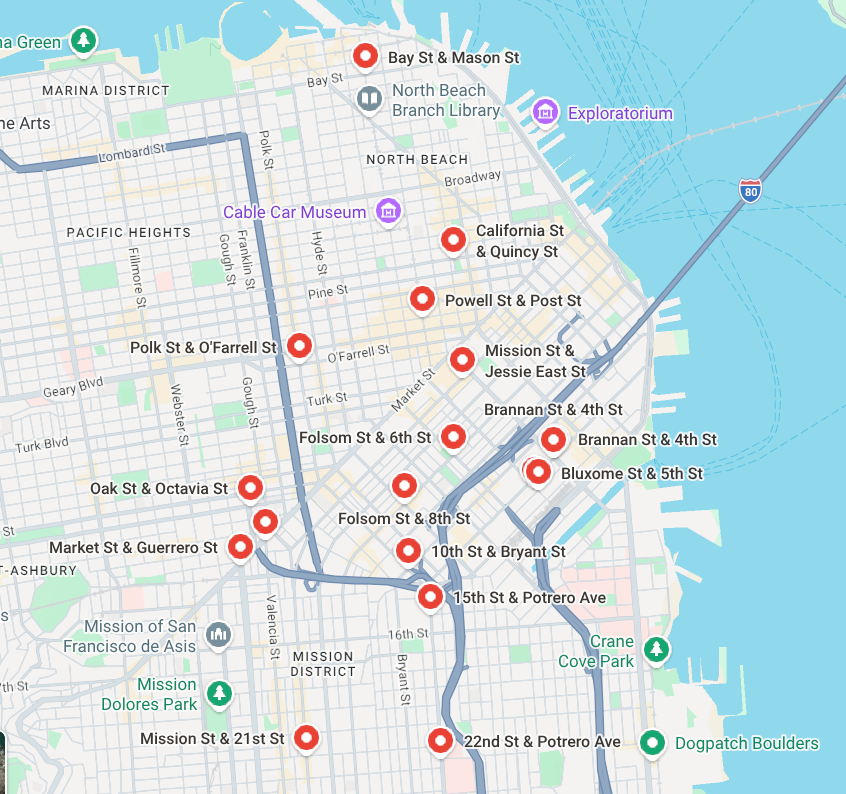
Alas, I was too late — only one location (California St & Quincy St) still had the postings up by the time I got there. It wasn’t particularly impressive: two bland-looking posters asserting ‘the humans stay.’
When I returned a couple of weeks later, they had been replaced by posters for The Onion.

This is a 7-figure campaign? Did they blow their budget on digital ads in Times Square? The website contains less than a hundred words.
Perhaps this tepid campaign is merely a reflection of the company’s diminished state. Scale is no longer what it is. When Meta bought 49% of the company last June, it sent shock waves through the industry. OpenAI had already been winding down their partnership, but other former and prospective customers, spooked by the Meta deal, decided to look into Scale's rivals. Staff turnover has been significant: not only was the CEO hired away, along with top employees, but the company initiated layoffs not long after. Plus, lawsuits are catching up to them: they no longer hire gig workers in California, after settling a series of misclassification lawsuits. There is an ongoing investigation by the city of San Francisco over labor practices, although Trump’s Department of Labor dropped their federal misclassification investigation.
Hilariously, the CFO appeared on CNBC last year to insist that Scale is “not a zombie company.” Zombie or not, the company is still going, buoyed in part by lucrative military ties: in May, the Pentagon awarded Scale a $500M contract to integrate AI into military operations. In July, a spokesperson for Scale described their “new focus on building AI applications for enterprises and governments, rather than solely data labeling.”
Scale’s pivot may simply correspond to the new stage of the AI arms race we’ve entered. No longer is it necessary to assemble giant datasets from scratch using a global army of workers: now these datasets are a given. There’s still always data work to be done, but the center of gravity — and profit — has shifted up the stack, toward building applications.
And now, Scale declares “the humans stay.” It’s so brazen it's almost impressive. A multi-billion-dollar company built precisely on the devaluation of human labor, then — after both founders have made their billions and departed — launching a marketing campaign claiming to center humans. Which humans stay, exactly? Certainly not any humans targeted by the US war machine. And not the humans who annotate for pitiful pay, whose contributions are made invisible and risk being rendered obsolete at any moment.
As Phil Neel writes in a forthcoming book on AI: “every AI model is the product of a hidden factory.” A user-facing company like OpenAI or Anthropic has a similar privileged position to Apple: sitting atop the global value chain, controlling the consumer distribution channels and thereby amassing the bulk of the profits. Scale is more like electronics manufacturer Foxconn, setting the conditions of work in a low-wage environment for a smaller share of the profits. To be a worker in this planetary factory is another matter entirely.
As a publicity campaign, Scale's 'the humans stay' slogan is vapid and meaningless. But as a sign of the times, it’s an indication that public opinion has soured on AI — and Scale knows it.
The AI backlash crosses party lines and shows no sign of slowing down. Not a single data center can be built without massive community uproar. Use of AI has become a flashpoint in every cultural domain, from music to film to books to games. A restaurant in San Francisco that used AI menu images promptly backtracked after public outcry. AI is increasingly being seen as not a neutral technology but a weapon in a class war.
Scale’s human-centric ad campaign attempts to position itself as the good guy here, as a responsible AI company that “keeps humans at the center.” We should be skeptical. For AI to be developed and used in a way that truly centers humans would require a complete departure from the profit-oriented system that dominates today. A complete reimagining of how the technology is assembled and deployed would be necessary. Empty slogans about centering humans from a company most famous for enriching its founders on the backs of its workers get nowhere close.
Scale declined to provide a comment on the record for this piece.

In Against Tech Oligarchy, two leading labor organizers chronicle the past decade’s tech worker movement.

In a city dripping with cash, San Francisco can’t get its kids to school.


Putrid vibes reigned at SF billionaire-funded Hamilton Society debate.


Human feces isn’t even the nastiest thing they’ve found in the backseat.