
Meet the Grandmas and Grandpas Building Tenant Power
When management neglected their building, elderly, majority-Chinese tenants in Downtown Oakland got organized and fought back.
When management neglected their building, elderly, majority-Chinese tenants in Downtown Oakland got organized and fought back.
Human feces isn’t even the nastiest thing they’ve found in the backseat.
Contrary to what Scale's 7-figure ad campaign claims, the company's ethos is anything but “centering humans.”

ILWU Local 6 workers are about to enter their fifth week on strike at C&H Sugar – their first strike in nearly a century.

When Kendra Sparks was a child, her curfew was the sound of the California and Hawaiian (C&H) Sugar factory steam whistle.
“You could hear it everywhere in town,” Sparks recalled.
C&H Sugar set the pace of Crockett, California — a small town just south of the Carquinez Bridge to Vallejo. Now its workers are shutting it down, at least for now.
At one point, the C&H Sugar factory, one of the leading sugar companies in the country, employed 95% of the company town. As a co-operative, they gave out turkeys for Thanksgiving and presents for Christmas. They built many of the town's public amenities, and designed residential homes. Many of those in town wore Hawaiian shirts on Fridays in honor of the Hawaiian sugar being produced in the factory. C&H Sugar was the lifeblood of Crockett.
“That’s where my mother met my pop,” Sparks said, adding that her four sisters and one brother all worked for the company at one point.
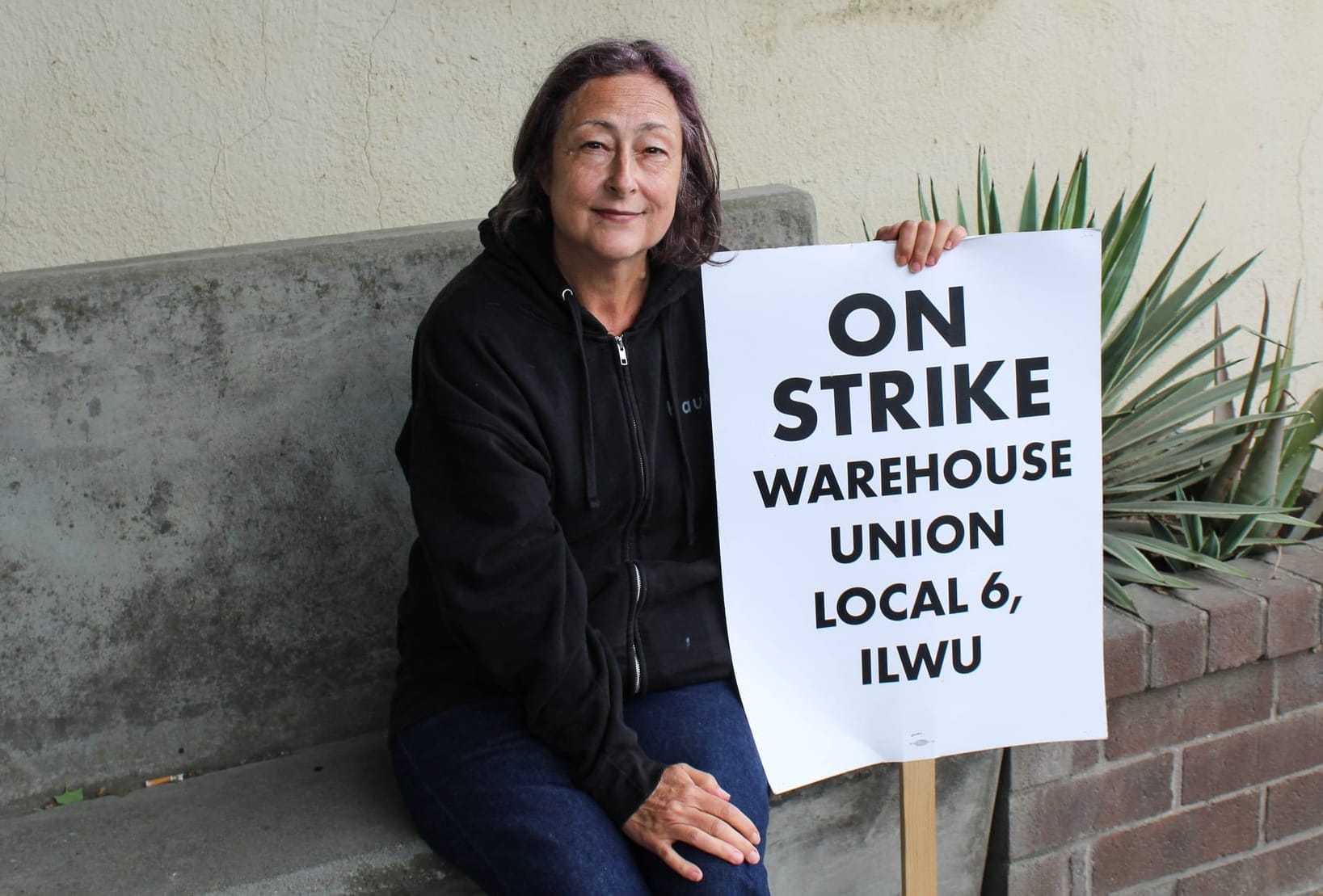
Sparks, initially hired by C&H Sugar at the age of 18, is now approaching her 30th year as a warehouse employee and International Longshore and Warehouse Union (ILWU) Local 6 member. Her familial ties to C&H Sugar are shared by nearly all of her co-workers — many, if not most, of whom entered the business in the footsteps of their parents or grandparents.
“There was such a sense of pride in working here. Everybody knew what good jobs they were,” Sparks explained. “The town itself had a lot of pride as being home to C&H sugar, too. But that definitely took a sharp [turn].”
After American Sugar Refining (ASR) bought C&H Sugar in 2006, the company prioritized profits over the well-being of their workers — both inside and outside of the physical workplace.
"...with the way things are in this country and how much power corporations and billionaires have, it’s not shocking to see they’re trying to take more away from the working class.”
Almost immediately upon company acquisition, ownership rolled back benefits. In the 2009 contract negotiated between C&H and ILWU Local 6, workers were told that anyone hired after that year would not qualify for previously-guaranteed retiree health or pension benefits. It was a sacrifice workers made with the chips they had on the table.
“Me and another 60 or so guys in here don’t have pensions,” said Manny Loera, a belt foreman who has been working in the factory for 11 years. “We’ll be working until we can’t, really."
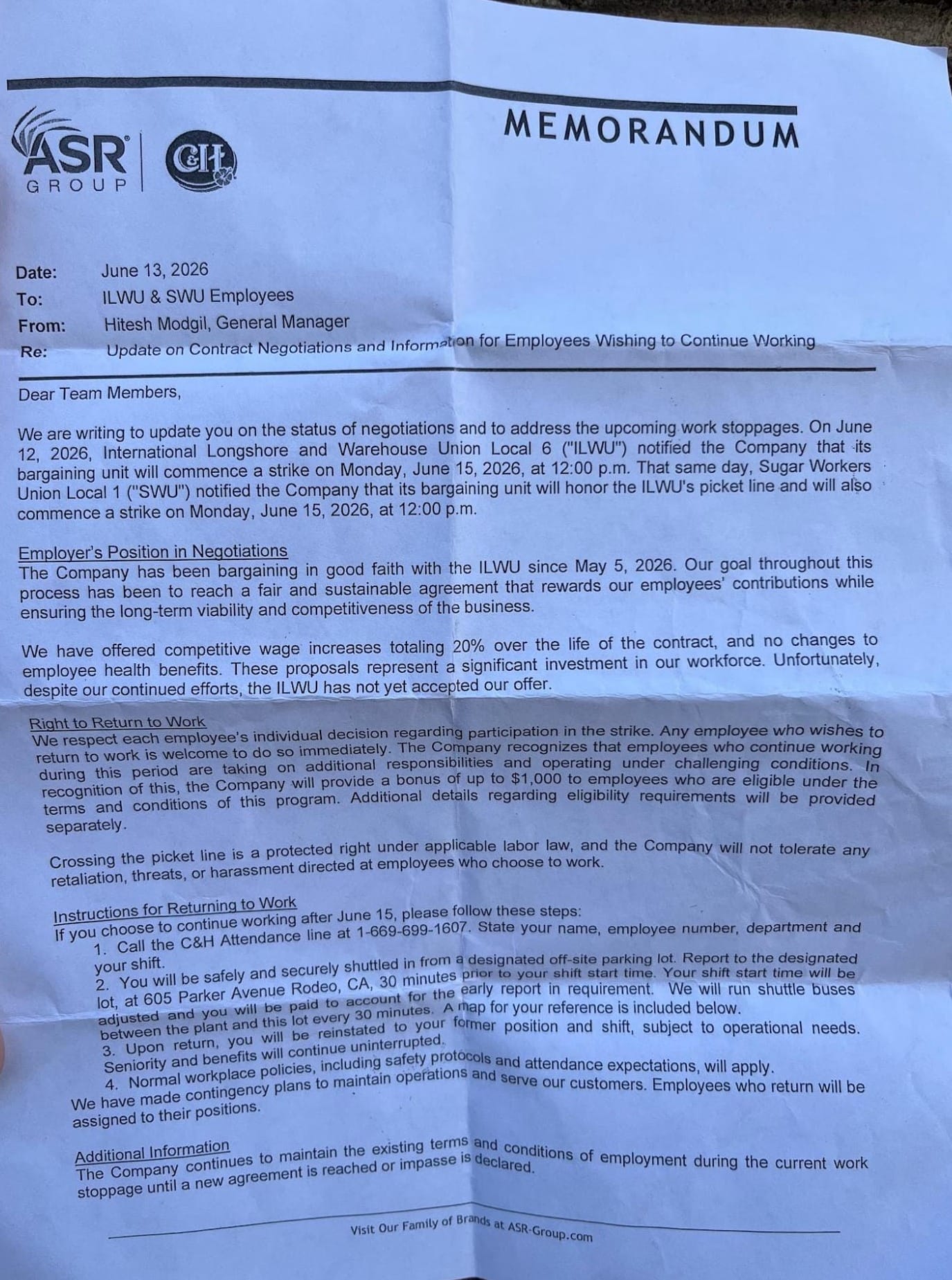
Flash forward to May 2026, and workers said they found themselves once again trapped by C&H management’s antagonistic bargaining. When the union contract expired on June 1st, 2026, workers were at the same place they were at the start of negotiations — with overtime pay, sick days, and more retiree benefits on the line.
On June 15th, 90 ILWU Local 6 warehouse workers walked out, beginning a now four-week-long strike against the world’s largest cane sugar refiner and marketer.
“The new contract is pretty much nothing but takeaways,” said Loera, whose brother, dad, uncles, and cousins have all worked for C&H Sugar at one point. “The fact that they were so strongheaded on this and not really wanting to work with us on trying to meet in the middle anywhere was kind of a shock, but with the way things are in this country and how much power corporations and billionaires have, it’s not shocking to see they’re trying to take more away from the working class.”
Under the company’s new proposed contract, all workers’ retiree health benefits would be revoked — not just those hired after 2009. This would mean that already-retired, former C&H Sugar workers actively using their retiree medical benefits would no longer be able to do so.
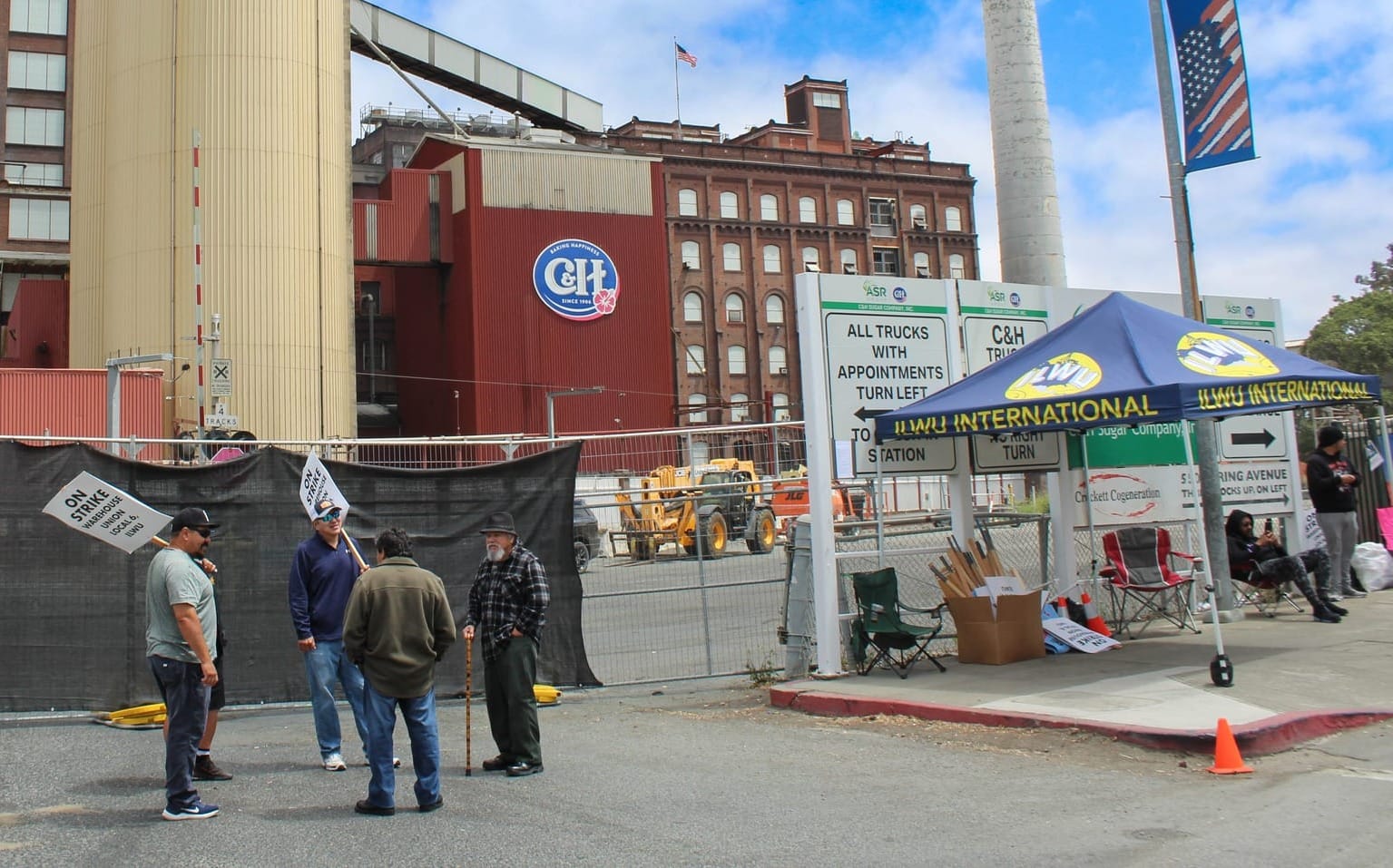
“The new employees that came in [after 2009…] at least they knew that when they came in and could make plans for their future accordingly,” Sparks said. “It’s just a big slap in the face to the [retirees] that are entitled to that and the people currently employed here.”
Sparks herself started working for C&H Sugar three decades ago in large part due to the benefits, specifically the retiree health insurance now on the line. Both of her parents, former C&H Sugar workers who are in their late 70s, now fear for their future.
“[My dad and my mom] would have to pay full price for their medicines and for their doctor visits now,” said Sparks. “It just feels like an act of cruelty to do this to people. Just really a ‘ha-ha gotcha’ kind of thing to the people who have invested so many years there and then to have them just pull the rug out.”
Many C&H Sugar retirees are showing up at the picket line — years after their last day of work — because they say they have no other choice.
According to Sparks, there are about 25 current ILWU C&H workers who qualify for the retiree medical benefits, and about 90 retired ILWU C&H workers who are currently on the plan.
Sparks said that under the company’s new contract proposal, workers would also not be able to receive time-and-a-half overtime pay until they have worked 40 hours in a week. Previously, it was after 8 hours, which is the California state standard.
“Normal shifts are 8 hours for all warehouse [workers], but 80% of us work 12 hour shifts every day, and maybe another 10% are hitting 60 hour work weeks at a minimum. Sometimes 18 days in a row — we’ve done 21 days in a row,” Loera said. “Easily 90% of us bank on having overtime here. There’s guys here where half their wages are coming from overtime, or more. With the new language on the overtime pay [...] that just gives them way too much power to alter our schedules and could potentially cost us $10,000 each in wages per year.”
Workers said the company could use forced overtime for their own financial gain by intentionally cutting their hours short right before they hit the 40 mark.
Sparks said this coincides with another part of the company’s contract proposal, which states that C&H Sugar would no longer be required to respect seniority for hiring or scheduling purposes.
“Because they're taking away the idea of seniority and with no guaranteed 40 hours, they could absolutely force you to do three 12 [hour shifts] and lay you off for a day, not pay you any overtime at all, and you’re not getting any full-time work,” explained Sparks.
In the past, schedules were determined by asking those with highest seniority first. Under the company’s new proposal, those who will work overtime may be handpicked by C&H management, giving the employer a tool to discipline workers. On top of this, management can hire externally without first regarding those already in the workplace who may be seeking a promotion.
“You’re taking your most experienced people who can pass on the most knowledge to their coworkers and not wanting to give them what they’re entitled to from their seniority,” said Sparks. “I just don’t understand how you want to take your most experienced people and really punish them the most.”
In addition to these changes, C&H Sugar's proposal involves cutting workers’ paid sick days in half — from 10 sick days to five.
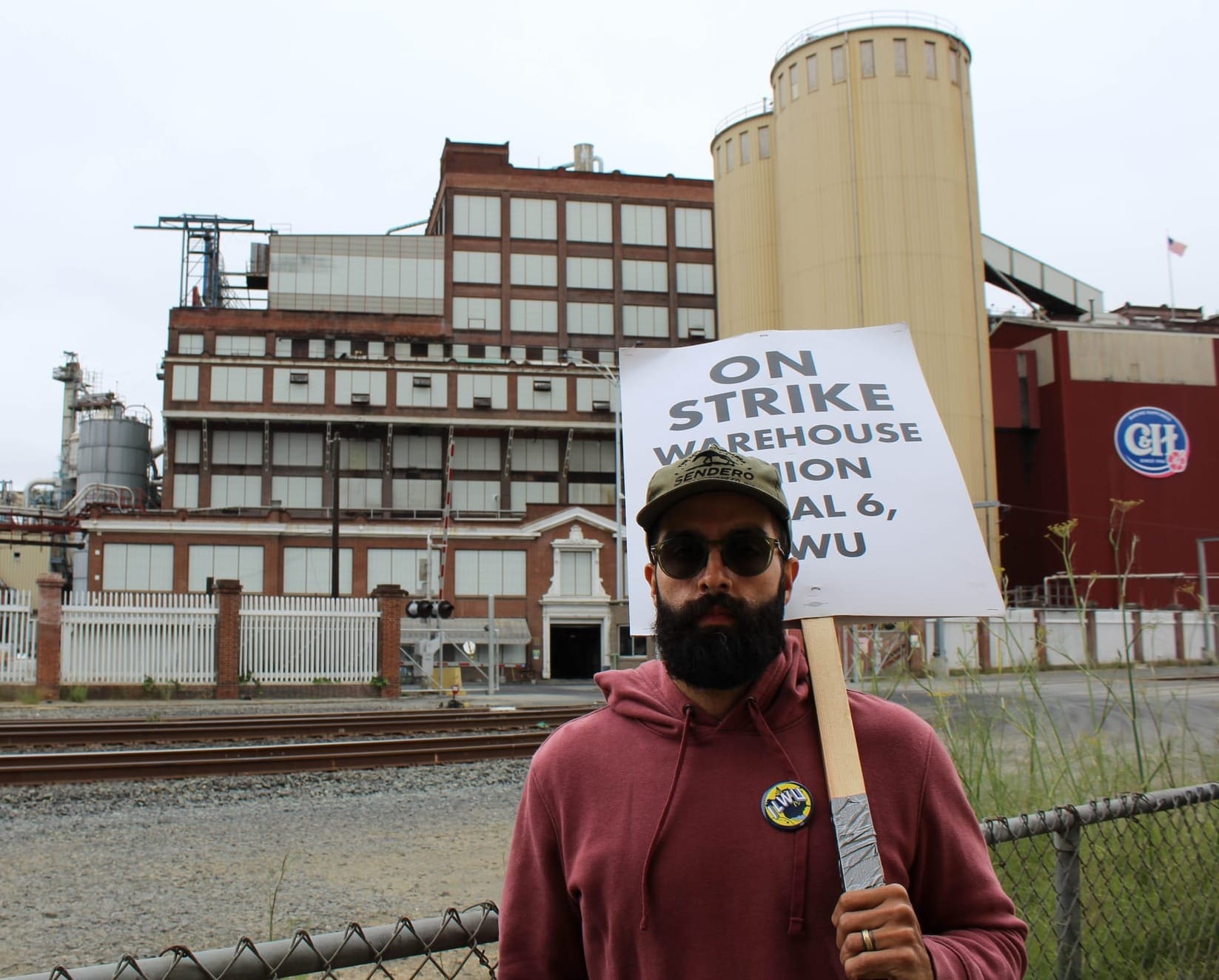
“Health issues happen, and if anyone has young kids, you know they’re getting sick all the time, and you’re going to have to keep them home from time to time, and we counted the sick days for emergencies like that,” said Loera, a father to a 3-year-old. “I could be disciplined or fired because my daughter doesn’t feel good one day, that’s just baffling that they want to hurt us. It’s going to hurt every one of us.”
In 2003, C&H Workers went out on a solidarity strike with the sugar workers represented by Sugar Workers Union Local 1, but this is the first time in nearly a century that the C&H Sugar warehouse workers have walked out. The last time was during a strike locally known as the Sugar War of 1938.
The ongoing strike, while not as violent, is just as contentious.
On June 25th, 2026, four ILWU warehouse workers received a call from C&H Sugar Human Resources saying that they were immediately terminated due to activity on the picket line.
“It kind of slapped me in the face, knowing I’m being terminated from a place I put so much blood and tears into for so many years, and this is how they repay me.”
“They told me that I would be terminated for striking an individual with my picket sign, which is totally false,” explained Robin Pittman, who has worked as a raw sugar operator in the factory for 44 years. Pittman had already put in his retirement date as July 1st of this year.
Pittman said he was reported by a private security officer working for C&H Sugar. Three other individuals received similar calls for incidents such as “driving sporadically” and “flipping the bird,” according to workers on the line.
“I was shocked. I was retiring to help watch my granddaughter,” said Pittman. “It kind of slapped me in the face, knowing I’m being terminated from a place I put so much blood and tears into for so many years, and this is how they repay me.”
ILWU Local 6 has since filed charges with the National Labor Relations Board (NLRB) for “unlawful” terminations as well as “bad faith bargaining tactics,” according to the ILWU Local 6 communications director, Roy San Filippo. The charges are still under investigation by NLRB Region 32 in Oakland.
Private security firms hired by C&H Sugar have been patrolling the perimeter of the factory since ILWU Local 6 gave the company 72-hour notice of the strike. Each security guard is equipped with a video camera. Workers said security guards videotape them at the truck entrance picket line every time a truck comes through the gate, and escort scab workers inside the factory.
On top of the paid, out-of-state security, workers say C&H Sugar is flying in the contracted scabs from out-of-state. The company is now paying for private shuttle service to bring scab workers to and from their temporary lodging in Concord and Fairfield.
“Not only are [the scabs] getting their salary pay that they normally get, they’re actually paying them time and a half after their regular eight hours. That’s one of the biggest reasons we’re out here fighting,” said Mario Rives, who has been working as a crane operator for C&H for a decade. “It’s pretty wild that our rights mean so much that they're willing to spend hundreds and hundreds of thousands just to keep us out here on the picket line without pay.”
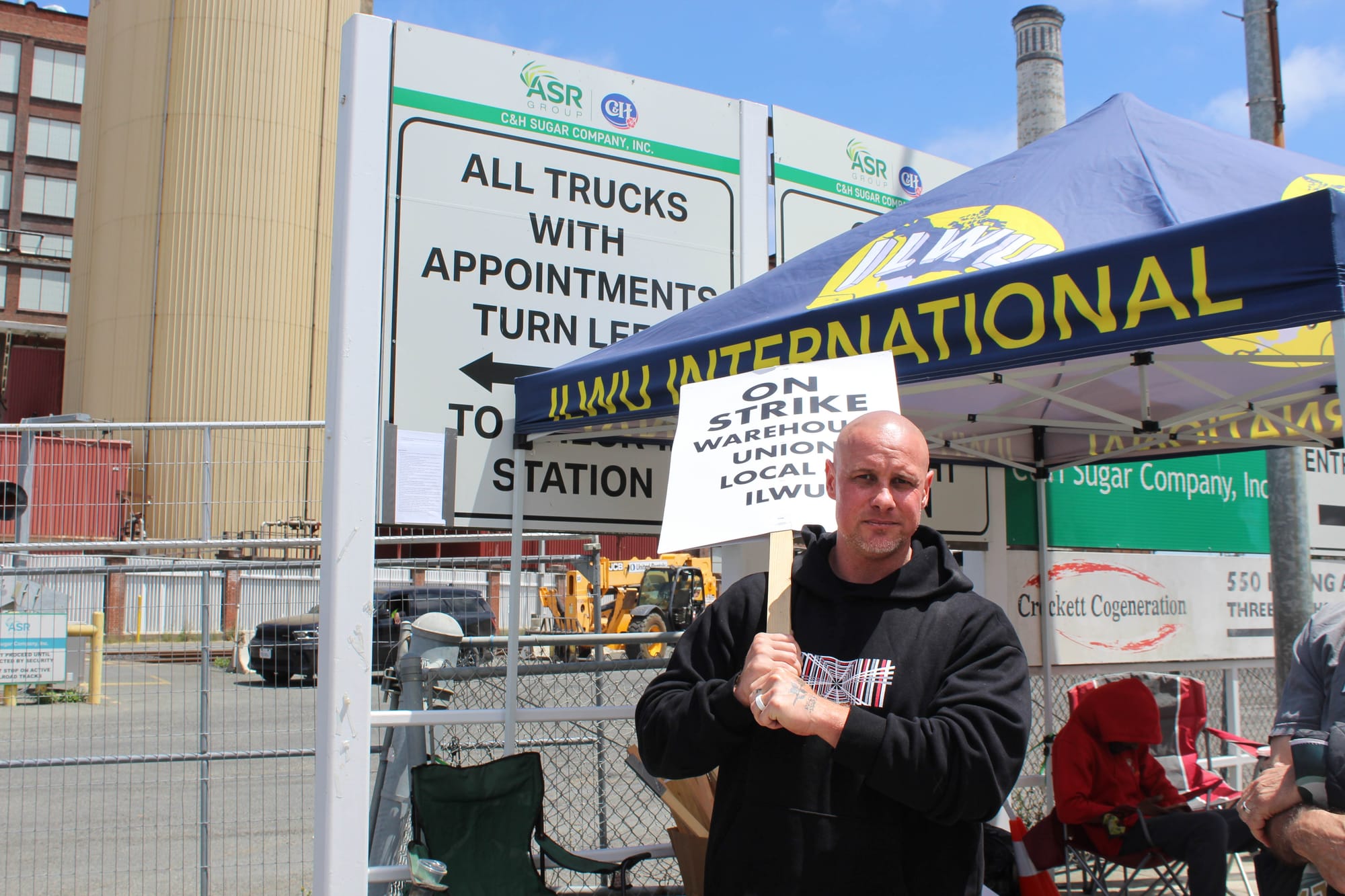
ILWU Local 6 is one of many locals without a strike fund, meaning that they are unable to provide any financial support to their members out on strike. As the scabs operate with bonuses, time-and-a-half, and private shuttles, Local 6 members don’t know when they will receive their next paycheck.
Paid scab labor has raised safety concerns. Workers on the picket line said they do not believe that the scabs are qualified to operate the warehouse machinery or complete necessary tasks.
Otis Brown, union shop steward and truck foreman, said trucks of shipments are being loaded incorrectly, posing a danger to the truck drivers and to those on the road.
“They’re loading more weight inside these trucks because they can get more product out,” explained Brown, who has been working at C&H Sugar for 25 years. “Usually I load 42,000, they’re loading 45,000, 46,000 pounds in a truck right now. The guys in the trucks don’t know the weights. They’re going down the highway [weighing] 80,000 pounds. That’s illegal.”
As for the equipment itself, workers said it takes months of training to operate property.
“We’ve got 30-year-old equipment in there that is not maintained very well, and I’m sorry I don’t care how smart a person is that they bring in off the street, they’re not going to know the nuances of the operation,” said Sparks. “They don’t seem to have any respect for that at all.”
In response to Bay Area Current’s press inquiry, C&H management said “We presented our ILWU members with a robust new contract that included a 2% signing bonus, a 4% wage increase in the first year and 20% increase over the five-year term of the agreement. We remain committed to an open and constructive dialogue with the union as our goal has always been to reach an agreement that supports our employees while ensuring the long-term sustainability of our company and the communities we serve.”
C&H Sugar did not respond to additional questions.
“They’re talking 4% this year… and that’s really just keeping up with inflation and the cost of living,” said Loera. “That sounds good on paper, but when you take into account everything else the company’s not promoting, all the takeaways, then we’re losing out big time.”
Workers on the line said that paid overtime accounts for as much as 25-50% of their income.
“If they’re going to cut you off at the knees and not give you any overtime, then [that pay increase] doesn’t really matter,” noted Sparks. “They are taking away the biggest piece of people’s income earning potential, which is overtime.”
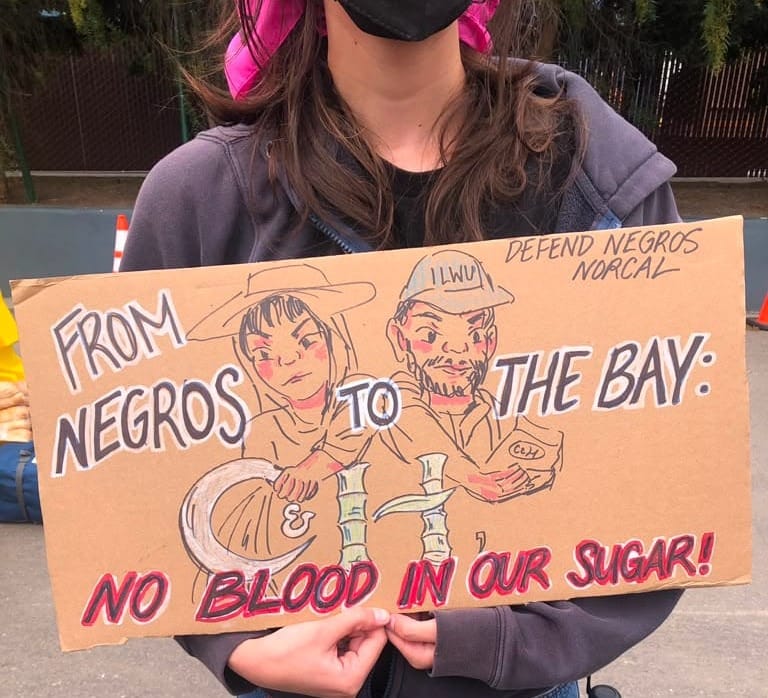
Compounding the battle for a dignified life for the Bay’s sugar refinery workers is contention around a shipment of sugar linked with a massacre in the Philippines.
ILWU longshoremen are refusing to offload a shipment of sugar currently in the harbor from the Philippines —– because it is allegedly “blood sugar.” The sugar was reportedly harvested on the site of the Toboso Massacre, an armed confrontation leading to the death of 19 individuals this April, including minors, community organizers, and a journalist at the hands of the Philippine Army.
Longshoremen and Filipino activist groups are protesting the offloading of the supply, meaning that the scabs inside will eventually run out of sugar supply. On Monday, July 6, ILWU and DSA Easy Bay held an emergency picket to block the sugar from being offloaded at the Port of Richmond with scab dockworkers.
Now, C&H Sugar has diverted the shipment from the Philippines to Levin Richmond Terminal Corporation, which handles scrap metals, coal, and other industrial materials.
Demonstrators have already noted the hazardous handling of the raw sugar import, with drone footage reportedly showing raw sugar being dumped onto the ground, uncovered. If the “blood sugar” is successfully brought to the factory, it could then be processed by scab labor at C&H.
After a protest Wednesday, Richmond City Councilmember Claudia Jimenez said city planning staff inspected the terminal, but has not yet reported back.
As week five of the strike approaches, the company has yet to schedule negotiations or reach out with updates. Nonetheless, workers' spirits remain high as they continue to fight for their rights — and for a job that can keep up with the Bay’s skyrocketing costs.
“We’re not asking for wage increases and more sick time, we just want to keep the status quo and keep up with inflation, that's all we want,” said Loera. “We want to go back to work.”
The ILWU Local 6 Strike Line welcomes supporters any day of the week at the intersection of Loring and Rolph Avenues in Crockett, California. East Bay Democratic Socialists of America (DSA) are hosting a fundraising party Friday July 10.

We spoke to one of the frontline union workers in the climate change fight.


Union workers face cuts amid eye-watering boss pay and refusal to dip into a $270 million endowment

“I'm just a dad that wants to go back to work.”

Ten picketers were arrested on July 21st during the strike at C&H Sugar. Their charges can be filed at any time within the next year.
