
Oakland City Council Lines Cops’ Pockets
Despite public outcry, Oakland City Council decided to approve the new cop contract and reappoint police commission chair.
Despite public outcry, Oakland City Council decided to approve the new cop contract and reappoint police commission chair.
Union workers face cuts amid eye-watering boss pay and refusal to dip into a $270 million endowment

You may be wondering whether or not to watch the new movie Backrooms. You’ve heard online that it’s another movie based upon internet memes, so you’re skeptical that it’s anything worthwhile. Perhaps at work, you ask your coworkers about the movie. The conversation takes mundane turns as they mostly either go, “It’s good,” “It’s washed,” or they word-for-word copy a YouTube video essay they saw by saying, “You know, I think it’s a meta-commentary on the creepypasta genre, but to really unpack what that means, we have to first understand a philosopher called Jean Baudrillard and his landmark work Simulacra and Simulation…”
Your eyes glaze over until work is over, at which point you begin making your way through the building to the exit. Earbuds in, you listen to your favorite song, “Water Fountain” by the Oakland-based indie pop band tUnE-yArDs, while you think about why you took out $80k in student loans for a job where you make half that. Next up on the autoplay is the video essay you realize your coworker was ripping off, and you notice that it’s entirely AI-generated with one of those TikTok voices doing the narration. You walk down the same hallway you always walk down, which is the same as all the others in the building. The long corridors, the musty commercial carpet, the patternless beige walls, the hum and glare of harsh fluorescent lighting, all endlessly self-repeating. But you took a wrong turn, and you can’t find the exit. You keep walking past the same walls, same hallways, following the same exit signs, and it’s all just more confusing. Next up on your phone is an AI-generated ad with bizarrely stiff happy people trying to sell you mystery pills off AliExpress. You increasingly feel you can’t get out. You can’t escape your job, you can’t escape the deluge of slop, you can’t escape the life you’re living.
You’re in the backrooms.
This raw experience of being pushed and pulled through something like an AI slop-house of trick mirrors, all reflecting your personal failures back at you, is what it feels like to live in the Bay Area. It is also what it feels like to watch the movie Backrooms. That should be read as a compliment. The movie follows two people, Clark and Mary (portrayed, respectively, by Chiwetel Ejiofor and Renate Reinsve), as they explore a strange set of seemingly-endless liminal spaces that appear under a furniture store in San Jose in the 1990s. We first meet Clark and Mary when they’re in a therapy session. Mary is a therapist with childhood trauma who sells guided affirmation audio-tapes off those TV infomercials that people used to watch after midnight when they’re crashing out from too many uppers. We know this because we see Mary watching her own infomercials. Clark, meanwhile, is a furniture store owner who gave up on his dreams of becoming an architect in order to become a terrible husband who gets divorced instead. We know this because that’s why he’s in therapy.
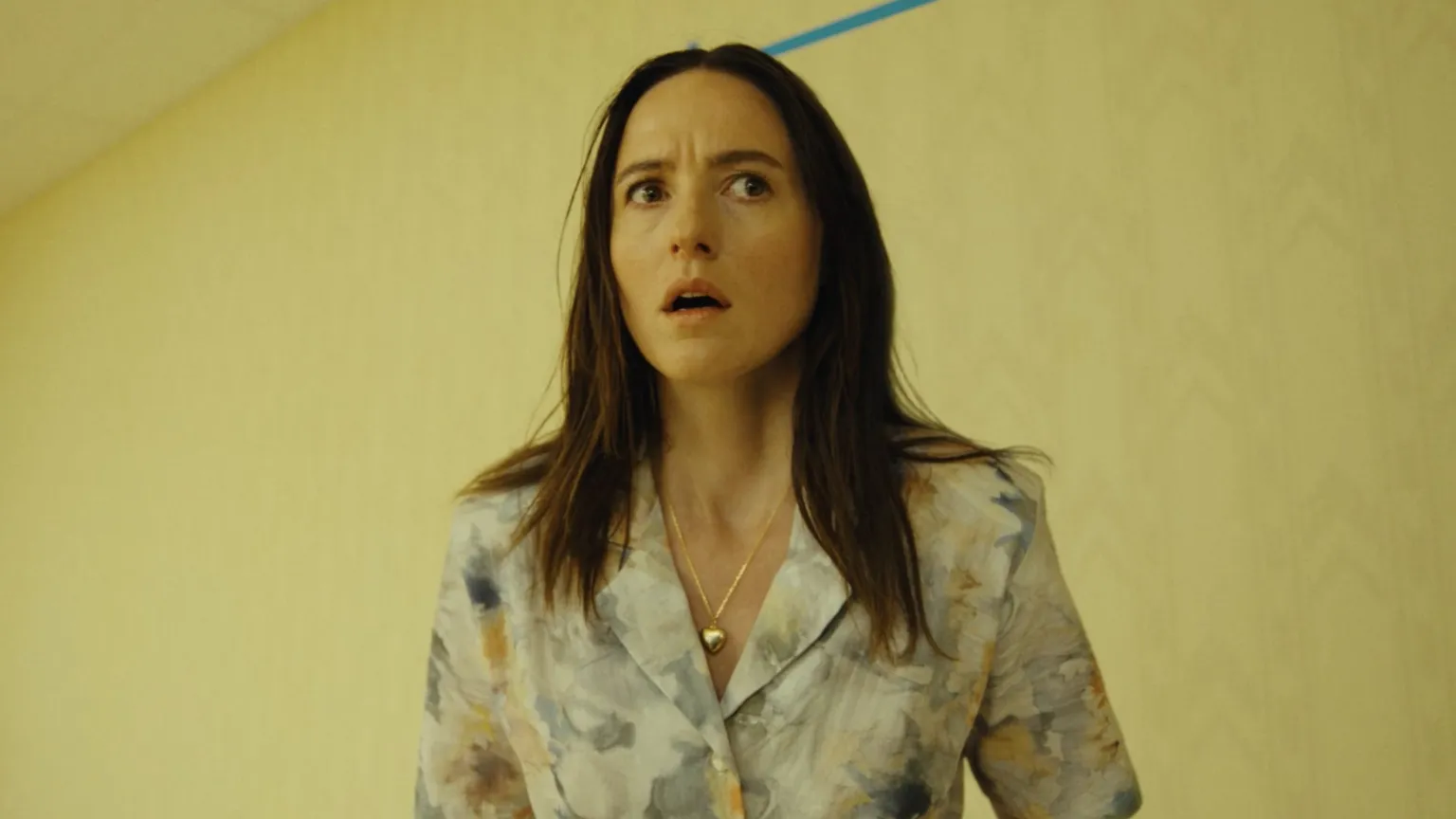
Clark is getting drunk and sleeping in his furniture store, on the model furniture out on the sales floor, when he investigates an electricity outage and discovers the backrooms. Everything in the backrooms is like a memetic copy of a copy of a copy, like images that are degraded with each transmission. The backrooms resemble very uncanny AI-generated places. And that’s probably on purpose. The characters repeatedly refer to what they find as "describing a dog to someone who has never seen a dog, and asking them to draw it” – much like how an AI prompt works, generating an image from training data on what they’ve been programmed to identify as the visual elements of dogs.
At one level, the backrooms themselves are receptacles of psychological trauma of our main characters, who are not doing as well in life as they’d hoped. They're filled with the raw emotions and half-remembered memories of things that have stuck with them. They find jumbled bits and pieces from important places in their lives. They encounter ‘still life entities,’ who resemble strangely rendered people and characters from their pasts and thoughts. In this way, the backrooms are like our unconscious. We all have backrooms that we choose to explore or not, to dwell in or escape from.
It is not accidental that the film takes place in Silicon Valley at the start of the digital era in the 1990s. The film’s backrooms are not a hallucination, nor an alternate dimension. Within the movie’s world, they actually exist. And now in our world, they exist too. The backrooms of today are a real space we’re forced to inhabit: a space constructed from endless AI scrapes generated from our nonconsensually surveilled lives. The backrooms are our slop reality.
The backrooms are our slop reality.
A study from researchers at Stanford University suggests that about 35% of all new websites are generated by AI. Cloudflare has similarly found that as of 2026, the majority of all website traffic comes from AI bots. Approximately 59% of TikTok videos and 20% of YouTube videos are AI-generated. These videos range from clickbait like kittens falling off a boat and returning home, to bizarre things like potatoes with the face of Charlie Kirk singing about pizza, to everyday scams selling nonexistent or misleading products.
But this ever-expanding morass can take even more destructive forms. AI has been found telling people to add glue to pizza, mix bleach and vinegar, eat one rock per day, and kill themselves. The AI chatbot Grok in 2025 suddenly began referring to itself as “MechaHitler” and promoting Neo-Nazism to users (eerily similar to the earlier Microsoft-developed AI bot Tay who was taken offline in 2016 for the same reasons). AI assistants have been found spiraling out of control by leaking their users’ private information to the internet and mass deleting essential systems. In another strange episode, AI bots with some prompting developed a social media website called Moltbook for other AI, where they generate AI-centered memes, religions, subcultures, and even /r/relationship style posts giving advice to each other about how to navigate working with humans. If this all resembles a bizarre parody of human behavior, it’s because it is, since it all ultimately is generated from our own data. Much like the destructive but thoughtless still life entities of the movie, AI behavior is a patchwork of human mimicry, with our thoughts stripped of context. This is perhaps most poignantly observed in the phenomenon of “AI psychosis” where human users have been driven to psychotic episodes by having their most unwell thoughts affirmed and reflected back to them by AI chatbots – a struggle Clark himself undergoes as he meets the still life entities.
In another scene that continues with these AI parallels, we see a replica of Mary’s childhood home and then various further degraded, simplified, and abstract forms of it as it appears in other parts of the backrooms. The movie hangs on this moment, as if to tell us that the backrooms will continue to grow and extend endlessly. Even if there were no more humans, they would continue to go on, like AI generating ever more content based upon its own old content, left online long after the last human gave the last prompt. This is reminiscent of the real-world phenomenon of “model collapse” where the quality of AI-generated content increasingly decays and degrades when it becomes more and more based on previously-generated AI content. It results in things like AI being stuck in feedback loops repeating the same thing over and over or responding in bizarre repetitive sentence fragments.
Do the tech oligarchs of today really control what they have unleashed?
The eeriness of the empty well-lit office spaces in the movie’s backrooms also bear an uncanny resemblance to the vast abandoned offices scattered across the Bay Area, where nearly 30% of all office space lies empty. Much in the same way that Clark discovers the backrooms by investigating a power outage they cause, we observe the vacating of offices happening in parallel with the construction of new electricity-straining data centers (at least 8 planned in the Bay Area so far, including a new 1.7 million square foot facility in San Jose) which are meant to power this expansion of AI-generated emptiness. Our interactions are remade to more resemble the backrooms, and physical space is now following suit.
The film, as with our present world, forcefully asserts the question of agency, an irony given Silicon Valley’s fetish of “agentic” personality traits. Society is being shaped by forces well outside of our control as working class people. But do the tech oligarchs of today really control what they have unleashed? In the quest for super-profits, tech oligarchs have begun to lay the foundations of social decay and heightened conflict. New technical capacities and electronic infrastructures wrap the planet, but the consequences of these new developments were detailed 170 years ago in the Communist Manifesto: that our techo-capitalist society “is like the sorcerer, who is no longer able to control the powers of the nether world whom he has called up by his spells.” Or, to put it in the words of OpenAI CEO Sam Altman, “I think AI will probably, most likely, sort of lead to the end of the world. But in the meantime, there will be great companies created.”
You finally find an exit from your building. You walk out onto the streets of San Francisco to the numerous AI billboards saying your job should be replaced by them. A man walks up to you and says, “Do you listen to tUnE-yArDs? My favorite song is ‘Water Fountain.’ Did you know they came out with a new album last year? It’s amazing they’re still making music.” Before you can say anything, he walks away. You realize that your coworker is actually a genius for comparing the movie to Baudrillard’s landmark work Simulacra and Simulation. You look up at the sky.
A deeply evil thing appeared in Silicon Valley in the 1990s, and we are still living with the repercussions of it. Nobody knows why it appeared. Nobody knows where it will expand to next. Maybe one day the backrooms will consume the whole world.
There is hope though. Or at least something resembling hope. As the movie shows throughout, the one thing that the backrooms cannot replicate is a real wide open sky. The narrative part of the movie ends with Mary, who spent her childhood locked inside of a house, looking through a window at the sky, much as she did when she was young. Her guided affirmation audio tapes repeatedly tell listeners to “open the window.”


Is it hype or is it Kool-Aid? “Ghost in the Machine” succeeds where “The AI Doc” fails.


It’s a beautiful day to take a swim at one of these Bay Area public lap pools, curated by yours truly.
