
AI Startup Launches Campaign To Exploit Humans, Ethically
Contrary to what Scale's 7-figure ad campaign claims, the company's ethos is anything but “centering humans.”
Contrary to what Scale's 7-figure ad campaign claims, the company's ethos is anything but “centering humans.”

In Against Tech Oligarchy, two leading labor organizers chronicle the past decade’s tech worker movement.
We spoke to one of the frontline union workers in the climate change fight.

Tech Billboard Decoder: Buzzy San Francisco-based startup Delve promises ‘AI-native compliance,’ turns out to be a house of cards.

Last fall, a company that sounds like it was named by ChatGPT started popping up all over San Francisco’s billboards, buses, and Muni stations:

Even in a city saturated with B2B slop, the ads were obnoxious enough to stand out. One ad featured a to-do list that started with ‘Drop out of Stanford,’ ‘Get into YC’ (referring to Y Combinator, a prestigious startup accelerator), ‘Raise $50m from a16z’ (referring to Andreessen Horowitz, a similarly prestigious venture capital firm), and then implicitly positioned Delve as the precursor before reaching ‘$100m ARR’ (referring to annual recurring revenue):

Other ads promised to get compliance “done” (a Delve branding keyword) at record speeds: “in days, not months;” “before your AI girlfriend breaks up with you;” “before your client’s lawyer throws a fit;” “before your parents know you dropped out of MIT;” and “before you even know what HIPAA stands for.”
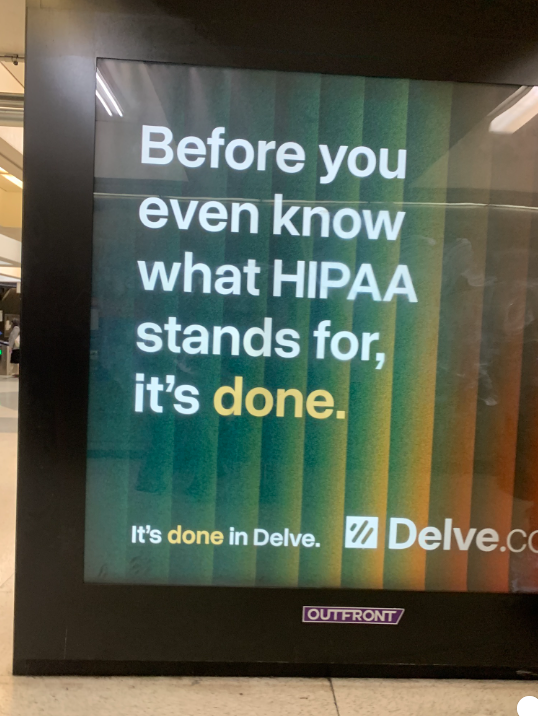
Here, ‘compliance’ refers to helping corporations comply with relevant regulations. It’s strictly a business-to-business matter, not a consumer product. Why, then, would the company invest in such an aggressive marketing campaign for such a niche product? Luckily, we needn’t wonder: Delve published a blog post explaining their billboard campaign in gory detail. They acknowledge trying to be “controversial,” citing positively the notorious “Still hiring humans?” campaign by AI company Bland, as well as the Friend.com subway ads that were quickly defaced. “Creating an identity is much better than being invisible,” they declare. A memorable campaign functions as a kind of social proof. From the blog post:
There’s a part of the human psyche that thinks “if this startup can afford this and pull it off, they must be legit.”
Total cost for Delve’s 2-3 month San Francisco campaign: $750,000.
So what drives a barely three-year-old company to spend three quarters of a million dollars on outdoor advertising in one city? In the case of Delve, it’s clear that over-the-top marketing to make themselves look like a big deal is a key part of their business model. Founded in 2023 by MIT dropouts who later made the Forbes 30 Under 30, the company went through Y Combinator’s Winter 2024 batch before raising a $3.3M seed round in early 2025, and then a $32M Series A less than a year later, at a valuation of $300M.
That would normally be a gigantic valuation for such a young company, but trajectories like Delve’s are commonplace in this new AI bubble. It helped that Delve was able to position itself as a key part of the ecosystem, pitching themselves as the go-to compliance solution for other fast-growing AI startups. “We built Delve to help secure the future of AI,” announced CEO Karun Kaushik on LinkedIn in 2025. In other words, Delve is a B2B software company that helps other B2B software companies meet specific regulatory standards of security and privacy that are useful to win contracts with their customers. For instance, a healthcare AI company might need to demonstrate HIPAA compliance before securing a software contract with a hospital. Or, a startup that provides AI call center software might need to demonstrate GDPR compliance in order to work with a European retailer.
Welcome to the insular economy: a phase of development where corporations are built by people who have never ventured beyond the AI startup bubble.
Regulatory compliance is a complex and somewhat arcane field. System and Organization Controls 2 (SOC 2), a popular U.S. standard for demonstrating secure management of customer data, usually takes between 3-12 months if done properly, and requires an audit from an independent accounting firm. To be clear, the slow and cumbersome nature of the process is by design; it takes time to do a thorough audit. Certifications are only meant to be issued to companies that can be trusted to follow the proper procedures. The ideal auditor is somewhat adversarial — think a health inspector at a restaurant.
That’s what compliance is supposed to be, in any case. Now, imagine being a founder of a fast-growing AI startup. You don’t care about compliance as such; it doesn’t matter to you that certain norms have developed as a way to ensure trust in an opaque corporate world. For you, compliance is little more than a box to check, a nuisance that the adult world has thrown at you to slow you down. You want to get your silly little certifications as soon as possible so you can focus on disrupting.
Spending one’s brief time on this mortal coil trying to convince companies to fire their customer support teams and replace them with AI voice agents is not the act of a grounded person, in touch with their humanity.
Enter Delve. Delve wants to “eliminate compliance busywork” with AI agents, resulting in an “agentic compliance experience.” They promise to get compliance done in days, with minimal effort. It’s not surprising that Delve has become the compliance solution of choice for buzzy AI-native startups, especially other Y Combinator companies, which often form the beachhead market for YC-backed products. Delve’s customer list is a veritable who’s who of B2B AI.
To name just a few: Greptile, a YC-backed AI code review platform founded in 2023 which raised $30m last year; Origami, an AI-powered spreadsheet for lead generation which is also YC-backed; Plivo, again YC-backed, maker of “conversational AI agents that answer calls with lifelike speech.” Conversion: an AI-powered marketing automation startup founded by UC Berkeley dropouts, which raised a $28m round last year. Lovable: a vibe-coding platform, “AI-driven”, founded in 2023 and now worth $6.6b after raising a $330m round. Wispr Flow: an AI dictation app which has raised $56m since 2021. Bland: another AI call center tool, YC-backed, with $65m raised since 2024.

To go through the list of Delve’s customers makes you feel like you are in a dream, or more accurately, a nightmare. All this money being poured into — what? Abstraction upon abstraction upon abstraction. These companies are so many levels removed from anything that might actually impact ordinary people, and the eventual impact is often negative: more frustrating customer service conversations, more annoying spam, more poorly-constructed apps. What real utility do they offer to the world, beyond a convenient excuse to enrich investors further?
So this is Delve: a three-year-old AI startup worth $300 million, sitting atop an ecosystem of other similarly overvalued and youthful AI startups, all promising to disrupt the world with their agentic bullshit. A decade ago, it felt like startups had to at least pretend that their products had some broader social value than merely enriching shareholders. Nowadays, nobody even bothers. An AI startup can raise millions of dollars without ever once suggesting a single positive social impact. The more intangible, the better.
The result is a tech boom even more disconnected from reality than previous ones. The AI companies that are being pumped up to astonishing valuations are, overwhelmingly, not solving for actual social needs.
Welcome to the insular economy: a phase of development where corporations are built by people who have never ventured beyond the AI startup bubble. No one even pretends to care about social impact anymore; it’s all about making as much money as possible, using whatever technology happens to be lying around. Spending one’s brief time on this mortal coil trying to convince companies to fire their customer support teams and replace them with AI voice agents is not the act of a grounded person, in touch with their humanity. It is an unintentional cry for help, the act of a person who has no principles to navigate by other than the brainless pursuit of wealth for its own sake.
In case you thought this couldn’t get worse: it turns out that rapid growth, AI hype, and seemingly endless cash make for a dangerous combination. Last month, fraud allegations surfaced, claiming that what Delve called ‘compliance’ was more like generating pre-filled audit reports, often rubber-stamped by India-based companies making half-hearted use of US mailing addresses. The catalyst: a Google spreadsheet accidentally leaked by a Delve employee which contained links to hundreds of audit reports, all suspiciously similar, even down to the typos. Customers were informed, in identical language, of their “incredibly high quality report.” For a while, private customer data was publicly visible.
While it is not unusual for an early-stage YC startup to be something of a Potemkin Village, the Delve allegations are extreme even by those standards. The screenshots suggest that there is little actual “AI” involved; instead, there are a bunch of forms that are manually filled out, and that will get reviewed (or not) by a Delve-friendly auditor firm. A tool that Delve allegedly claimed to be their own was actually an open source tool released by a fellow YC alumni, except with Delve’s branding slapped onto it. What Delve calls “agentic compliance” looks more like Temu for Compliance — shoddy, vaguely unreal, made as cheaply as possible.

The backlash was immediate. Social media was abuzz with scorn for Delve. Their biggest investor took down the webpage announcing their investment in Delve, then, maybe fearing the Streisand effect, brought it back up. Even Y Combinator distanced themselves, with Delve’s Chief Operating Officer announcing that they have ‘parted ways.’ Many Delve customers, including flagship clients Lovable, Wispr Flow, and Bland, released statements either claiming to have already changed vendors, or declaring their intent to switch.
Delve’s response was predictable. Initially, their “Response to Misleading Claims” tried to spin the allegations as a matter of jealousy: “given how competitive this industry is, attacks like this sadly come with the territory.” A few weeks later, though, they admitted that as they “moved quickly to scale,” they “fell short of the standard [they] hold [themselves] to,” offering complimentary re-audits and penetration tests to current customers. Still, they affirm that they are “not going anywhere.” The allegations are dismissed as a “coordinated, targeted cyberattack.”
However Delve tries to spin things, it’s not looking too good for them. Not long after the allegations surfaced, malware was discovered in an open-source software tool released by YC-backed LiteLLM. Who did their compliance? You guessed it — Delve.
A scandal like this generates distrust across a whole ecosystem: anything touched by Delve is suspect, and rightly so. Delve’s fall from grace is, of course, an indictment of Delve’s founders for choosing to take shortcuts, and of their investors for either encouraging or overlooking such behavior, and of their customers for choosing them despite the obvious red flags. But more than that, it’s an indictment of the prevailing entrepreneurial ethos. Delve is a predictable consequence of the YC mentality, with its fetishization of a ‘fake-it-til-you-make-it’ approach, and the elevation of ‘disruption’ for its own sake. Nothing is sacred, even regulations meant to protect workers or consumers. The ideal YC founder behaves like an entrepreneurial zombie: an unthinking entity, ambulating forward in the mindless pursuit of growth, even if it involves outright fraud.

Delve was not the first startup to fly too close to the sun. It won’t be the last, either. Next time you see a billboard for a startup whose founders are on the Forbes 30 Under 30, adjust your skepticism accordingly. Even if the startup happens to be doing exactly what it claims, skepticism might be warranted anyway; its financial success will likely come through making life worse for the rest of us.
Wendy Liu, author of Abolish Silicon Valley, explains what those weird tech billboards are really saying for Bay Area Current.

Contrary to what Scale's 7-figure ad campaign claims, the company's ethos is anything but “centering humans.”

In Against Tech Oligarchy, two leading labor organizers chronicle the past decade’s tech worker movement.

Putrid vibes reigned at SF billionaire-funded Hamilton Society debate.


Human feces isn’t even the nastiest thing they’ve found in the backseat.