


Film Review: ‘Wood Street’ (2026)
Caron Creighton's camera captures the vibrant and organized unhoused community of the Wood Street Commons in West Oakland, and the trials they must endure to fight for the right to survive in the face of a looming eviction.

A modified version of this review was published in Street Spirit’s April 2026 joint issue with Bay Area Current. Print copies of the newspaper are available at your local vendor.
Disclaimer: There may be light spoilers ahead if you have not seen the film.
A beat-up white pickup truck, with the message “Where Do We Go?” spray-painted onto its side, is crudely hoisted into the air by a forklift as highway patrol officers stand sentinel behind masks and sunglasses. A small army of contracted workers in hard hats and neon high-vis jackets pour through the frame. Underneath a highway in a West Oakland lot, an unhoused man shouts, “I’ve got three jobs! I can’t afford to go nowhere else! I work just like you!” More unhoused people shout impassioned slogans at a demolition crew, like “People deserve to live in freedom and in dignity!” and “Housing is a human right!” as others are arrested.
These brief flashes of conflict and protest comprise the chaotic overture that opens award-winning Bay Area journalist and filmmaker Caron Creighton’s new documentary Wood Street (2026). Frenetic free jazz percusses through these moments, shaping the scene: Oakland police are forcibly removing an unhoused community from their encampment in West Oakland. Time signatures in Tyler Blomstrom-Moore’s score switch up at a moment’s notice, and cymbals crash out of nowhere as if in ambush.
Leading up to this moment, much of the Wood Street community’s fight to remain has been similarly discomfiting. The unpredictable clamor of addiction, mental health crises, natural elemental forces, and betrayals from city officials have threatened to undo this community. For about a year of close documentation leading up to this battle, Creighton followed Wood Street with a camera. Amidst all the external disarray, what she found within them was…organization.
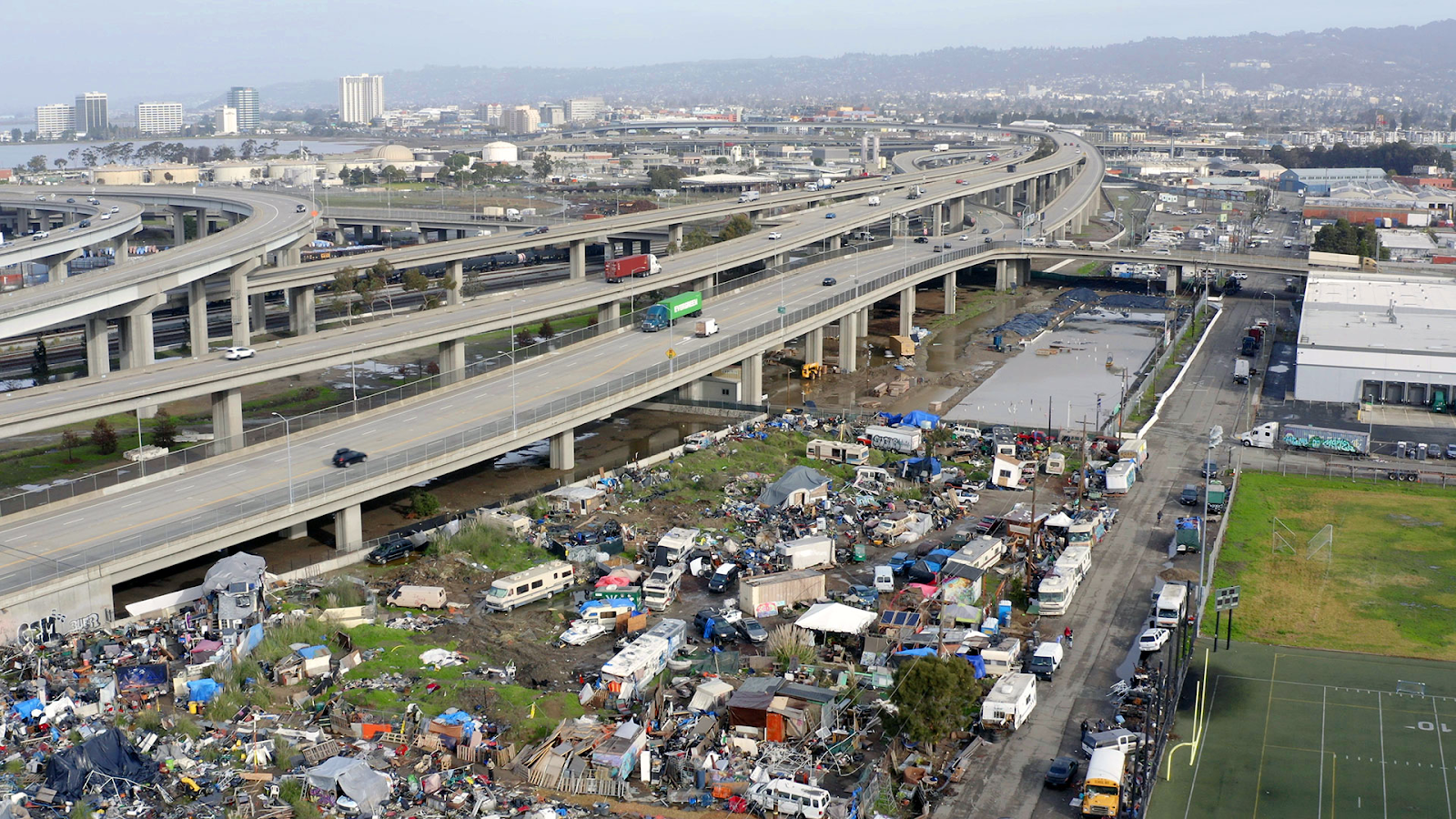
Context is provided to set the scene: the Wood Street encampment has grown into a community of 300 people over a decade; they were told to go there by police. However, one half of the encampment was swept in 2022, displacing over 100 people. Now, the other half of the encampment known as the Wood Street Commons also faces the threat of eviction.
Both John Janosko and LaMonté Ford, two unhoused Black men living at Wood Street, serve as leaders of the community and function as the film’s protagonists. They work within the Commons to manage the conflicts of the residents, interface with city officials, and liaise between those officials and the Wood Street residents. Both face a mountain of pressure in trying to advocate for themselves and the Commons, with a weary understanding of how the system works, or rather, doesn’t.
In a playful vertical video pulled from social media, John introduces himself to us “reporting live” from the Commons’ resource centers. Juicy crimson bell peppers and citrus fruits abound, sourced from donations from the outside community and food John has picked up from local businesses to share with his neighbors. A gumbo is prepared with fresh crab (“There go all the crab!”). Throughout the video, John introduces us to Lydia (“Yeah, that’s my girl right here!”), Jaz, Theo, Boots, Nova (a lovely little dog), and others. It’s hard not to smile witnessing the palpable love between everyone at the Commons.
With less than a year until their forced removal, the residents of Wood Street organize. John and LaMonté lead the community’s efforts to strategize with a lawyer that they’ve hired. One of their tactics is to send a diplomatic envoy to then-Mayor Sheng Thao’s inauguration celebration to get some face time with her.
“[We’ve got] a lot of problems here in Oakland, a lot of issues we can take care of. We have homelessness, public safety, and there’s one way of getting it done, and it’s the Oakland way. Unity, and community!” says Thao during her inauguration party speech. LaMonté and other Wood Street residents, decked out in dapper partywear, cheer with the crowd. In a front-facing video dispatch for social media, John remarks that they were able to briefly meet Thao and take pictures with her. “Hopefully sooner than later we’ll be in some great negotiations with the city, working side-by-side to figure out how to end homelessness in Oakland,” he says.
Later, LaMonté infectiously pops and locks to a remix of Bay Area legend E-40’s “Tell Me When to Go” on the dance floor at the party’s reception.
Seeking to follow up with the Mayor after a positive first encounter, the Wood Street residents attempt to schedule an audience with Mayor Sheng Thao at a later event in front of Oakland City Hall.
“Hold on, you see me,” says LaMonté as he sternly confronts a city official trying to avoid him and another Wood Street resident. Dressed in a blazer and jeans, LaMonté catches up to them, and they slow down. “Thank you, you quickened your step on me…I met [Thao] at the inauguration...My situation is kind of dastardly right now, we’re about to be due for eviction. The only thing that can save us is the mayor.”
They are never given a clear answer on when they can reach Thao, or if she will receive their message.
In a revealing encounter, representatives from the Oakland Community Homelessness Services take a meeting with members of the Wood Street Commons on an empty lot on the north end of Wood Street. The city plans to build a transitional shelter for encampment residents on the northern half of Wood Street.
The only options that the City of Oakland have offered them once they are evicted, are to either: move into minuscule temporary (max two years) housing cabins run by local nonprofit shelter operator Building Opportunities for Self-Sufficiency (BOSS), or fend for themselves somewhere else. There is no path forward outside of these two options, other than hope they might be able to move into a new, 170-unit “affordable housing” apartment building that will be constructed on the Wood Street lot.
The social workers unveil their grand plan for the lot to the Wood Street residents, and it quickly becomes clear that the presentation should rather have been a discussion. What is presented as an empowering path forward feels more like handcuffs, and not even golden ones. Wood Street residents scoff at the temporary residence project, likening it to “submitting yourself to incarceration” and an experience wherein “you might as well go to jail.” John later explains, “We gotta have plans that show greenery, life growing...like we grow.”
When public dumpsters are mentioned as a feature to these cabins, it’s met with a mixture of relief from some, and extreme frustration from others. The Wood Street residents have already asked the city to send a cleaning service that they will pay for themselves to manage their waste countless times, to no avail. The mounting trash has been a safety hazard for years, and Wood Street’s residents have felt the misdirected anger from their housed neighbors. The message is loud and clear: the city will provide you with the fundamentals necessary for your survival, but only on their own terms, and in service of an eventual profit-driven housing enterprise that is out of your rental budget to begin with.
“We’re supposed to be grateful for something that we didn’t even ask for, and quite frankly don’t want,” explains Wood Street resident Freeway. Xochitl, an advocate on the scene, adds, “Make them part of it. These are the experts. The people that are most impacted are the experts on how to solve these issues.”
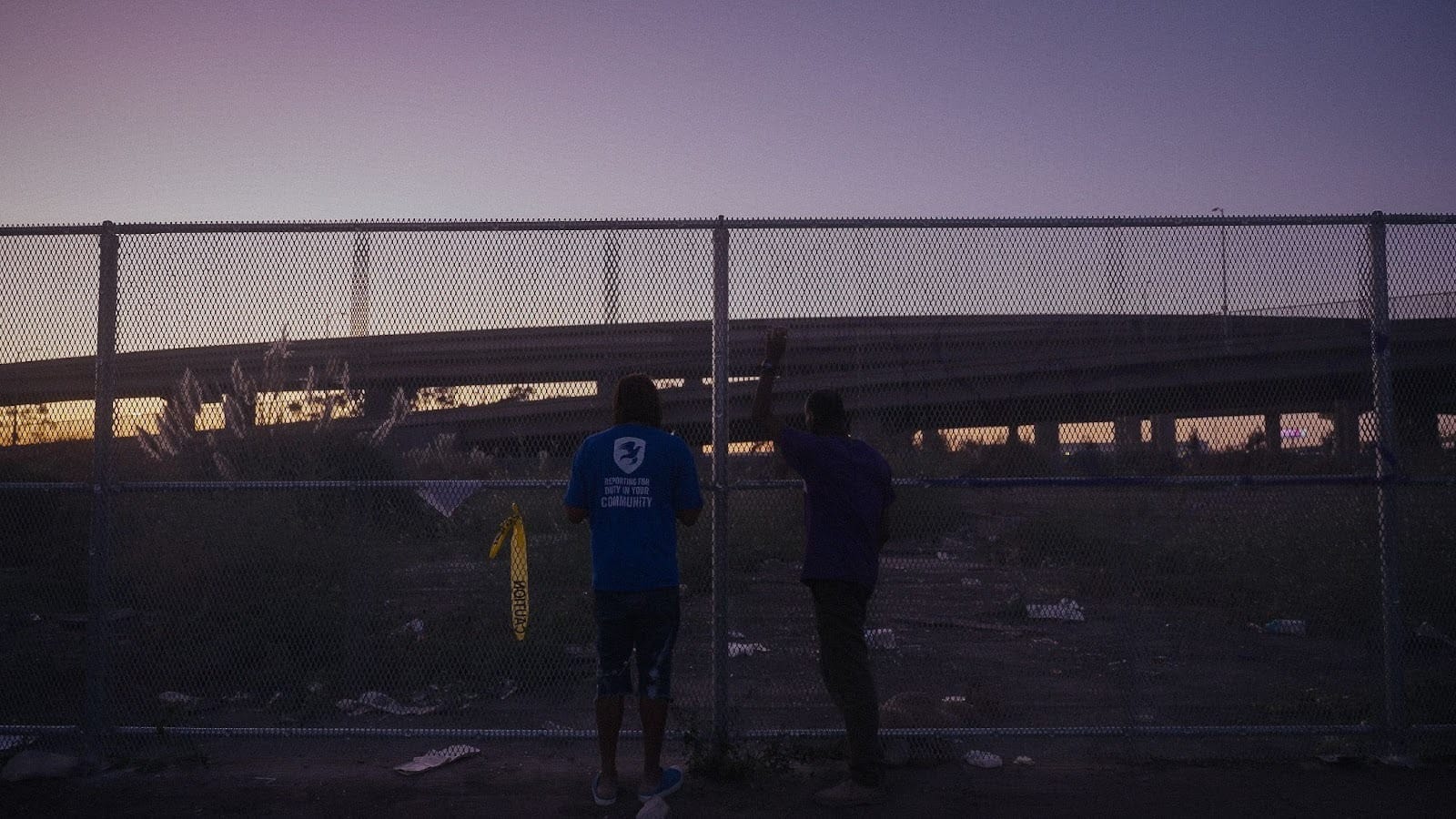
While the Wood Street community is an impressively united front, there are still some loose threads that need figuring out. Some of which include: how much of the temporary housing plan is worth salvaging? How much trust should they ultimately give to Oakland Community Homelessness Services, BOSS, then-mayor Sheng Thao?
More questions emerge from this ambiguity: What makes a community? In a passionate discussion about the meaning of Wood Street to themselves and their found family, John and LaMonté trade their interpretations.
“This lot...this fucking piece of land...doesn’t make us. It doesn’t make our community, doesn’t do shit for us. We make our community, so wherever the fuck we go, we’re gonna make it.”
LaMonté sees it differently. “This place has made me. This place has held me, comforted me, kept me out of jail, kept me alive...this place,” he replies.
Ultimately, temporary solutions like moving the Wood Street residents from place to place will not abate their homelessness, it’ll just continue their cycle of displacement over and over again.
J. Jonah, a resident of the encampment, explains how he was born and raised on Wood Street—on 11th Street between Wood and Willow—and has lived there for all 46 years of his life.
“Removing people that’s been here for years, giving them no adequate place to go or stay...
"I do have a right to live, even though I don’t have much money,” he says. “I do have a right to be somewhere...Life, liberty, and the pursuit of happiness, that’s what they say.”
From Wood Street’s point of view, the police already told them to go there. Whether the city likes it or not, they have created a dynamic community of unhoused people that have built systems, resources, and family there with what little they have. There is literal history there, spanning decades. It begs the question: why scatter and snuff out a complex network of relationships and memories, instead of preserving the community in a way that benefits the unhoused?
By forcibly removing the Wood Street residents from their neighborhood and planning a housing complex, the city is essentially taking money that they could use to house the unhoused, and instead kicking off a new community of people that are not unhoused and can already pay for housing. How could the sub-affordable housing community of Wood Street not take this as intent to erase them?
Like any assemblage of activists, there are competing ideologies, and things do get messy over the course of the film. But Wood Street embodies a remarkable calm and resilience as the eviction gets closer, and is able to reset and continue working together even when disagreements get loud. Creighton smartly shows how this tension can be productive—their shared perspectives and experiences can build into incrementally clearer understandings of what they can and can’t accept to live with a sense of dignity and security. A plan that doesn’t acknowledge their concerns will almost certainly lead to them being back on the street.
The eviction day arrives.
LaMonté starts a conversation with a city official on-site. “Are you a decision-maker?”
The official’s suit, tie, and sunglasses make him stand out like a sore thumb in the sun. “Uhhh, I’m...what would you like to hear?”
“The truth,” LaMonté answers.
The official prevaricates, but LaMonté persists. An extremely vulnerable and tense exchange ensues. LaMonté’s civil, but firm attempt to have a clear-eyed conversation with the decision-maker in charge of his life is met with, “Thank you, I need to run.” You never see his eyes through his shades.
As the apocryphal quote goes, the true measure of any society can be found in how it treats its most vulnerable members. Opting to show the ugliness of an encampment sweep up close and personal, Creighton foregrounds the living, breathing effect of forced displacement with uncomfortable intimacy.
Dramatic drum fills and anxious hi-hats return to soundtrack the city’s destruction of the encampment. Cranes lift residents’ belongings out of their reach. LaMonté cries.
Watching this movie feels like listening in on a secret that the state would rather we all, housed and unhoused alike, not think about: The decision-makers that call the shots of our shared livelihood do have the power and the resources to listen and enact meaningful, life-changing policy that could actually make a difference in our material lives. They often just...decide not to. Easier to just paint the unhoused population with awful dehumanizing stereotypes, insist that they don’t have agency, pass violent legislation that criminalizes their existence, and push them deeper into dangerous environments that lead to their incarceration or death.
None of Wood Street’s city officials seem to anticipate an organized unhoused community with reasonable demands, and all of them fail to step up to the challenge in varying degrees.
It is tempting to walk away from this documentary with the takeaway that it affectingly “humanizes the homeless.” It does do that well, after all. However, in 2026 we shouldn’t need a documentary to understand this. What Wood Street offers that is novel, is a close look at the strategy and organization that is possible within unhoused communities, and seldom shown at this scale. Even more fascinating, it shows an unhoused community with a more impressive imagination for brighter collaborative futures than their public leaders.
The residents of Wood Street are organized. They are activists, advocating for themselves and for anyone who might find themselves in a similar situation. To live in harmony in a neighborhood, you need neighbors that will work with you. Watching Wood Street, it’s difficult to reckon with the clear effort the unhoused make to collaborate productively to find solutions, only for their elected representation to play over them.
Follow Bay Area Current on Letterboxd.
Read next


Breaking News: Seniors in Affordable Housing Say No to Retaliation from Management, Hit the Picket Line and Win
The majority Chinese-speaking tenants at a downtown Oakland building organized to fix hot water, broken doors, and lack of security. Management’s response: shut down their community room.

Beware the Genre of Criti-Hype: Two Documentaries about AI
Is it hype or is it Kool-Aid? “Ghost in the Machine” succeeds where “The AI Doc” fails.
