
Bay Area Workers Fight Bosses For First Union Contracts
Hundreds of workers have unionized—but will they be able to secure wins for the long-term?
Hundreds of workers have unionized—but will they be able to secure wins for the long-term?
The company’s Integrated Behavioral Health Services workers hold one-day strike against AI.

Wallace Shawn’s ironic polemic against class society takes audiences on a psychic and physical journey after dark.
The strike follows almost a full year of negotiations and a last-ditch prevention effort by the city’s mayor, Daniel Lurie. We hear from teachers, students, and supporters from across the city.

On Monday morning, thousands of San Francisco Unified School District students and faculty walked picket lines during what is usually “first period,” marking the beginning of the first strike in almost 50 years for the city’s educators.
The strike follows eleven months of negotiations between members of the United Educators of San Francisco (UESF), representing over 6,000 educators across 100 San Francisco schools, and the San Francisco Unified School District (SFUSD).
The union – which, beyond teachers, includes counselors, school psychologists and social workers – is demanding a 9% wage increase over two years and health coverage for dependents as well as better pay and conditions for special education teachers.
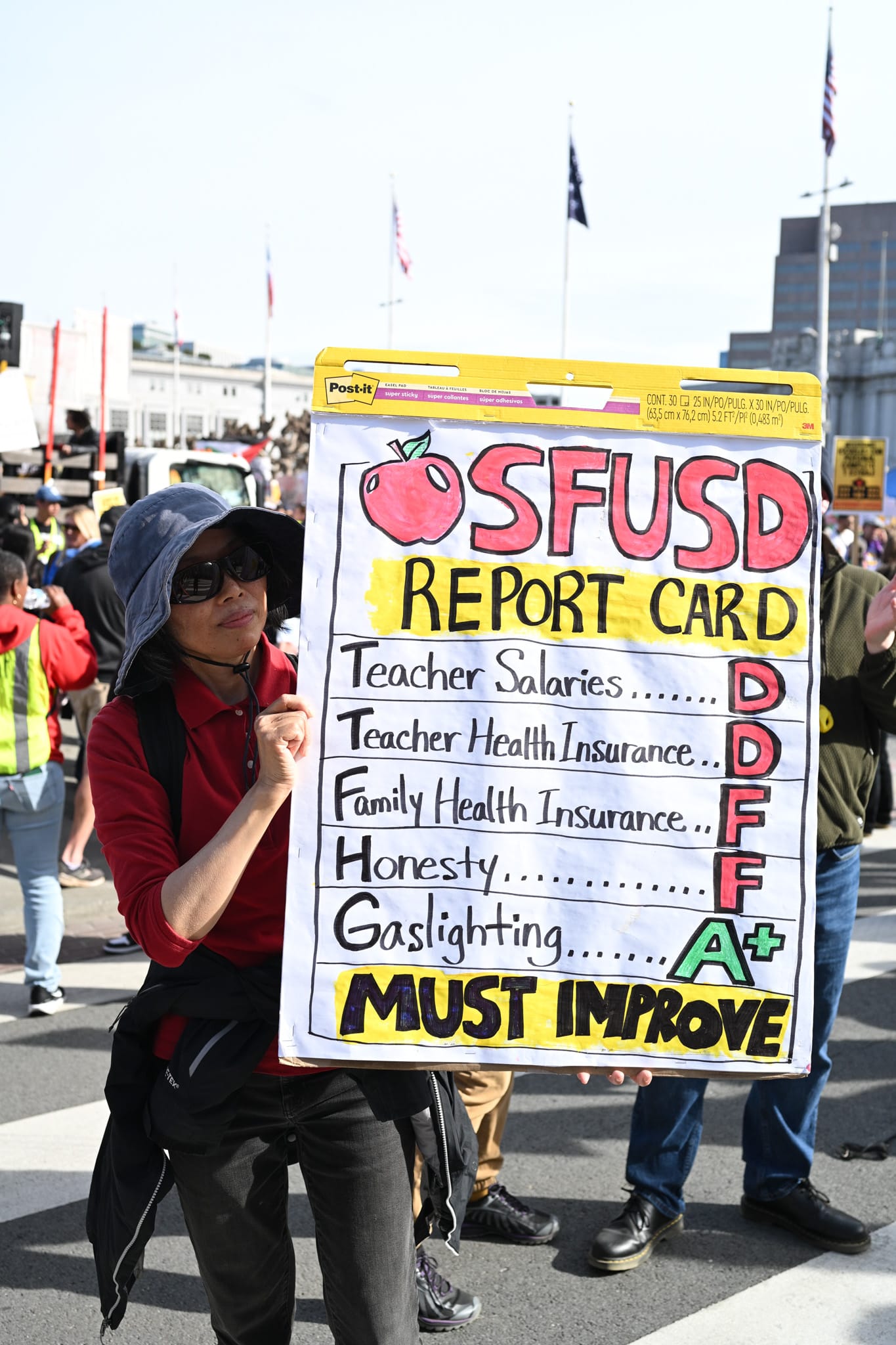
UESF says that members pay up to fifteen hundred dollars a month out of pocket for dependent health coverage – around 40% of the paycheck of the lowest-earning crucial support staff. This, coupled with San Francisco’s cost of living, has forced UESF members to seek work in neighboring districts.
“Two years ago, the workload was so difficult that I was looking to move to another school district,” explained Nadia Mufti, an English teacher for over 10 years and the English Department Chair at Mission High School. “The thing that kept me here was the students. It wasn’t the district. The district doesn’t have much to offer but our students do, and that’s why we’re fighting for them today.”
After almost a full year of negotiations, educators say that a strike was the only possible next step.
“We don’t want to be striking,” Mufti emphasized. “We want to be in the classroom with students, and we really feel like we’ve been forced by the district to shut down schools because they’re not hearing us. They’re not hearing the needs of our students. They’re not hearing the needs of their employees. So, we really feel like we have no other options but to strike.”
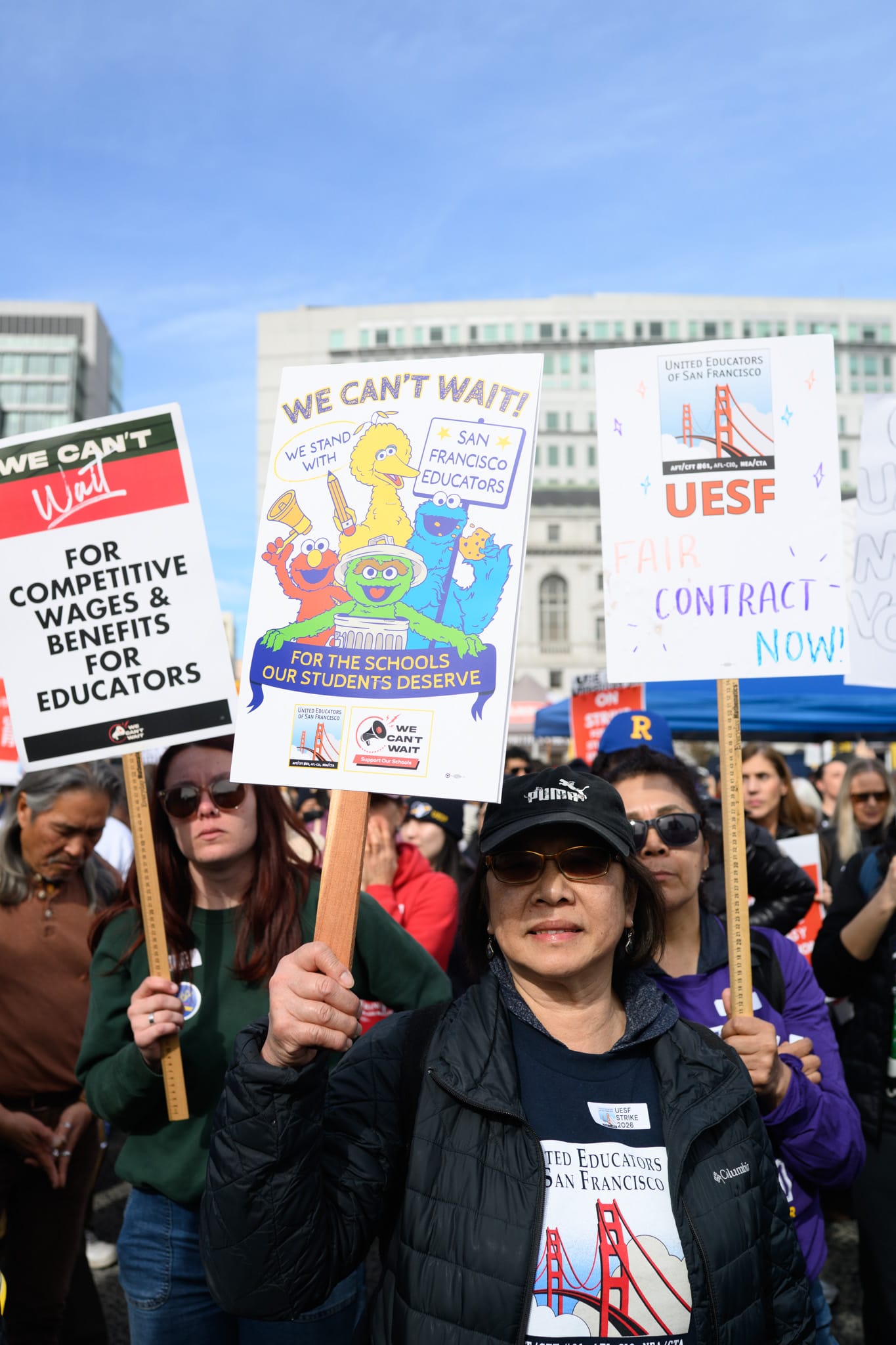
At Mufti’s own Mission High School, last year was the first year since before the pandemic that there was a fully-staffed English department.
On top of the educators, more than 200 members of the United Administrators of San Francisco (UASF) – which include principals, administrators, and department supervisors – went on sympathy strike today in support of the educators.
“[Staffing levels are] an equity issue for our students because we lose the most teachers from the hardest-to-staff schools, which serve the most struggling families. When you have that kind of turnover, you never get a foothold on your programming and education and everything you need to do to run a good school,” noted Mark Sanchez, the principal at Harvey Milk Civil Rights Academy, an elementary school in the Castro neighborhood. Sanchez is also a member of the UASF. “We lose around 300-500 credentialed teachers every year. For that reason alone we should be offering an equitable wage for everybody – to keep everybody in the classroom doing their jobs.”
SFUSD custodians and clerks of the Service Employees International Union (SEIU), also went on a sympathy strike Monday.
“Everyone – given the opportunity– everyone walked out the door,” said Josh Davidson, a chef for the school district for the last 16 years and a member of SEIU. “That is not a good sign for how they’re managing the schools. We’re all here standing together because we all agree about what needs to happen. The people who don’t agree are still in the office buildings trying to figure out how to talk to us, but they don’t even know how to listen to us yet.”
“SFUSD has been around for 170 years. We were able to fully staff the schools in the Depression. We were able to fully staff the schools in the 19th century. Somehow we can’t do it today, and I don’t think that’s on me as a cook. I don’t think that’s on an individual teacher in the classroom. I think it’s a system problem and the people in charge of the system have to get it fixed.”
The strike did not come without pushback.
San Francisco school Superintendent Dr. Maria Su, as well as Mayor Daniel Lurie, and lawmaker Nancy Pelosi, urged the union to come to an agreement by Sunday, with Lurie and Pelosi even pleading for a three day delay to the strike.
This request did not sway UESF, whose members showed up in numbers on Monday morning to picket schools and later that afternoon for a rally at San Francisco City Hall, which was attended by thousands.
“Some of these people have the chutzpah to ask you to wait three days,” said David Goldberg, the president of the California Teachers Association and a speaker at the rally. “You’ve been waiting 50 years! Decades of disinvestment.”
It’s not just the educators who have felt disillusioned by the district — it’s students, too.
“It’s not fair that people like Maria Su are getting paid 380,000 dollars a year, and our teachers are – honestly some of them are on the poverty line, below the poverty line,” said Helene Smolenski, a senior at Ruth Asawa School of the Arts. “I’m out here supporting my teachers and I’m also standing against the billionaires and millionaires who run our city, who have the funding to give the money to our teachers but are choosing not to do it.”
Superintendent Su’s salary is in fact $385,000 a year and could increase by 2% after the first year of her term.
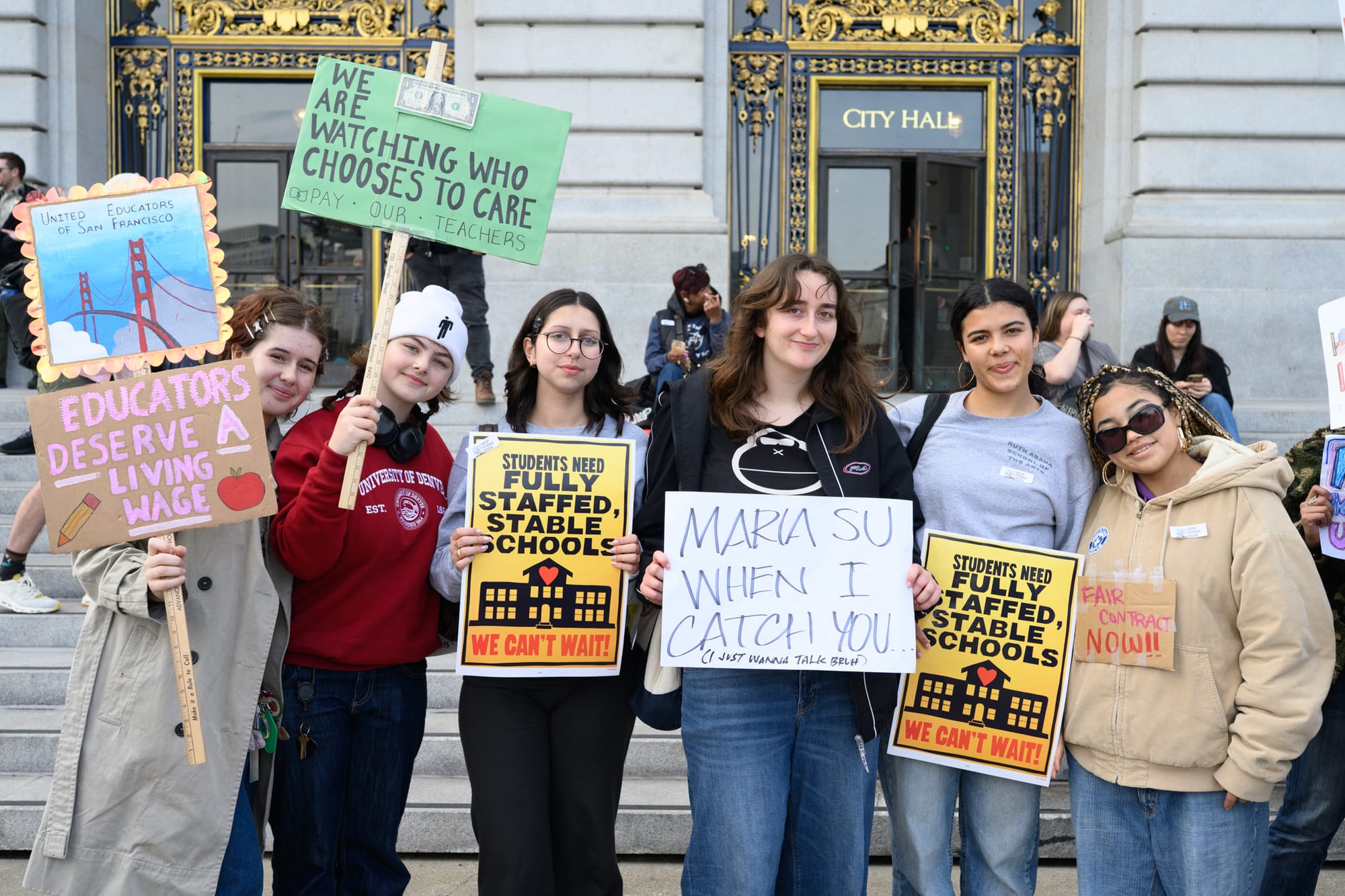
Many students were also joined by their parents at the picket lines and rally on Monday.
Lisa Gonzalez, a parent at Glen Park Elementary and an educator at San Francisco Community School, showed up with her daughter to UESF’s rally. When asked why she chose to attend the rally, Gonzalez responded, “I believe that this is the best education I can offer my daughter because this is me walking my talk [...] If our teachers can’t live, how is that going to make them able to do their best work?” Gonzalez explained. “These kids are the future so it should matter to everybody.”
This past weekend involved tense, last-minute negotiation sessions where only non-monetary progress was made, including making San Francisco a "sanctuary district.” However, the union’s key demands continue to be rejected.
“[The strike] is disruptive and that’s the point!” urged Kevin Bess, a parent and PTA Secretary at Paul Revere, a K-8 school in Bernal Heights.

Hundreds of workers have unionized—but will they be able to secure wins for the long-term?

The company’s Integrated Behavioral Health Services workers hold one-day strike against AI.

Today marks *twenty four* calendar days since seven Highwire workers have been laid off by the company in a move workers deem to be anti-union retaliation. However, the workers are far from dissuaded, and the fight is far from over.

Dublin Teachers Association secures class size caps, raises, and health care in tentative agreement.