
This Nonprofit Promised Housing but Left Tenants Homeless Instead
Tenants fight back and plan for the worst: “We’re trying to see where to go for the holidays.”
Tenants fight back and plan for the worst: “We’re trying to see where to go for the holidays.”
When management neglected their building, elderly, majority-Chinese tenants in Downtown Oakland got organized and fought back.
The Community College of San Francisco is closing its downtown campus while the Mayor’s Office touts elite university expansion into the neighborhood to boost property values.

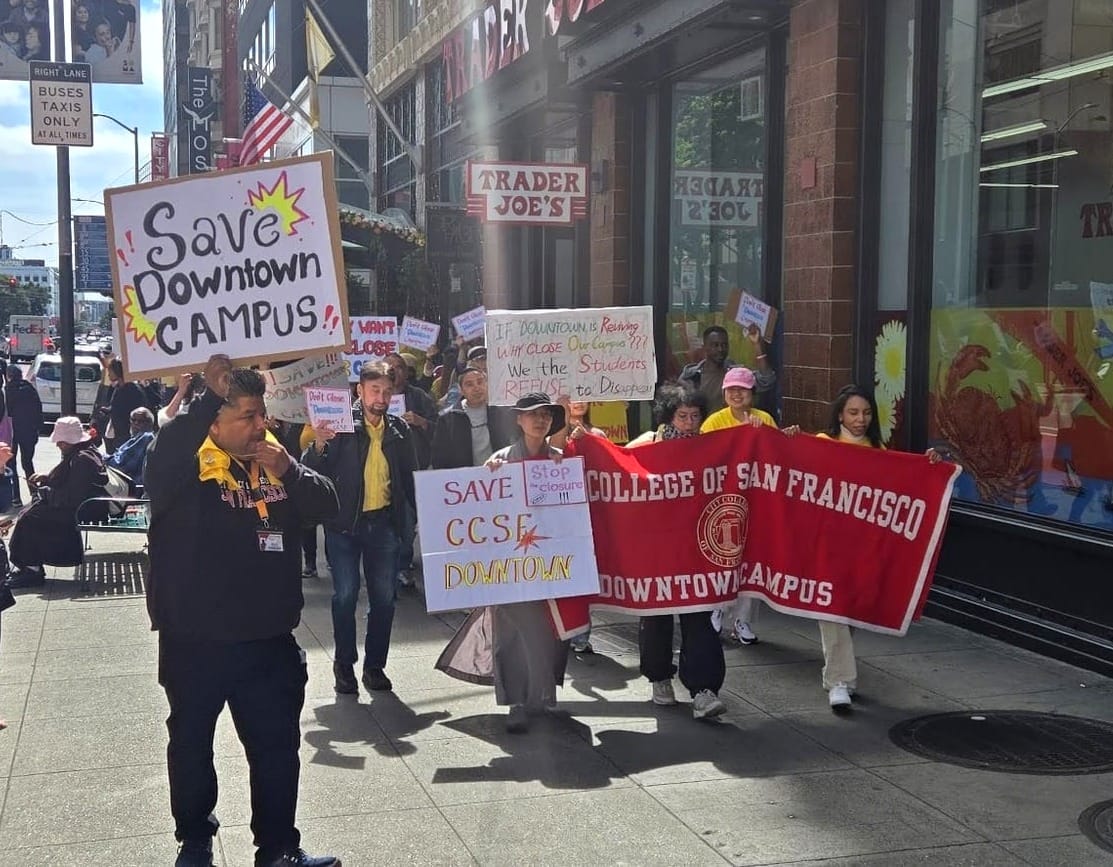
On the morning of April 9, chants of “don’t back down, save downtown” could be heard over the usual buzz of commuting on Market Street and 4th in San Francisco. About 100 people carrying placards filed out of the downtown campus building of the City College of San Francisco (CCSF) with signs that read “Don’t close our future,” and another, “Don’t close downtown, our hope.” The protestors were marching in response to the announcement a month earlier that CCSF would indefinitely close their downtown center for classes beginning in the fall 2026 semester, citing enrollment numbers that do not make up for the cost of maintaining the building. The current course schedule shows there are no classes currently offered at the downtown campus.
While CCSF students are left without their local campus, wealthy private universities like Vanderbilt University and the University of Pennsylvania are expanding into downtown San Francisco. The office of Mayor Daniel Lurie has actively attracted and supported these moves over the past year. His plan to bring universities and students to downtown does not, it seems, extend to CCSF and the working-class students who depend on it.
The median family income of students at CCSF is one fourth that of students at Vanderbilt, Yale or the University of Pennsylvania.
Guilherme Albino, one of many students who studies English as a second language (ESL) at CCSF downtown, explains that while “some people see downtown as a bad place,” he lives close to campus. “It’s easy to get to work.” Milana Bezborodova, who moved to the city from Ukraine, described what’s unique about the campus: “they can’t close downtown because it’s such an international community.” Because immigrants come there from so many places, she explained, “we speak with each other only in English.”
The administration of CCSF insists that financial conditions beyond their control have made it untenable to keep classes at the downtown campus. Chancellor Kimberlee Messina’s presentation to the Board of Trustees on May 28 showed over $9.5 million in deferred maintenance costs for the building. The campus, meanwhile, is set to lose $2.2 million in direct state funding for failing to provide sufficient credit hours to enrolled students.
Faculty at the downtown campus argue that it is lack of institutional support, not lack of student demand, that’s driving down enrollment. Daniel Halford, an instructor of English as a Second Language (ESL) at CCSF since 2006, told me that “Teachers who’ve been here say that with new classes, they fill up immediately.”
The union for CCSF faculty, AFT 2121, showed in documents sent to the administration that the 75 percent enrollment decline over the last ten years was likely caused by a corresponding 86 percent cut in the number of classes, and pushed the district to provide any evidence that low student demand was a factor.
The long-term future of the campus is not yet settled. At the trustees meeting in May, Chancellor Messina laid out three options: partner with “educational institutions, community-based organizations, or industry/workforce partners” to keep the space open, lease the campus to other occupants, or sell the building.
Among the potential partners that Messina mentioned were supervisors and city officials that she said had met with CCSF administration. However, it’s not clear whom the University has met and whether they have pursued this option. Messina’s office did not respond when asked to give more detail on whom they had contacted. Matt Dorsey, the Supervisor for the district where the campus is located, had not met with representatives from CCSF as of early June, his office said.
Notably, the Mayor’s office and Supervisor Dorsey have both touted universities as engines for the “revival” of a downtown that was recently an epicenter of doom-loop narratives about San Francisco. Lurie has made attracting new universities into downtown a goal of his “Heart of the City” directive that he announced in September.
According to reporting from the Chronicle, existing downtown universities have lobbied the mayor’s office to focus support for the students and institutions, like CCSF, that are struggling to stay in the area. Mia Nguyen-Rusali, the former dean of City College’s downtown center, posed the question in 2024, when former Mayor London Breed was also trying to draw in new universities: “Why invest in something new when you already have something existing?”
One answer can be found in Lurie’s directive, which sets a policy to “prioritize development projects that make downtown’s office stock more appealing.” Of this plan opponents are asking: appealing to who? Lurie’s office did not respond to questions about any plans to support CCSF downtown.
While CCSF and Golden Gate University — which has served mostly part-time commuting students for over a century — downsize their presence downtown, the mayor’s office has succeeded in encouraging well-endowed universities based outside the area to move in.
Lurie has touted his support for Vanderbilt’s acquisition of the California College of the Arts campus in Potrero Hill in January, and he met with the Chancellor more than once in the process. He and Dorsey welcomed the Third Coast Foundry, a consortium of midwestern research universities that includes the University of Chicago and Carnegie Mellon University, which moved into a building downtown in March. City officials invited leaders from Yale University to tour potential sites for a satellite campus the same month.
The Wharton School of Business at the University of Pennsylvania also announced plans to expand its presence in a new building in the neighborhood in October.
These wealthy universities are drawn by the physical proximity to venture capital and the promise of connections to AI companies. The Third Coast Foundry, according to its press release, will be “a shared space where founders could meet investors and partners in person.” Vanderbilt’s chancellor cites AI as an attracting force, and Wharton started an AI-focused MBA program this past year now open to students at its new Financial District campus. Jensen Huang, the Nvidia founder whose fortune comes from the chips that power the AI boom, donated $75 million to Vanderbilt’s new campus — enough to have a college named for him and his wife.
Behind several of these partnerships is Ned Segal, the mayor’s chief of housing and economic development — a position created specifically for him. The former Twitter executive has brokered the meetings with Vanderbilt and Yale, and extolls the central role of public-private partnerships in his project to remake downtown SF.
Segal painted a picture of what he wanted a revitalized downtown to look like at a real estate conference in April 2025, where students “with a university name across their shirts” would shop at downtown businesses and drive new construction.
Private universities like Vanderbilt and Yale have endowments in the tens of billions of dollars to fund new construction. Meanwhile, the median family income of students at CCSF is one fourth that of students at Vanderbilt, Yale or the University of Pennsylvania, according to New York Times college mobility data. This asymmetry could fuel ongoing gentrification in an already expensive SF.
Lurie’s most recent budget proposal makes clear that his office sees CCSF students as less an investment and more an expense. His initial proposal would have cut $3 million from a program that subsidizes cost of living and transit expenses for CCSF students. After public pushback, the final budget approved by supervisors restored the financial support.
Space like CCSF’s downtown campus is valuable to better endowed universities because it’s close to potential investors and the center of the AI boom. Without support, which is so far not forthcoming, the building could be up for sale. The students who stand to lose the most understand the stakes. Milana Bezborodova, who has been studying at CCSF downtown for a year, wondered at the building’s future: “Who can afford it? Only big businesses.”

When management neglected their building, elderly, majority-Chinese tenants in Downtown Oakland got organized and fought back.

Despite public outcry, Oakland City Council decided to approve the new cop contract and reappoint police commission chair.

In a city dripping with cash, San Francisco can’t get its kids to school.


Ten picketers were arrested on July 21st during the strike at C&H Sugar. Their charges can be filed at any time within the next year.

