
Highwire Coffee Roasters’ Union Says Management Stalling On First Contract
Management has also hired an infamous anti-union law firm
Management has also hired an infamous anti-union law firm
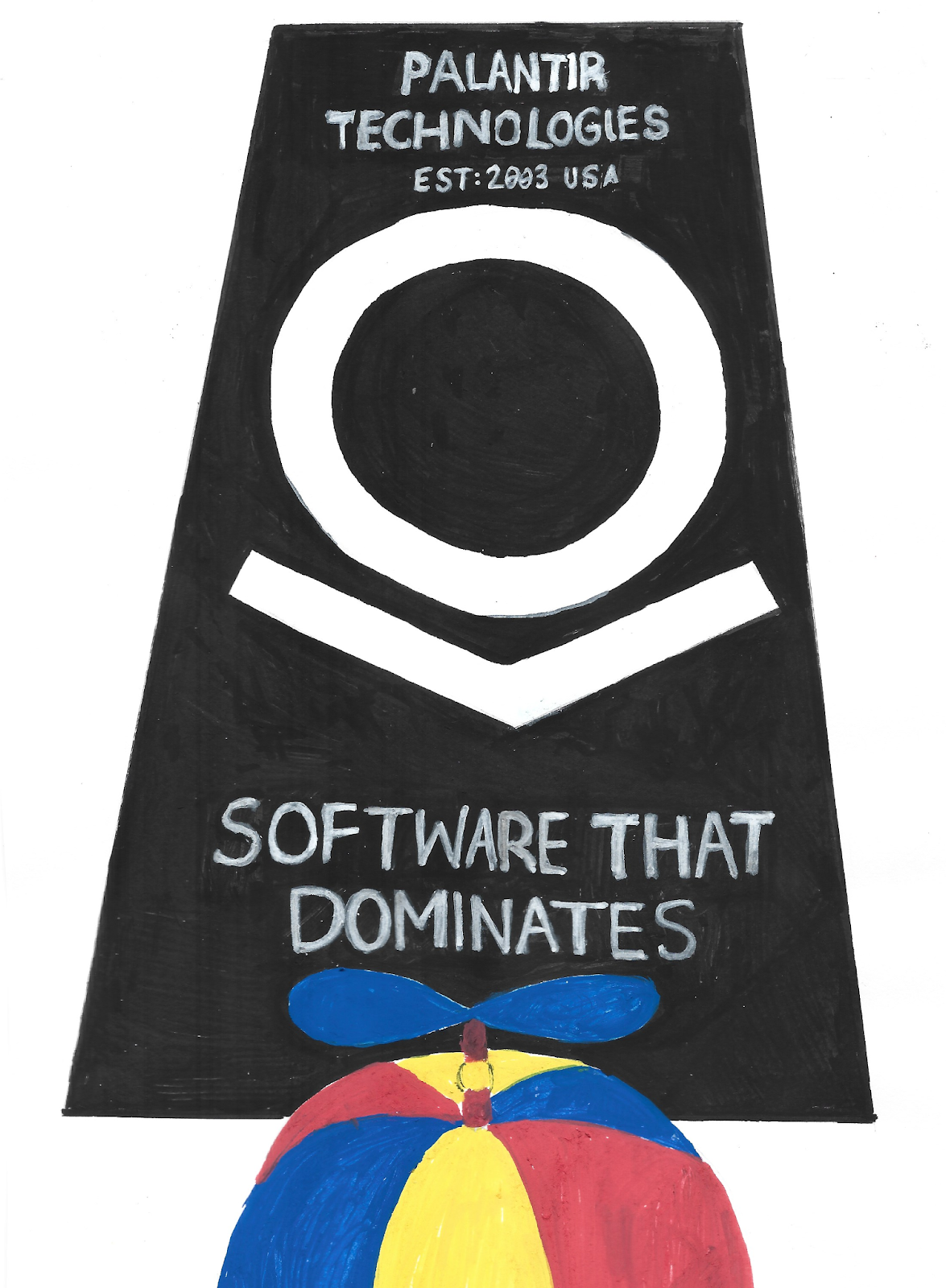
Tech companies used to portray themselves as do-gooders. But as Palantir's new billboard suggests, their commitment to domination was there all along.


You have arrived at the airport at the crack of dawn. Bleary-eyed and only semi-conscious, you rush towards your gate. Suddenly you’re met with an enormous ad: PALANTIR TECHNOLOGIES. SOFTWARE THAT DOMINATES. There’s a giant abstract logo, which looks like an orb hovering ominously on top of an open book. You were about to embark upon an airplane trip but now you have found yourself on a trip of another kind. And it’s a bad one.
Such was the experience that awaited travelers at San Francisco International Airport this summer. Located in Harvey Milk Terminal 1, across the way from an outpost of Green Apple Books, this massive display ad loomed menacingly over passengers waiting in line for the lounge or walking to the Ritual Coffee. Welcome to San Francisco: we have books, coffee, and domination.
It’s a strange ad, but it makes more sense once you understand Palantir. Despite having a market cap of over $400 billion at time of publication— only a little less than Netflix, and twice that of Uber — Palantir isn't a household name, mainly because it isn’t consumer-facing. It was founded in 2003 by Peter Thiel, whose previous company, PayPal, had just gone public, providing him with ample startup capital. But where PayPal’s product was for consumers, Palantir's product was targeted at organizations, primarily government agencies and corporations. What the software actually does is notoriously hard to pin down — even former employees struggle to explain it concisely — but it basically involves centralizing an organization’s internal data in order to draw insights. Thiel’s original vision involved adapting PayPal’s fraud recognition system for counterterrorism purposes: “I defined the problem as needing to reduce terrorism while preserving civil liberties,” Thiel said to Forbes in 2013.
So what exactly is Palantir dominating? In theory, they are dominating the bad guys. The name Palantir comes from the Lord of the Rings trilogy, in which a ‘palantir’ is a crystal ball used for scrying and divination made by elves. From the name alone you get a glimpse of a whole worldview: the gentle, noble, and conveniently Aryan-looking elves versus the savage orcs who threaten to upset the social order.
Palantir the company, then, is surveillance software to help the good guys protect themselves from the bad guys. At least, that’s the theory. In practice, it is murkier. In a world that is becoming increasingly unequal and militarized, where the definition of terrorism has seemingly expanded to include antifascists and immigrants, Palantir’s software ultimately emboldens a repressive right-wing regime. Their founding mission is explicitly centered on ‘defending the west’. It’s been criticized for its work with the military, with ICE, with the LAPD, and the IDF. Who, exactly, are the bad guys here?
Let’s go back to the airport ad. What’s curious about this ad is that it says nothing about the actual technology; instead, it’s purely a flex, establishing the company as a lifestyle brand with a sharp edge. Palantir has long been associated with a particularly masculinist strain within the tech industry, one which fetishizes defense tech and espouses conservative values. The subtext: You cucks, with your boring Silicon Valley jobs. If you were real men, you’d work at Palantir. Tech workers who’ve been paying attention should get this message, as Palantir relocated its HQ from Palo Alto to Denver in 2020, citing high rents and Silicon Valley's 'woke mob.'
This branding is juvenile — an unimaginative attempt to dominate the viewer. But maybe because of that, the ad feels like a perfect symbol for our times. The tech industry has undergone a profound vibe shift in recent years. These days, it feels more sinister: more mask-off, more openly evil. The early 2010s felt playful and optimistic, but the current moment is cynical and even nihilistic. Dinky social apps to ‘make the world a better place’ aren't cool anymore. You know what's cool? Domination.
Let's turn the clock back a decade. It’s December 2015, nearing the end of Obama's second term. Donald Trump is running for president but he is mostly ignored by a largely Democrat Silicon Valley establishment. It’s a different time: lighter, more effervescent. Facebook is not yet Meta and their ‘social mission’ is to 'make the world more open and connected'. Google, recently restructured as ‘Alphabet’, still has a reputation as a good employer. Money is flooding into the tech industry in the pursuit of easy profit. Startups that claim to be ‘disrupting X’ or building ‘Uber for Y’ are raising money left and right. A wifi-connected juice machine has raised $20 million and is seeking more.
Even then, tech has its detractors. The Google bus protests are highlighting divisions between the incoming tech elite and the city’s existing residents. Questions are being raised about Theranos, the blood-testing company helmed by Stanford dropout Elizabeth Holmes, whose primary qualification may be her Steve Jobs impression. Critics are worried about potential monopolies, the industry’s lack of diversity, and the exploitative nature of the gig economy. But the critiques don’t receive much attention. Insiders easily tune them out.
Now let's fast forward through the next decade of Silicon Valley. First, prison sentences: Elizabeth Holmes gets 11 years for defrauding investors; Sam Bankman-Fried, founder of cryptocurrency exchange FTX, gets 25 for fraud and money laundering. Next, high-profile oustings: Travis Kalanick, founder of Uber, is pushed out after a slew of bad press; Adam Neumann, founder of office space giant WeWork, steps down after a disastrous attempt at going public. The juice machine company goes bankrupt, but only after raising $120 million. Google quietly removes most mentions of ‘Don’t be evil’ from their corporate messaging. And of course there is the Cambridge Analytica scandal, which ignites a broader public distrust of Facebook, later rebranded as Meta in a mostly forgotten attempt to capitalize on the metaverse.
Meanwhile, the tech job market becomes more precarious. Tech giants, coasting on their worker-friendly reputations, increasingly employ contractors who lack the benefits of full-time employees. Layoffs become commonplace, often preceded by ‘voluntary exit’ programs or hiring freezes. Perks and benefits are scaled back.
At the same time, tech workers are organizing collectively in brave and unprecedented ways. But management eventually cracks down. Google retaliates against employees involved in labor organizing, in the mass walkout, in protesting work with Israel, in criticizing bias. At smaller companies, attempts to form unions meet with aggressive responses, including mass firings.
Slowly but surely, a different labor regime is inaugurated: less carrot, more stick. It turns out firms don’t need to lavish all their employees with perks to get the job done; defeated workers can be as productive as happy ones. Management can be more mercenary when deciding which employees are worthy of the carrot. Elon Musk buys Twitter, renames it to X, and cuts 80% of its workforce, in a private-equity-style act of cleaning house which he would later repeat with DOGE. Executives all over the world watch, and ponder. The Twitter building, a powerful symbol of city-backed 2010s-era tech optimism, is abandoned in the cost-cutting frenzy, to be taken over by a company that provides AI for the trucking industry.
The culture of tech work changes, too. The early 2010s were the heyday of corporatized diversity programs, which at least offered lip service if not much in the way of actual change. Still, their mere existence spurs a reactionary backlash. The infamous James Damore incident at Google sparks a broader debate about the purpose of diversity efforts, given the so-called ‘biological differences’ between the genders. Later, the ‘MEI’ hiring philosophy proposes ‘Merit, Excellence, and Intelligence’ as a conservative counterpoint to the ’Diversity, Equity, and Inclusion’ movement, and is immediately praised by Elon Musk.
While all this is happening in tech, the broader political landscape of America is swinging to the right — with Silicon Valley not far behind. Trump becomes president, twice, with the early backing of Peter Thiel, whose companies stand to benefit enormously from the new administration. The rest of the tech industry does what it can to cozy up to power, donating to fund Trump’s new White House ballroom and angling for contracts with ICE. And despite the progressive sheen of Obama’s presidency, it ends with many of his staffers going through a revolving door toward cushy tech jobs.
The vibe shifted. Feel-good mission statements and not-quite-profitable social apps are out. Naked greed, in. The Palantir ad says the quiet part loud. The optimistic frothiness and utopian rhetoric of the long 2010s are over, having been superseded by the fetish of force and aggression. Now tech is all about making money through domination, whether in the form of military technology or through AI that menaces workers.
The vibe shift has not gone unnoticed within the industry. Tech insiders ascribe the exuberance of the 2010s to something called ZIRP — zero interest rate policy — referring to the low interest rates that prevailed across the western world in the wake of the Great Recession. In other words, money used to be cheap, and much of it flooded into the tech sector despite the riskiness of the investments. But in the early 2020s, the ZIRP era came to an end. Interest rates are higher now, and investors altered their expectations — there’s less appetite for zany products with uncertain business models. Hence the vibe shift, and the Tech Bro 2.0.
This explanation has some power, but it’s not the whole story. The political dimensions of the shift are important, too. The ending of the cheap debt era coincides with a larger rightward swing in the US and globally. It aligns with a bi-partisan agreement that a new Cold War should dawn. Money being more expensive has not stopped massive amounts of cash from being poured into the black hole of AI, which is now positioned as a weapon in the arms race against China as well as a way to save the flagging US economy. Thus we end up with trillions of dollars being pumped into data centers to power this new AI boom, despite all the terrible environmental and social consequences.
The vibe may have shifted, but we shouldn’t overlook the continuities between the previous era and the current one. The tech industry was never as wholesome as it claimed to be. The crypto boom and bust, which minted new garish billionaires even as others lost their life savings, is a farcical repeat of the collapse of the dotcom bubble. Tech workers being afraid to speak out despite moral qualms about what they’re building is what CEOs have always wanted, even if they couldn’t admit it. Meanwhile, the industry’s new billionaires are using their ill-gotten gains to build compounds and commission superyachts — and we may soon see the world’s first trillionaire, in the form of Elon Musk, who first made his mark during the dotcom era. Can we really be surprised? This is where the industry was headed all along. It was naive to expect anything else.
The techno-optimist 2010s are over. Some may mourn, but I say: good riddance. There was always something inauthentic about that era, whose cheery do-gooders tended to ignore the economic forces that structured the industry. Their claims to make the world a better place were always in tension with the underlying objective of making profit, a tension that was never truly addressed.
In hindsight, we can see the industry’s former veneer of progressivism as merely a stage in its rise to power. In the early days, the dangled carrot: the promise of world-changing technology, the potential for shared prosperity, the chance to be part of something meaningful and good. Now that the industry’s place in the world is secured, particularly in the Bay Area, there’s less need for the carrot. The industry has matured and its political and economic power has solidified. Tech is here to stay, whether we like it or not. Greed no longer needs to be disguised by sentimental mission statements; the tech barons got what they wanted, and now they’re free to show us who they really are.
In a way, this shift is refreshing. Software that dominates — an unpleasant thought, yes, but also an honest declaration of the tech industry’s role under the cold logic of capitalism. This is how it’s been all along. At least now our tech overlords freely admit it.
Wendy Liu, author of Abolish Silicon Valley, explains what those weird tech billboards are really saying for Bay Area Current.
Support the Bay's left-wing newspaper. Sign up for our free newsletters, or chip in a bit per month.

Management has also hired an infamous anti-union law firm


After formerly incarcerated survivors of sexual abuse fought to get this Dublin prison closed, they fear it may be used to hold immigrants.

The history of resistance to Japanese American internment echoes through the fight against ICE today, with key differences but revealing similarities about our political reality.

