
Dublin Unified School District Bosses Relent to Teachers Strike Threat
Dublin Teachers Association secures class size caps, raises, and health care in tentative agreement.
Dublin Teachers Association secures class size caps, raises, and health care in tentative agreement.
Libs and the far-right ‘link and build’ in the Bay’s tech publication scene.


The offices of Arion Press, the last vertically integrated bookmaker in the United States, are tucked into a museum-like building with a view of the Golden Gate Bridge. It’s a clear summer weeknight, and I’m here for a happy hour for local writers and publications — which in San Francisco typically means tech writers and tech publications.
Gatherings like this one are microcosms of a wider tech culture that, over the past few years, has shifted decisively toward the political right. This trend is clear as day among billionaire CEOs, but it can now be felt even in everyday spaces like this happy hour, where left-liberals and rabid nationalists rub shoulders.
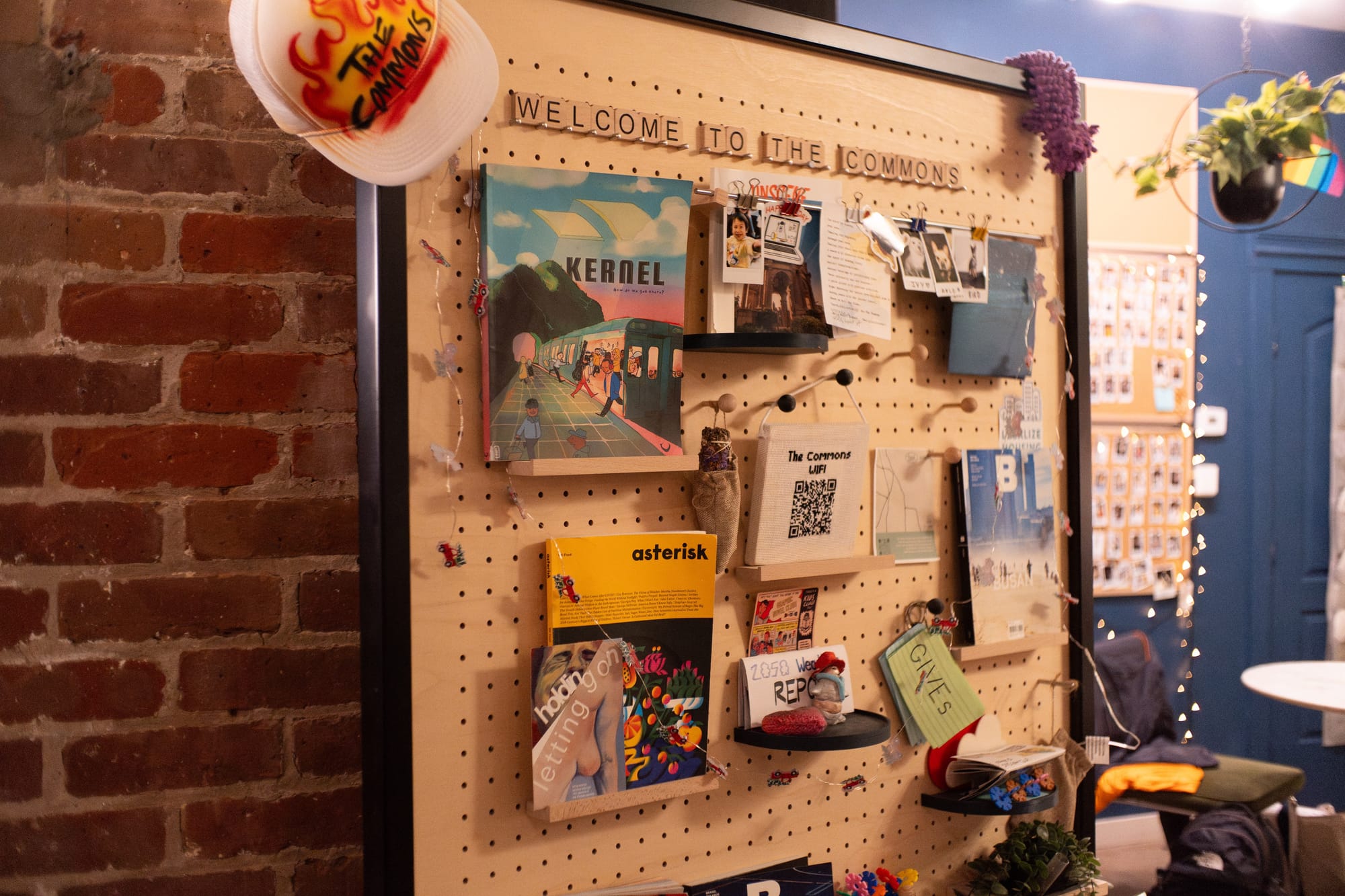
Entering the lobby, I’m confronted by a wall of neatly shelved metal type for different fonts, an open bar, and stacks of the periodicals featured at this gathering: Kernel Magazine and Asterisk Magazine.
Kernel is a slick print outfit covering tech from a “progressive,” “techno-optimist” perspective. The typical reader is a young techie, but the kind who added on a humanities minor in college and still writes poetry on the side. This is also roughly the image of their editorial collective, which emerged in 2021 from a cluster of Stanford undergrads. One of them, Jasmine Sun, co-hosts this event. Sun is a rightwardly mobile liberal who at a previous happy hour announced earnestly to the crowd, “I don’t hate billionaires.” Maybe this is because Kernel has received funds from Omidyar Network (as in Pierre Omidyar, the founder of eBay) and the libertarian Mercatus Center, among others.
But Kernel itself is not a mouthpiece for billionaire interests. Its contributors, comprising programmers, artists, and investors, are enthusiasts of technology through and through, but try to reckon with its terrible failings. Kernel splits the difference: on the one hand, it publishes apologetics for crypto and angsty startup founder fiction; and on the other hand, it provides a platform for critical stories on for-profit prison phones and self-censorship on TikTok. What unites these authors is not faithfulness to any political project, but identification with the expert worldview of the technologist.
The other event host, Clara Collier, is here representing the effective altruist magazine Asterisk. For the untainted, effective altruism (EA) is a very online social movement popular in tech circles, which was originally concerned with how to get rich philanthropists to donate to the most “effective” charities but is now just as well known for its booster-doomerism about artificial general intelligence and for having had the convicted crypto fraudster Sam Bankman-Fried as a notorious benefactor. The leading (legitimate) financier of EA-aligned projects, however, is decabillionaire Meta and Asana co-founder Dustin Moskovitz, whose nonprofit Coefficient Giving (formerly Open Philanthropy) has bankrolled Asterisk into something like the paper of record for the EA movement. In recent issues, two AI think tank executives appeal to us to consider the “perspective and interests of AI systems” as if they were living beings, a journalist laments environmental regulations that are slowing down AI data center expansion, and a blogger wonders aloud why the rationalist community (a utilitarian philosophical movement closely tied to EA) spawns so many cults. At the same time, Asterisk has devoted an entire issue to worrying about the possible extinction-level events that many in the EA world believe will befall humanity if this hypothetical superintelligence is trained without technical “alignment” to human values.
Mingling with the crowd, I meet various writers and journalists, a designer, an economist, a rationalist novelist, and a barrel of software engineers — a cast of characters familiar to me from my years working in tech.
But then a pale bespectacled guy wedges in next to me and introduces himself as Samo Burja, editor of another magazine called Palladium. I try to suss out his deal, but his answers are careful. “We write about governance,” he says, “a lot of our readers are venture capitalists.” At the same time, Samo assures me, he counts Karl Marx among his personal influences, and says Palladium has in fact published a Marxist. What he doesn’t mention is that they prefer to publish monarchists and white supremacists.
As soon as that conversation ends, another Kernel editor pulls me aside with a look of concern and says, “I couldn’t help but notice the two political extremes in the room were talking to each other.”
I would later discover that Palladium Magazine is widely believed to be bankrolled by Peter Thiel, the ghoulish far-right billionaire known for helming PayPal and Palantir, delivering bizarre lectures on the Antichrist, and struggling to answer questions about whether humanity should exist. Unnamed donations to the magazine since 2021 total in the millions of dollars. Thiel did not respond to our request for comment.
One of Palladium’s founders, Jonah Bennett, previously lived and worked out of a Thiel-funded think tank-group house in Oakland called Leverage Research, where past members have alleged cult-like experiences including abusive psychological experiments. In 2019 he was outed as a member of online white nationalist groups, though he would claim he “was never a white nationalist” and is “not proud of…that period of time.” The other founding editor, Wolf Tivy, suggests “maybe democracy doesn’t matter” and that societies thrive under a “coordinated and benevolent elite.” Neither Bennett nor Tivy responded to our questions or provided comment.
Despite telling us in an email that “monarchy is merely one viable form of government with strengths and weaknesses,” Palladium editor-in-chief Samo Burja has repeatedly extolled the virtues of monarchy including as a recurring contributor to a neo-reactionary blog, where he also gave a full-throated defense of IQ scores as a measure of intelligence.
Within the pages of Palladium you can find articles embracing a future “age of eugenics,” the return of child labor, and a new caste system. They urge the implementation of Trump’s “Freedom City” in the Presidio and promote projects affiliated with the Network State, a nascent movement plotting digital secession from traditional nation-states. Curtis Yarvin, leading theorist of the neo-fascist Dark Enlightenment (also known as neo-reactionary) movement who counts JD Vance among his fans, calls for an ultra-militarized “Orbital Authority” that “dominates, owns and controls the whole planet.” Burja himself peddles a repackaged great man theory of history, “Great Founder Theory,” which he developed while at Leverage Research.
The magazine’s reactionary-futurist aesthetic speaks as loudly as its words: glossy covers idolize Greco-Roman antiquity; Grimes, seemingly a regular at Palladium parties, poses nude in one of their issues, free-floating in the middle of an exotic space colony.
As for who is reading all these windbag authoritarian thinkpieces, frequent contributor Ben Landau-Taylor told me Palladium is “geared towards elites and people at the top of their profession,” including prominent venture capitalist (VC) Marc Andreessen, Ethereum blockchain founder Vitalik Buterin, and of course, Peter Thiel. I haven’t the budget or the stomach to attend Palladium’s launch parties (a limited set of invitations are extended quarterly to its $200 per month subscribers), but past photos suggest the demographics of a MAGA soiree, without the semblance of a good time.
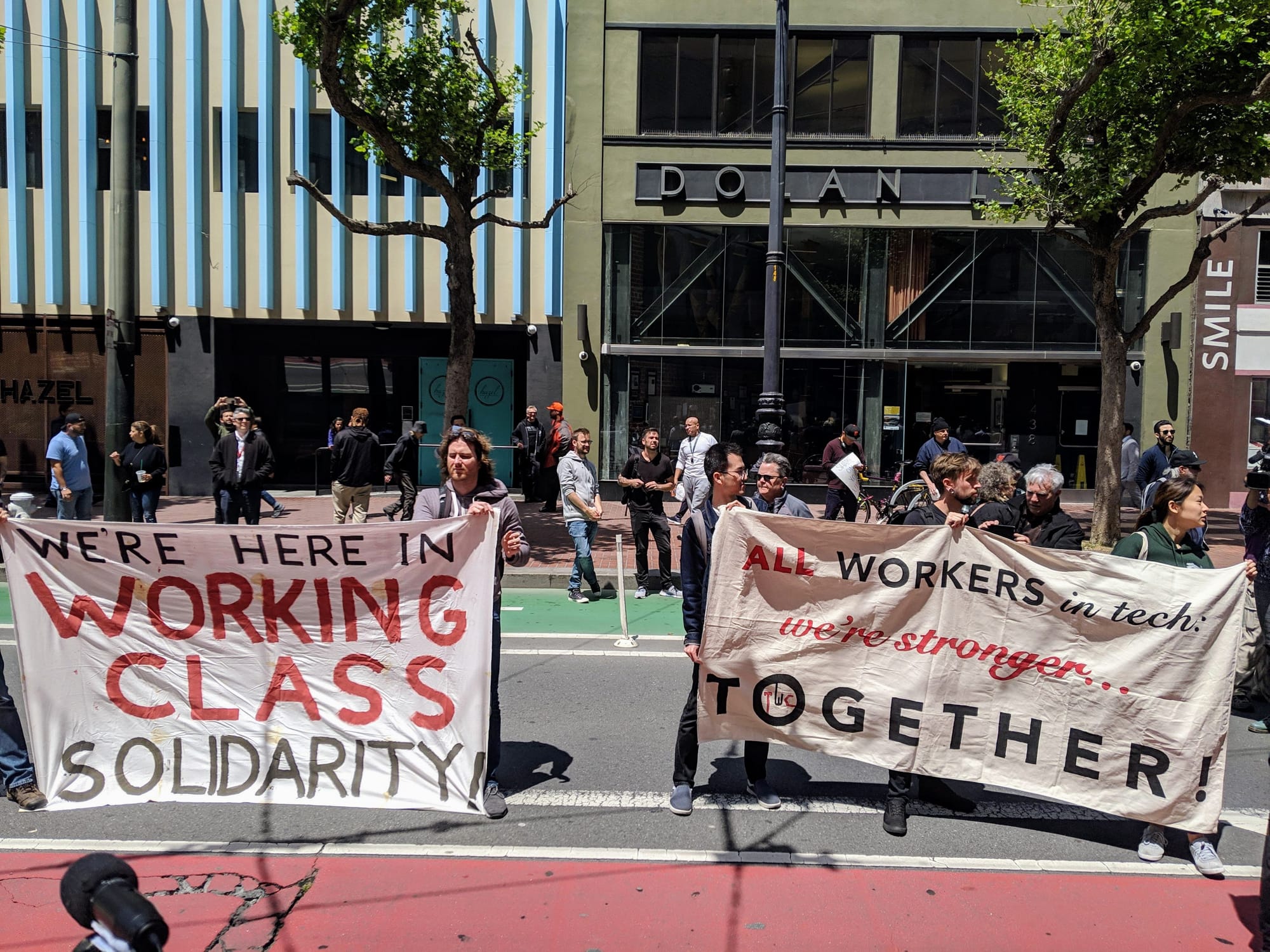
Tech writing and publishing in the Bay Area wasn’t always like this. In the second half of the 2010s, a rising tide of public discontent with Silicon Valley — the “techlash” — coincided with the first Trump inauguration to produce a mass politicization of tech workers. I was one such worker, and became a labor organizer in the tech industry alongside others who would go on to orchestrate everything from a global walkout at Google to salting programs at startups.
Such resistance movements in tech animated, and were in turn supported by, their own homegrown publications. One of them, Logic Magazine, was a forum for tech criticism that was widely read by partisans of the tech worker movement. Logic was where you could go to learn about racist criminal sentencing algorithms, tools for tenants to research landlords, and how to sabotage computer vision systems. My comrades published real-time histories of the tech worker movement and exposés on their employers in Logic; we showed up to their in-person events in San Francisco to meet others who thought similarly.
But that now feels like a past life. Today, the techlash is a receding memory and the tech worker movement is running on fumes, the preserve of a few lonely unions. In a sign of shifting winds, Logic rebranded as Logic(s) in 2022, pivoting to subjects outside Silicon Valley proper, and transitioned to a new editorial team institutionalized at Columbia University.
In the second half of the 2010s, a rising tide of public discontent with Silicon Valley — the “techlash” — coincided with the first Trump inauguration to produce a mass politicization of tech workers.
In the years since, the tech industry has gladly unburdened itself from the critiques leveled at it during the techlash. Nowhere is this more obvious than in tech’s involvement in building weapons of war.
Whereas in the 2010s there was little VC money chasing after military startups, today’s tech sector embraces lethality. From 2019 to 2024, venture capital allocated to defense tech startups increased tenfold, and titans like Meta and Amazon now openly develop cloud compute or virtual reality glasses for the US military.
Accompanying the change in political economy has been a vibe shift. Corporate behemoths like Google used to face intense public backlash when they were caught working on Pentagon projects, but today tech executives flaunt their patriotism and amplify Cold War-like rhetoric to attract investment and curry political favor — threatening, for instance, that if US-based AI companies are prevented from unfettered development of large language models, China will be first to achieve artificial superintelligence. On campuses like Stanford, where students once organized against Palantir, there is now a thriving ecosystem of clubs and institutes promoting careers in military tech. Many leading VC firms prominently display “defense” as a pillar of their portfolios; Andreessen Horowitz’s website, for instance, features a comically jingoistic video promoting “American dynamism.”
This militaristic nationalism finds a fervid voice in Arena Magazine, a print and digital outlet about “tech, capitalism, and the USA” that launched in 2024 and is led by several former editors-in-chief of the Stanford Review, a whiny, reactionary rag founded by Peter Thiel when he was an undergrad there. Like Palladium, Arena’s following is stacked with tech elites, but is skewed more towards startup founders, engineers, designers, and people employed in manufacturing, military tech, and biotech — in short, builders.
Though headquartered in Texas, I bumped into Arena people twice in one week in San Francisco without even trying. The first instance was at an event in SoMa for Asimov Press, a biotechnology publisher with a mild bent towards EA-style concerns like human longevity, animal welfare, and AI safety. There, an Arena editor, Zaitoon Zafar, explained to me that it seeks a correction to the “attacks on technology and people who actually do things” — the entrepreneurs and builders “in the arena,” as startup heads are fond of saying. On another occasion I was approached by an Arena writer and defense tech salesman named Adam Wong, who summarized the magazine as being pro-Trump and publishing articles about “sociology, anthropology, and fifth-generation warfare.”
Arena’s editor-in-chief Max Meyer is less mealy-mouthed: “This magazine is 200-proof, pure distilled American propaganda,” he posts. Every copy of a recent issue includes a detachable spread advertising Anduril Industries, a manufacturer of autonomous military drones founded by former Palantir executives and backed by the “patriotic” venture capital firm 8VC (where, incidentally, Meyer has worked). Bombs and fighter jets streak across the ad, whose text reads: “REBUILD THE ARSENAL.” The remaining pages of Arena are littered with glowing profiles of assorted sea, air, and spacefaring war machines; praise for fracking, uranium enrichment, and consumer eugenics services; and calls to use AI to secure “enduring dominance over our adversaries — namely, China.” The CCP lives truly rent-free in the heads of Arena contributors, almost none of whom manage to write a piece without invoking or stoking the threat of Big Bad China.
Thank you to the brilliant advertisers who make this company possible - and who contribute to the beauty of the magazine! pic.twitter.com/MV2O1RKsHB
— Maxwell Meyer (@mualphaxi) August 1, 2025
What do niche publications like these actually want? What do they accomplish? No doubt they are often, at least in part, vanity projects for their founders and funders. But they are also functional political devices, projects and projections of class power. This is especially true of print media: Print inevitably precipitates a face-to-face community, giving it the capacity to represent and in turn catalyze real-world movements.
This was the case with Logic, which helped cultivate a feminist, anti-racist, anti-capitalist tech perspective, and a working-class movement that gave teeth to those ideas. It was imbued with a class character.
So, too, are reactionary projects like Palladium and Arena, which cohere and embolden militaristic, revanchist, and authoritarian members of business and state — and, when possible, try to sway a broader public. Those at the helm of Silicon Valley know that their outsized influence is tenuous; it can always be challenged by movements from below. Which is why they and their adherents have a keen interest in diffusing their class interests, their way of thinking, into the common sense throughout all strata of the tech world — even among workers. “The cardinal goal of doing this crazy print publication [Arena],” says Max Meyer in an interview, “is to mind-infect people to work on the right things, the cool things, the pro-America things.”
The day after the social where I met Palladium editor Samo Burja, I message Jasmine Sun, the event host and Kernel editor, urging her to disinvite him and any of his Palladium colleagues from her future events. A few days later, Sun replied with her opinion that Palladium “doesn't seem overtly fascist” and besides, she doesn’t want to be “in the business of defining fascism.” She “disagree[s] with the tech right and effective altruists, but they're both influential parts of the intellectual scene here” and worries that “kicking one person would lead to others weaponizing that to try to kick others out.”
The response is spineless, but admits a basic truth: differentiated as they may seem from within the SF tech bubble, when viewed from a distance, these ideological formations form parts of a cohesive whole.
For one thing, their communities intermingle in spaces throughout the Bay Area. Show up to the public events of any of these publications, and most of the others — sometimes all of them — will be there. Kernel, Asterisk, and Asimov all have contributors in common; so do Palladium and Arena, who shared the stage at a war-themed salon.
Just as these groups can be found in the same physical spaces, so too they overlap ideologically in their common adherence to techno-optimism, the belief that technological development is an inherent good. Kernel Magazine’s opening manifesto explicitly names techno-optimism as its doctrine, but Kernel’s veneration of technology is arguably the mildest among them. In various guises, Asterisk, Asimov, Arena, and Palladium all profess a deep optimism, as well as inevitability, about the limitless development and proliferation of technology as it’s currently produced — by private firms for profit. In this way, tech discourse conflates, or even redefines, “progress” as capitalist technological progress.
Fascism doesn’t just exist in the marketplace of ideas, but in actual persons living in our cities, funding and constructing their visions for our collective future.
Much like the class-segregated locomotive in Bong Joon-ho’s eco-apocalyptic film Snowpiercer, capitalist technology represents, for these thinkers, the vital engine of human history. Some, like the right-wingers of Palladium and Arena, believe (Western) society is destined for greatness so long as we continue fanatically shoveling fuel into the furnace — with no regard for the misery of sub-economy class passengers in the last carriage. Others, like the liberals of Kernel, want do-gooders within Silicon Valley to nudge the train in a collectively beneficial direction on behalf of the masses. But as with the ideologues aboard the Snowpiercer train, none of them can imagine doing what is actually needed: putting on the brakes or, if necessary, derailing the whole thing to start anew.
Because the various tech politics are so enmeshed, it’s not clear how to excise only the noxious elements. The operation of classical fascism could be described, as Hannah Arendt did in The Origins of Totalitarianism, like the concentric circles of an onion: At every stage, you could point to someone more extreme than you as well as someone more of a normie than you, and it's hard to know when you've gone too far. In a similar way, contemporary tech discourse is a melting pot of ideas good, bad, and ugly, lacking well-defined layers. Spend enough time in this milieu, it seems, and you won’t even know where you stand.
Still, we cannot be passive observers to a slide into barbarism. Fascism doesn’t just exist in the marketplace of ideas, but in actual persons living in our cities, funding and constructing their visions for our collective future.
The Bay Area is now surveilled by thousands of Thiel-funded Flock cameras that transmit our movements to ICE. Network State-aligned projects are being built in Solano County and next to Powell Street BART. Lest we forget, the feds already patrol our streets; they are snatching up our neighbors; they have begun to criminalize antifascism itself. Just because any line in the sand would be in some sense arbitrary, doesn’t mean we shouldn’t draw one.
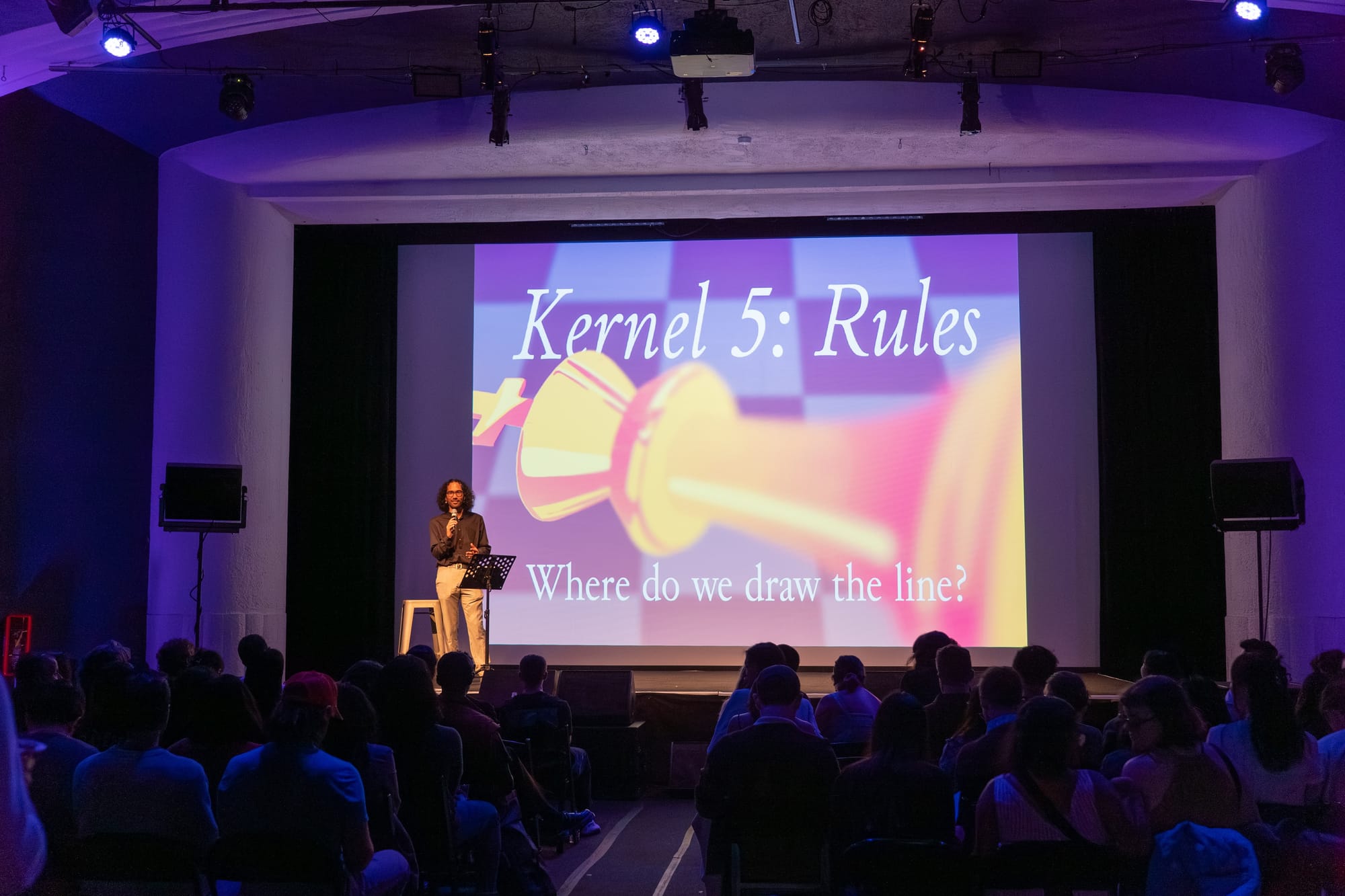
I skim a copy of Kernel before setting it on my coffee table. Written on the front cover is the editorial theme for Issue 5: “RULES. Where do we draw the line?” Where indeed.
Support the Bay's working-class publication. Sign up for our free newsletters, or chip in a bit per month.

“It’s a matter of life-and-death that we continue to organize.”

There’s money behind AI in SF schools. Striking teachers don’t want it taking jobs.

San Francisco special education teachers tell us why they’re striking.


We wanted to hear directly from the elite-lovers at their “March for Billionaires” in San Francisco — here’s what they said.

