
The Book Your Tech Boss Doesn't Want You to Read
In Against Tech Oligarchy, two leading labor organizers chronicle the past decade’s tech worker movement.
In Against Tech Oligarchy, two leading labor organizers chronicle the past decade’s tech worker movement.
We spoke to one of the frontline union workers in the climate change fight.

TUES, SEPT 22 — Surrender yourself to the transformative sounds of Lulu the African Gray Parrot (and some human counterparts). Remember

The company’s Integrated Behavioral Health Services workers hold one-day strike against AI.


If you have sought mental health services through Kaiser Permanente in the last 18 months, chances are, you did not speak to a licensed therapist until your actual appointment. You may not have even spoken to a human being.
Kaiser has gutted its triage staff throughout its clinics in Northern California in recent months, rapidly de-skilling its labor force to rely increasingly on low-wage work through the form of Teleservice Representatives, or TSRs. Triage TSRs now field calls from prospective and returning patients and make decisions about how urgently they need to see a mental health professional, and what kind of care they need. For the Integrated Behavioral Health Services (IBHS) chapter of the National Union of Healthcare Workers (NUHW), the union that represents triage therapists that have been laid off, this personnel shake-up, along with vague contract language surrounding AI, signals a turn towards a more extreme and devastating reorganization.
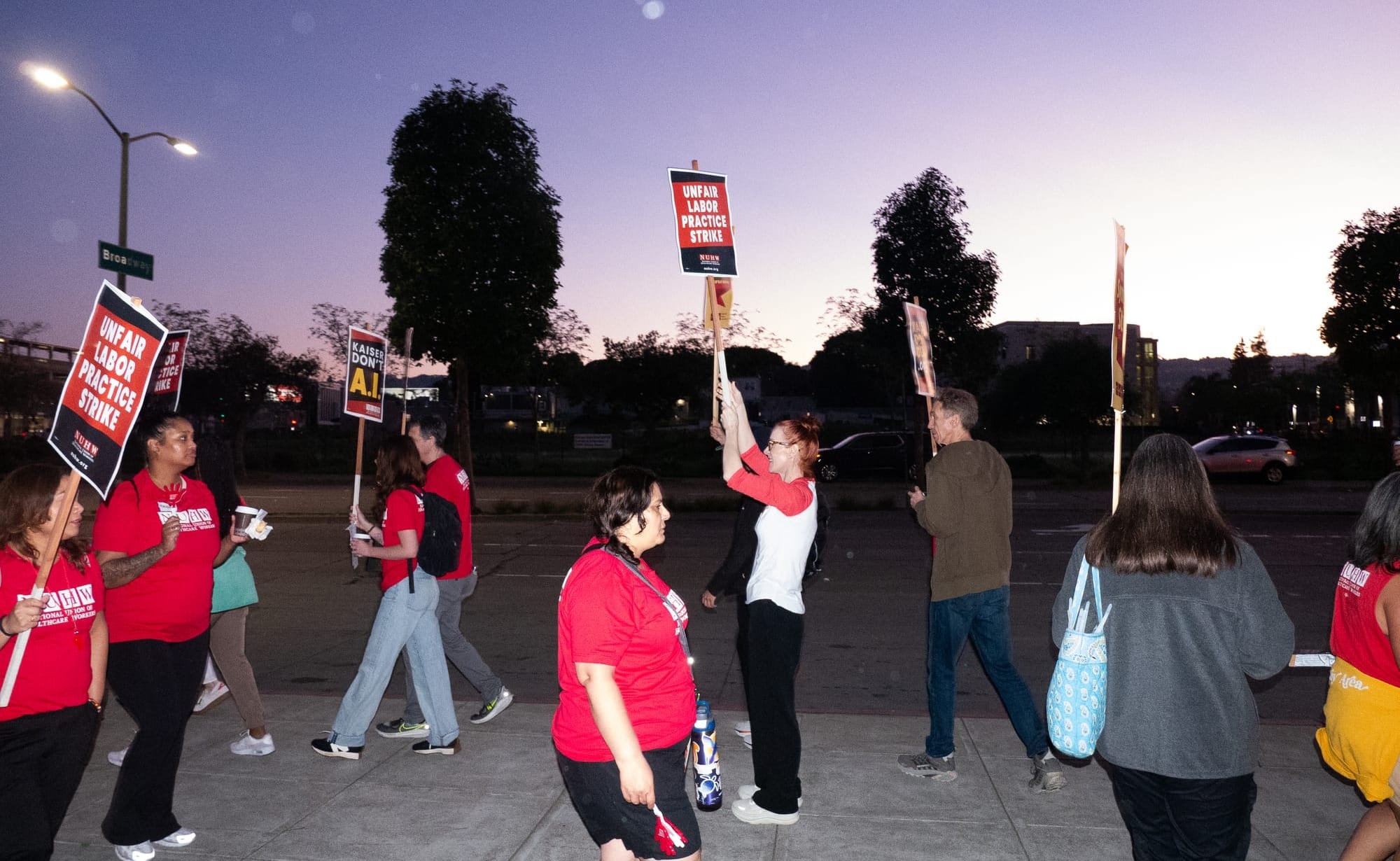
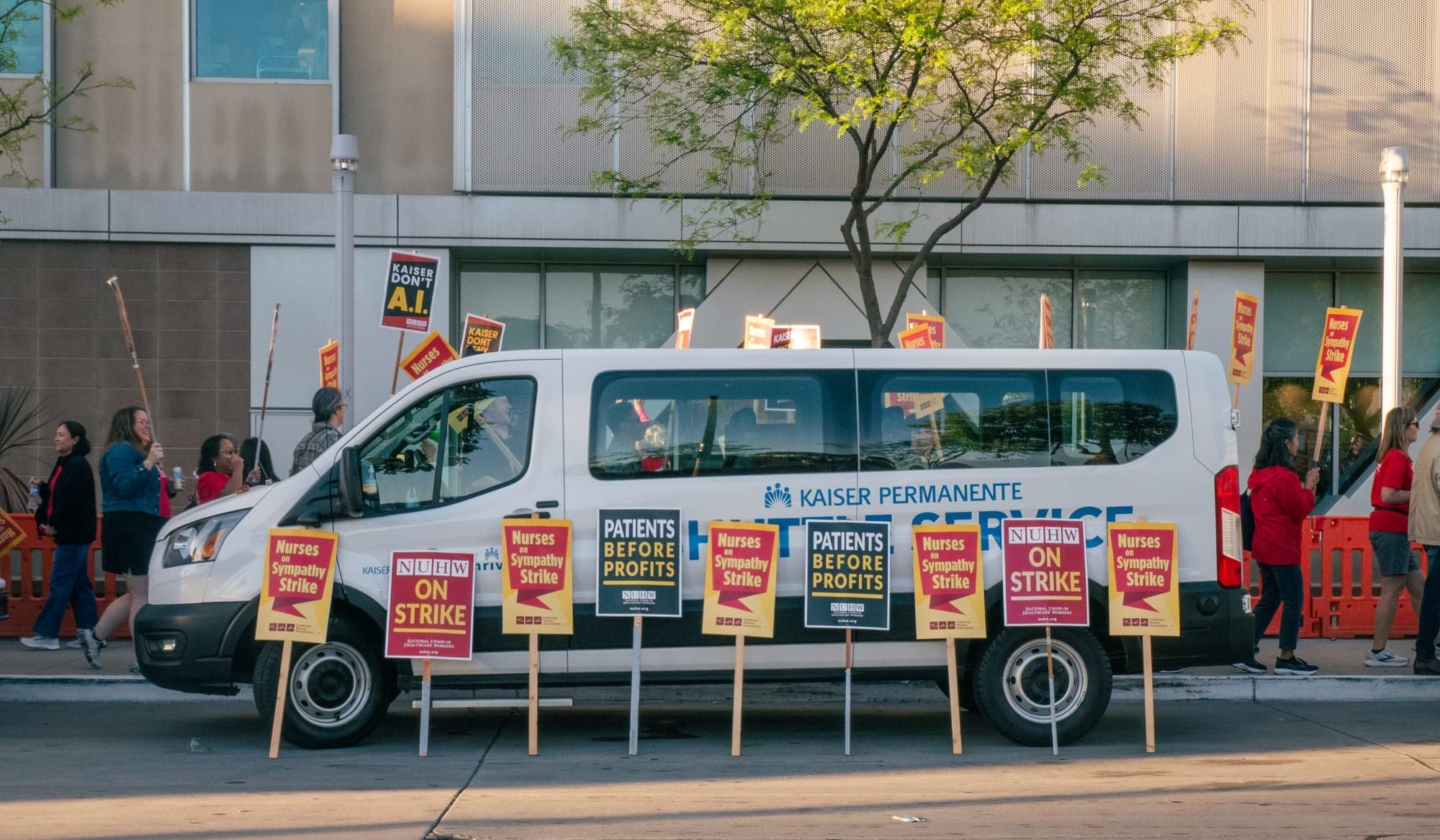
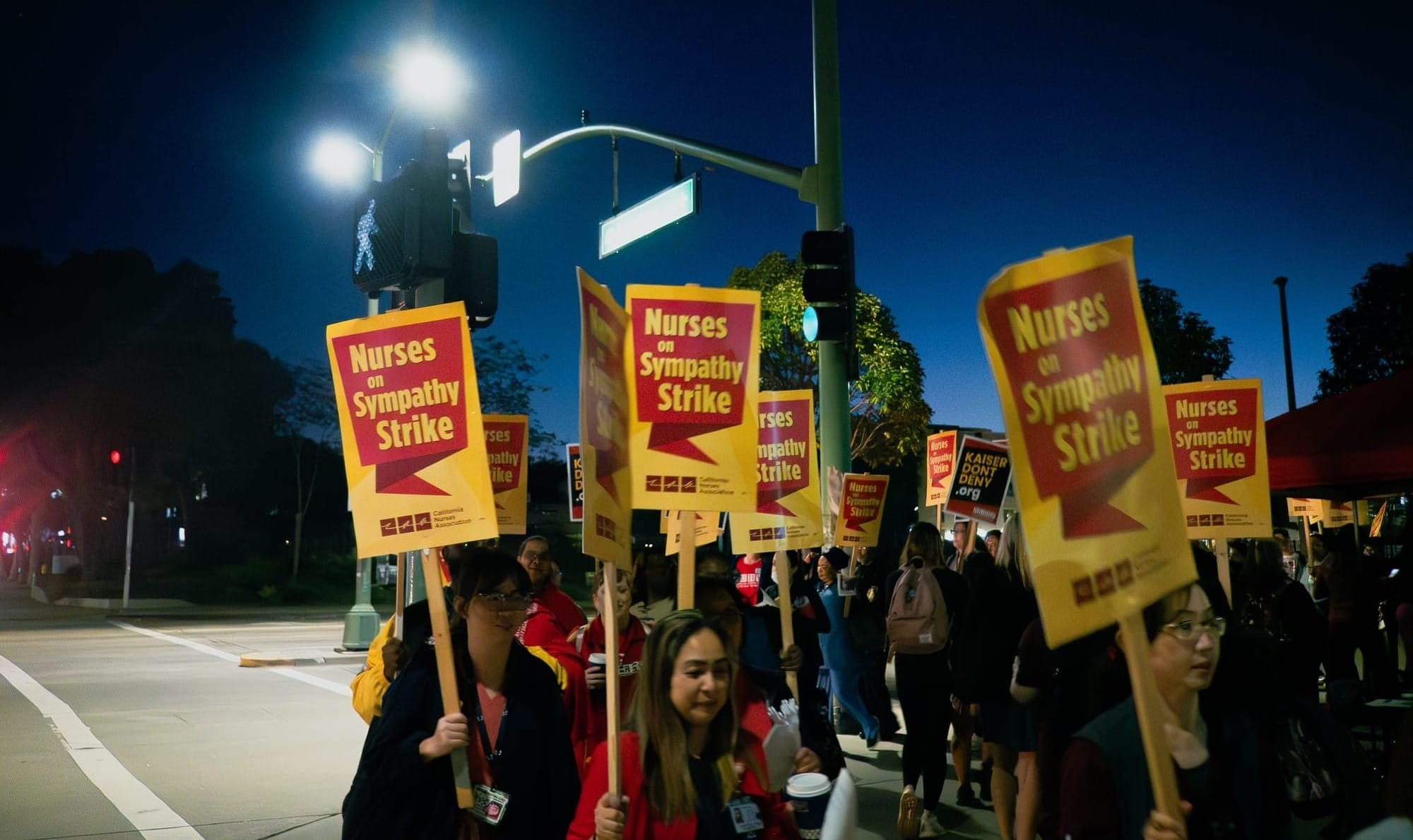
IBHS held a 24-hour strike outside clinics in the region, beginning before dawn on March 18. Hundreds of workers, including both NUHW members and other unionized workers on a sympathy strike, woke up in the dark to hit the picket line at the corner of Broadway and MacArthur, outside of the main Kaiser building in Oakland.
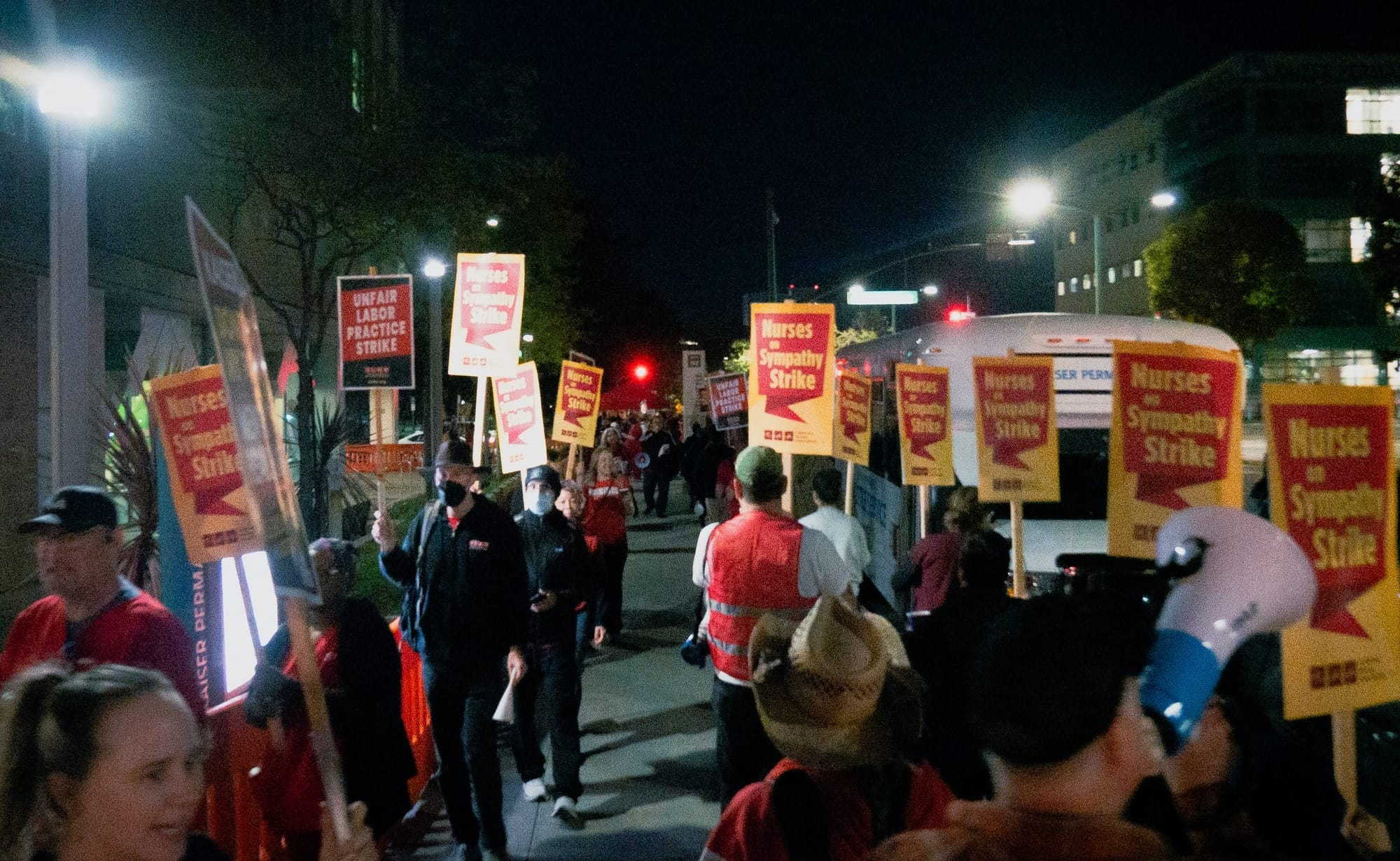
“Our staffing has gone down about two thirds,” said Harimandir Khalsa, one of three therapists performing triage work in Oakland. TSRs are now mostly responsible for the intake process, though new patients can also be triaged through online questionnaires. The clinic in Oakland is home to one of the last triage teams, but they’re working with a skeleton crew. “The role is illegally shifting from a licensed psychologist or therapist to clerical staff,” Khalsa continued.
While this strike is nominally about preempting the use of AI for mental health services, the Unfair Labor Practice (ULP) charge NUHW filed is about triage being executed by unlicensed TSRs, which they claim violates California law and endangers patients. More broadly though, their concern is over a looming pivot to gig work in healthcare — mediated by AI.
NUHW wants Kaiser to be explicit about its plans for AI use in mental health services. Union members read their unwillingness to do so as intent to compromise labor power and patient quality of care.
“They want free reign to be able to lay off Kaiser clinicians and outsource all of that work to third-party subcontracted mental health providers,” said Paul Boyer, a social worker in the Adult Psychiatry Department at the Oakland clinic. “Kaiser is seeking to hire the mental health equivalent of an Uber driver,” he said. Kaiser TSRs in the Bay Area make, according to Indeed, an average of $28 an hour. A licensed psychologist or therapist at Kaiser makes around $52 an hour.
Kaiser, which operates its hospitals as nonprofits and its clinics as companies, may be motivated by more than just cost savings to dismantle its mental health services. According to Kaiser Ventures’ website, AI and software-as-a-service companies are disproportionately represented in Kaiser’s investment portfolio, including companies like Abridge, which provides “generative AI for clinical documentation” and raised a staggering $150 million in Series C funding. Other companies, like DexCare and Softheon, tout integrated AI solutions to optimize healthcare workflow and billing.
While Kaiser is not yet publicly investing in companies that explicitly work on AI replacements for therapists, the company is clearly incentivized to do so. In 2023, Kaiser was found in noncompliance with the Mental Health Parity and Addiction Equity Act for not reimbursing patients for care Kaiser could or would not provide and ordered to pay a 28.3 million dollar settlement. If Kaiser is obligated to provide or pay for patients’ mental health, it tracks that Kaiser would look to refer patients to a cheap (or free) external mental health chatbot or one of the existing digital therapy platforms Kaiser contracts with, like Headspace — or an up-and-coming product they have poured money into, like “Sleepio,” a digital tool from a company called Big Health that treats insomnia with cognitive behavioral therapy.
Mental health workers at Kaiser are already facing pressure to refer patients outside the system. Boyer attributes this to a staffing shortage artificially created by the company. “I have a colleague called a generalist, kind of a regular therapist at Kaiser. His caseload at last count was 173 patients,” Boyer said. “How anybody provides adequate care to that many people, I have no idea how he does it.”
This problem of unnecessary out-of-network referrals is exacerbated by the use of TSRs. Khalsa described a patient that had been harming themselves and still struggled to make an appointment with a real therapist. “They did a questionnaire on Kaiser's website, and from that questionnaire, they were referred to an external digital platform for text-based, AI-based, bot-based services, and that was not adequate for them,” she said.
Emma Olsen, a psychologist with Kaiser in Vallejo, confirmed that many patients do not receive the more intensive level of care they need because of flaws in the new triaging system and lengthy wait times for appointments. “They basically ask you, are you feeling like you want to kill yourself right now?” she said. If the answer is anything more complicated than yes, you are unlikely to be prioritized for an appointment. “It doesn't really capture people who've maybe felt that way really recently or maybe don't necessarily feel comfortable answering that question right off the bat in a phone call,” Olsen said.
Kaiser has built a reputation for its long wait times and byzantine scheduling processes — contradicting the stated purpose of its integrated model of care. For management, a turn towards gig work and AI is done in service of “efficiency” or “optimization.” This messaging relies on audiences conflating budget efficiency with the efficiency of operations, when often, and obviously to workers and patients, the two are inversely proportional. Kaiser therapists are clear on the fact that the move to optimize the triage system with TSRs has only created more work for therapists and patients.
“I talk to 25 people a day, five days a week in triage. They say, finally, I got to you!” Khalsa said. “Some people will go to these external provider networks because they know they can't get an appointment more than every five weeks at Kaiser. That should not be a reason either. It should be clinically determined,” she said.
Kaiser’s degradation of care has been somewhat gradual. They’ve tested the waters with TSRs and corporate partnerships, but NUHW has recognized that this current bargaining process and AI-generated impasse is ground zero for accelerating it.
“When we say let's put contract language that establishes the rules for doing the right thing, Kaiser absolutely opposes it,” Boyer said.
Just as with AI companies, regulation and guardrails are an enemy to Kaiser; companies that embrace the gig model of labor see the vast networks of labor unions, particularly in the healthcare sector, as an existential threat to their bottom line, regardless of the impact on care.
Members of the IBHS bargaining unit reported that Kaiser appeared “quite distressed” over the fact that nearly 24,000 registered nurses were also striking on March 18. The job of NUHW — and unions everywhere — is to strategize new ways to capitalize off of this fear.
The union’s persistence to win on the AI clause is, for many IBHS workers, a reminder of what drew them to this line of work in the first place.
“I think the relationship between therapists and patients is really something so special and so sacred, and really so much healing can happen there that can't really occur in any other kind of context,” Olsen said.
“When I get to do the work, I love it. It's wonderful and beautiful and on its best days just transcendent,” Boyer said.

We spoke to one of the frontline union workers in the climate change fight.

Despite public outcry, Oakland City Council decided to approve the new cop contract and reappoint police commission chair.

Union workers face cuts amid eye-watering boss pay and refusal to dip into a $270 million endowment

“I'm just a dad that wants to go back to work.”