
Bus Drivers Are Struggling. The Cracks Are Starting To Show.
Current takes a look at two key issues for bus drivers, and maybe explains why the bus is often late…
Current takes a look at two key issues for bus drivers, and maybe explains why the bus is often late…
“They are so brave. They are representing the future and are giving us hope.”

We were in a very Chinese time in our lives. We decided to do something about it.
Current takes a look at two key issues for bus drivers, and maybe explains why the bus is often late…

AC Transit bus drivers are struggling. Unsustainable schedules, failures to quickly address safety, and supervisory pressure are burdening workers of the East Bay’s primary transit provider. As rider delays and problems mount, the cracks are starting to show.
In a post-pandemic bid to restore ridership, the agency recently passed Realign, a sweeping and controversial service reorganization. For drivers, it's brought more headaches and skipped breaks.
Current talks to drivers firsthand about the biggest challenges of late: increasing pressure for drivers to skip breaks, and lack of support to deal with the various crises that happen on their buses.
In a region with an annual GDP of $1.4 trillion, public transit and its riders are often late. A late bus or an unreliable schedule can obviously irritate riders, but how does it affect the bus drivers?
Simply put, tight or unrealistic scheduling leads to bus drivers being late on their routes, which in turn pressures those drivers to skip breaks.
“The time points are very unrealistic,” said Carlos Ferrer, a driver based out of Hayward. On the 51A, a route he often operates, official schedules call for buses to cross much of Alameda in 9 minutes. But in reality? Natural events like car traffic, heavy patronage from local shops and schools, lengthy boarding from retirement homes, and transfers from other routes all cause natural delays.
“It’s simply unrealistic to commit to that timeline!” Ferrer said. That leaves drivers with a choice: either they can take their breaks, or they can keep to the bus schedule.
Pursuant to labor laws, AC Transit cannot force drivers to skip breaks. But the agency does pressure them into doing so, according to Jack Watkins, a bus driver and assistant shop steward with the Amalgamated Transit Union, Local 192 (ATU 192).
“Management makes sure that they do not verbally or in writing tell people to skip breaks,” Watkins said. “However, they manufacture the schedules without appropriate accommodation to take one.”
According to Watkins, ATU 192’s collective bargaining agreement protects drivers to take a 10-minute personal break for about every 4 hours of work. Drivers, though, still have to balance their right to take a break against the pressure to keep to an unrealistic schedule.
When asked about drivers skipping breaks, AC Transit provided no specific comment on this issue.
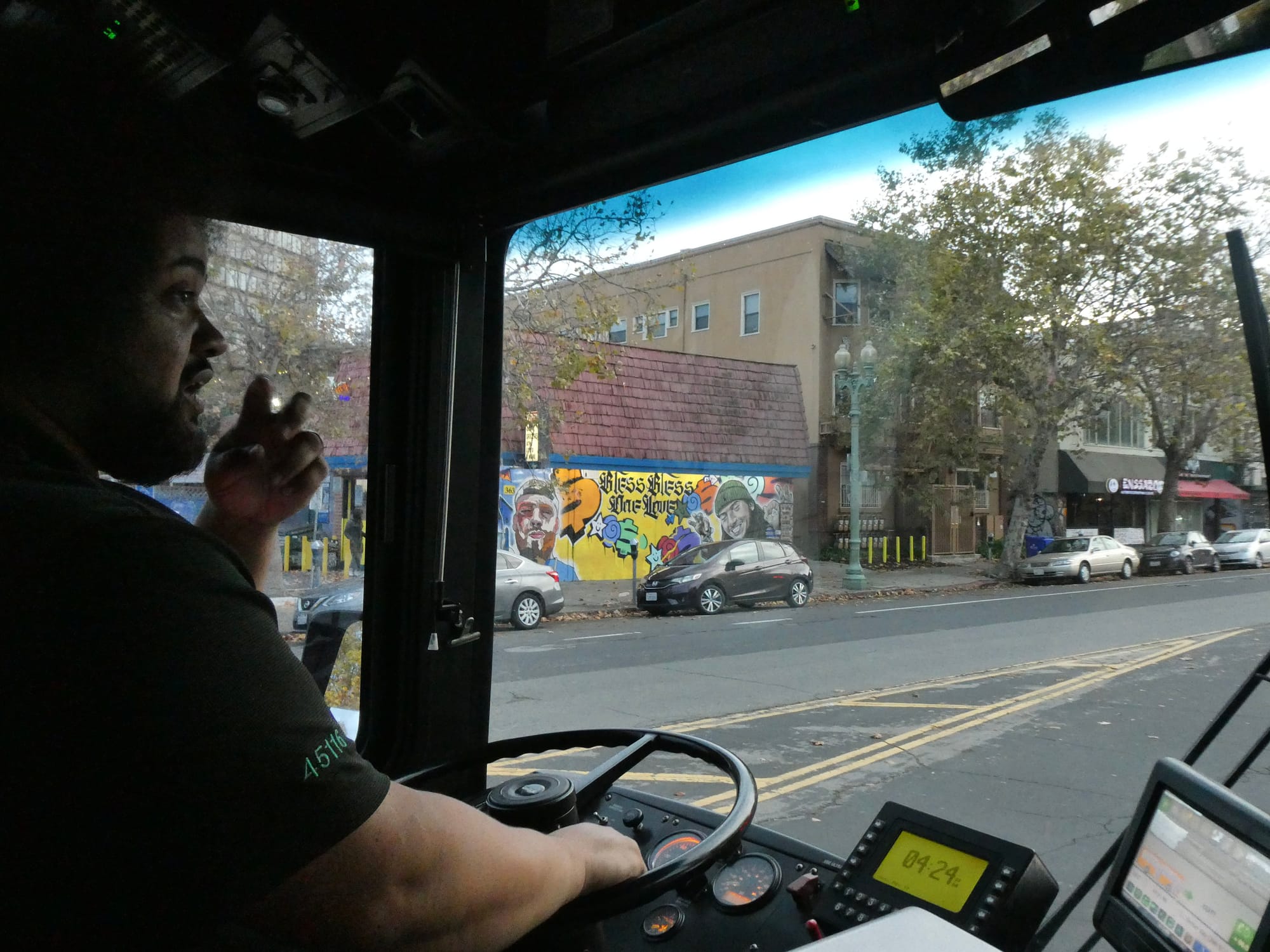
“They’re doing everything they can to keep those plates spinning. To do their job well by the metrics presented to us from management without consideration of themselves. And they end up physically and mentally suffering,” Watkins said. “Initial skipping isn’t unreasonable. But after they accumulate, it's suddenly been three hours since we’ve stood up, checked in with our family, and drank or eaten.”
Watkins has heard colleagues talk about how tired they are, how their backs, arms and shoulders hurt, and how they skip meals and eat irregularly.
“It ruins our metabolism, nutrition, sleep, and eating habits. It’s a result of us juggling this idea that we have to maintain time in order to do our job well,” Watkins said.
Unrealistic schedules can push bus drivers to work more intensely, with drivers choosing to skip their breaks in order to maintain those schedules. Across the bay, drivers in San Francisco have been forced to ask for bathroom breaks.
For a moment, let’s imagine a bus is late, in part because a driver took a break instead of skipping it. Who exactly should we blame for the late bus?
Ferrer recalled a moment where a passenger on his bus experienced a life-threatening seizure. He pulled the bus over, and attempted to contact a supervisor while passengers called 911.
“Nobody got back to me the first few tries,” Ferrer said. “The 911 dispatchers hung up on the passengers until their third try.” After ten to fifteen stressful minutes, help finally arrived.
In addition to skipping breaks, bus drivers are growing frustrated with the lack of support for handling crises. Although limited resources like de-escalation classes exist to instruct drivers, many argue that it’s not enough.
“It’s more than just a bus driver job,” Ferrer explained. “Sometimes you’re their therapist and someone to talk to. Oftentimes you’re reaching out to the community, seeing all walks of life, and helping them.”
“It’s more than just a bus driver job. Sometimes you’re their therapist and someone to talk to. Oftentimes you’re reaching out to the community, seeing all walks of life, and helping them.”
While this job aspect is fulfilling, Ferrer, like other drivers, doesn’t believe he’s adequately trained to handle crises such as medical emergencies.
“They never really told us what to do in a medical emergency,” Ferrer said. “It was frightening. What if it was really urgent?”
Avenues do exist for drivers to voice their concerns. According to Robert Lyles, AC Transit’s Media Affairs Manager, the agency “regularly engages with bus drivers through an internal Drivers’ Committee.” Through this, driver feedback is integrated into quarterly service changes, which sees schedules rewritten to accommodate driver needs. Still, many drivers are saying there’s more to be done on the ground.
In response to concerns, ATU 192 has implemented a crisis intervention course. Through workshops and seminars, the course helps drivers, as Watkins said, “recognize the very real human conditions that perpetuate trauma.” The program prioritizes drivers’ well-being, and the union instated a peer care team that shows up to aid distressed drivers.
Amidst the ongoing fight to save Bay Area transit, organizations like the People’s Transit Alliance (PTA), are joining drivers to push for better working conditions on buses.
The PTA, which is backed by the East Bay Democratic Socialists of America (a fiscal sponsor of Current), was instrumental in challenging scheduling problems in the past and winning hazard pay for workers during the pandemic.
“We’re launching an ethics and schedules campaign to work on fixing some of the working conditions on AC Transit,” said Amy Thomson, co-chair of the PTA. “We’re publicly bridging the movement of workers and riders by advocating a powerful united voice and message together.”
This unity is influential, especially as ATU 192 members like Watkins acknowledge the real potential for change. ATU 192 passed a new collective bargaining agreement last year, which raised wages and granted more protections for drivers to take breaks. In addition, come February 1st, schedules will be shifted to accommodate, as Lyles said, “restroom access, layover times, operator travel connections, and service frequency.”
“This all comes from a foundational political education around prioritizing the needs of the worker,” Watkins explained.

Management has also hired an infamous anti-union law firm


