
Bay Area Workers Fight Bosses For First Union Contracts
Hundreds of workers have unionized—but will they be able to secure wins for the long-term?
Hundreds of workers have unionized—but will they be able to secure wins for the long-term?
The company’s Integrated Behavioral Health Services workers hold one-day strike against AI.

Wallace Shawn’s ironic polemic against class society takes audiences on a psychic and physical journey after dark.
Hundreds of workers have unionized—but will they be able to secure wins for the long-term?

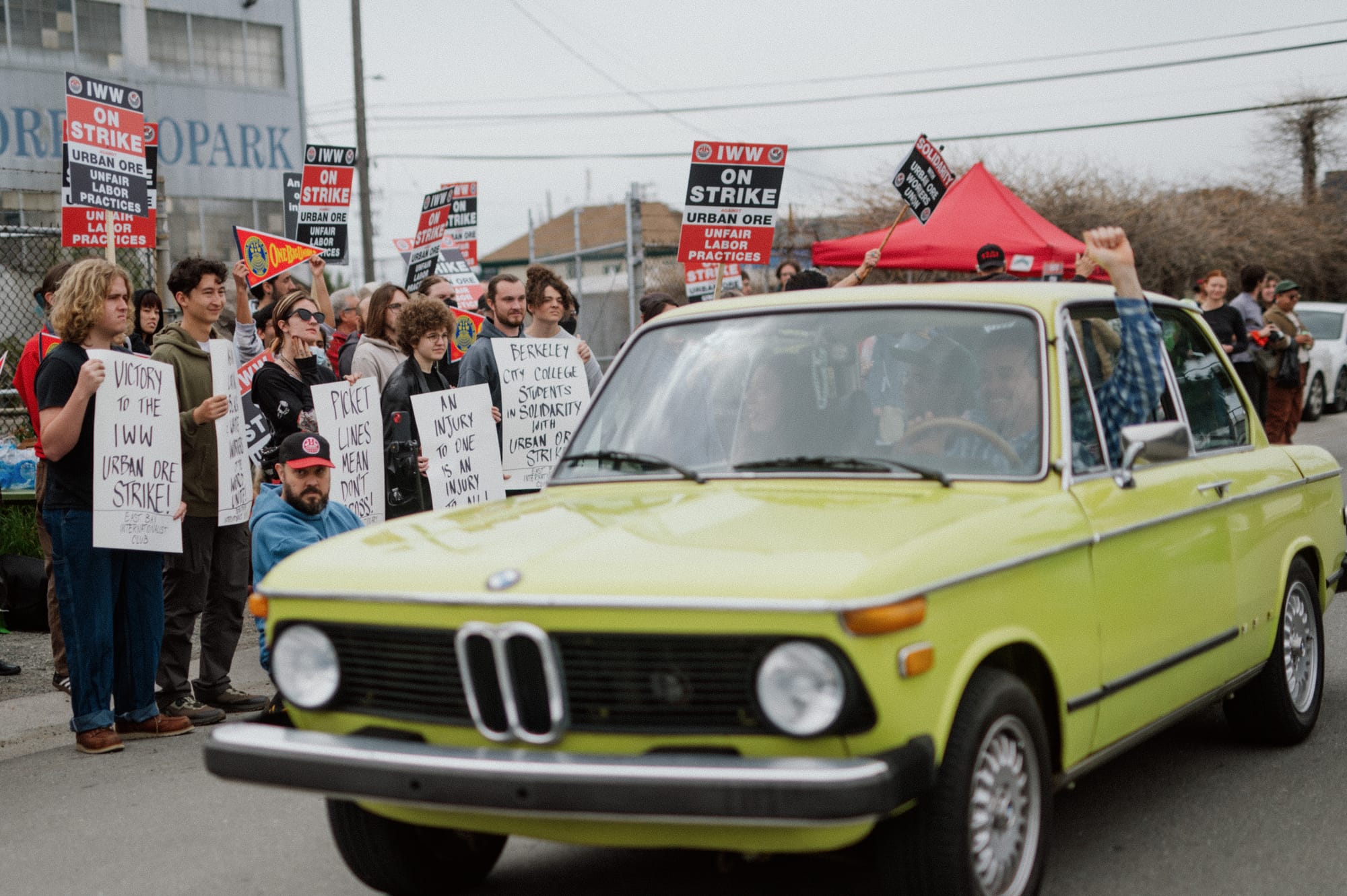
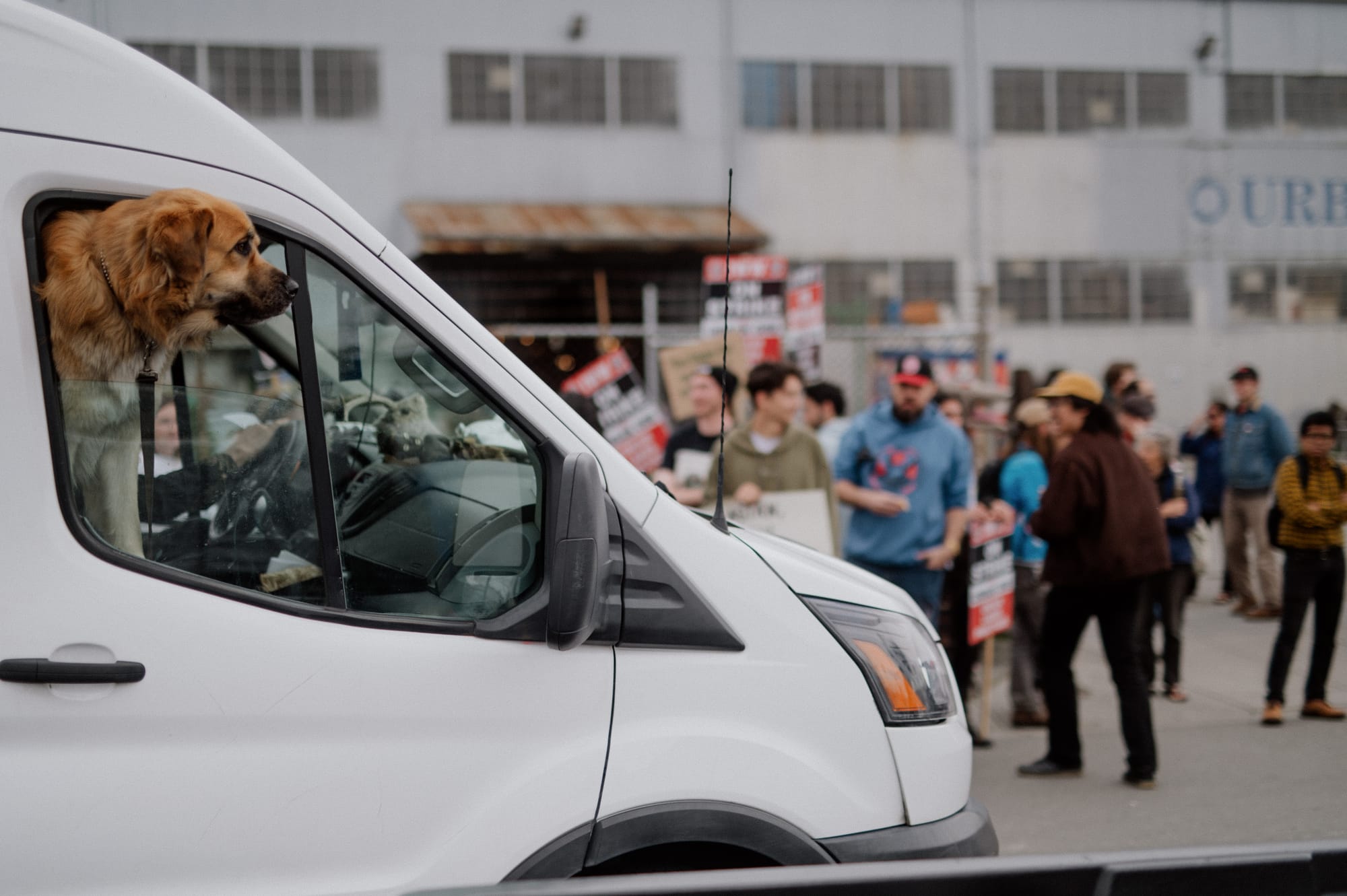
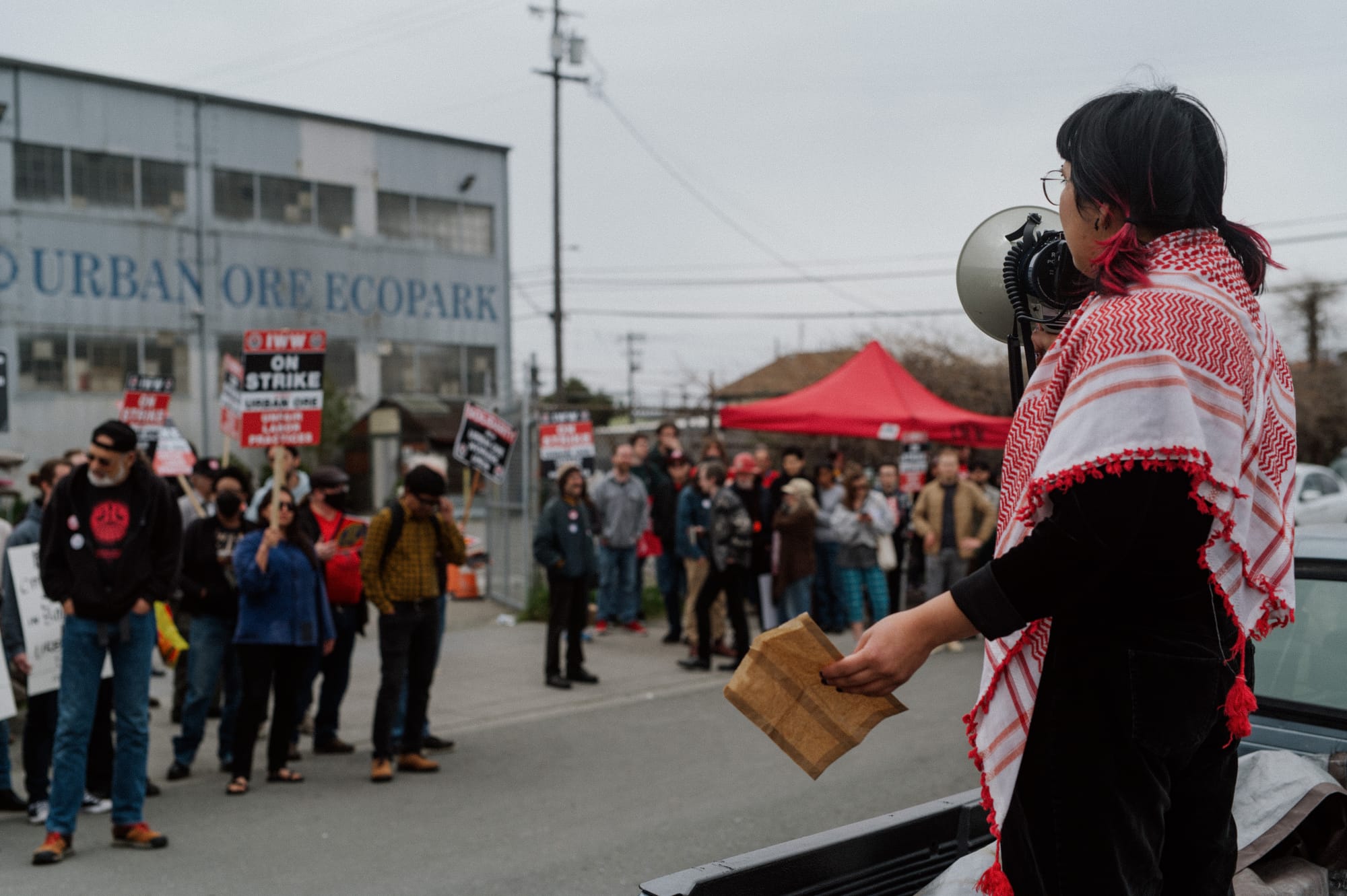
Outside of Urban Ore, a salvage yard and general store in Berkeley, a crowd of about 40 celebrate as cars pour into the parking lot. Drivers look to the crowd for permission as they enter, some holding a fist out of the window in solidarity.
It’s May 1, 2025 — May Day — and it’s the day Urban Ore workers called off their 40-day strike.
“We ended with pretty satisfying and successful end of strike terms,” said Spencer Jordan, who’s worked at Urban Ore for over three years. “We had the support of a huge portion of working people in the Bay Area behind us: people who know better than to cross the picket line.”
Things looked different the day before. After unionizing in 2023, and then months of unsuccessful negotiations with their employer about pay and workplace rights, Urban Ore workers voted almost unanimously to go on strike in March 2025. The picket line had been running nine hours a day, every day, for five weeks. Rumors of imminent store closure hung over the striking workers. Claiming the company was hemorrhaging money every day and was at risk of closure, the owners had laid off five strikers. Jordan said the boss’ message was coming through loud and clear: “How absolutely unreasonable it was that we were doing this.”
The store didn’t close, though.
Instead, the pain of the strike pushed the owners to come to a deal with workers. The strike ended on May 1 with an immediate pay raise and agreement to rehire laid off workers. It took another eight months, and the specter of another strike, to finally agree on a union contract.
The stalled bargaining, the strike, the breakthrough deal, the return to bargaining, the threat of another strike — all are part of the Urban Ore Workers Union’s fight for a first union contract. It doesn’t always end in success.
After workers organize for and win a union election, they face a new milestone: bargaining with their bosses for the first time to establish a collective bargaining agreement. A legally-binding contract between the company and the workers, it’s this first contract that codifies higher wages, new benefits, protections from firing, and/or a clear path to deal with workplace issues, which is known as a grievance procedure.
After two years of contract negotiations, only 57 percent of unionized shops in the U.S. have signed a first contract.
Bargaining for a first contract often takes years, with bosses waging a war of attrition against the very existence of the union. After two years of contract negotiations, only 57 percent of unionized shops in the U.S. have signed a first contract, according to recent research.
Urban Ore workers are not alone in their fight for a first contract. In the Bay Area, numerous unions have emerged over the last couple years, often at smaller workplaces and unaffiliated to large existing unions.
Workers at various Peet’s Coffee locations, the Rockridge Trader Joe’s, the Berkeley Ecology Center, and the Berkeley Philz coffee all unionized either as independent unions or with the volunteer-driven Industrial Workers of the World (IWW). Workers at Good Vibrations, Highwire Coffee, Planned Parenthood Northern California, The Greenlining Institute, Creative Growth, and the Asian Pacific Environmental Network (APEN) all organized with larger institutional unions. All of the union campaigns mentioned in this article contacted and received varying support from East Bay Workplace Organizing Committee, a local chapter of the national Emergency Workplace Organizing Committee, which helps workers to form unions.
Many of these new unions, like the workers at Urban Ore, have struggled to get a first contract.
It was August 2021 when, interested in organizing at Trader Joe’s after benefit reductions while working there, Kaitlyn Custer reached out to a friend from college with union organizing experience. She had never done this sort of thing before. Of all the people involved at that time, not one had organized a workplace before, Custer said.
After almost a year of underground organizing, the union effort became public. In April 2023, they won their union election with 73 ‘yes’ votes to 53 ‘no’ votes. The Trader Joe’s store in Oakland’s Rockridge neighborhood became the fourth in the country to win a union, joining stores in Massachusetts, Kentucky, and Minnesota.
“I felt very bold at work, and protected and powerful,” Custer said. “A time of a lot of momentum, a lot of energy, a lot of actions at the store.”
With the election victory, the union turned to bargaining. Now the goal shifted to getting Trader Joe’s — a company with 631 stores and about $16.5 billion in yearly revenues — to agree to the first union contract in its history.
“In hindsight, getting to the union election seems sort of easy,” said Mikial Weronko, who also works at the Rockridge Trader Joe’s.
Around the same time, workers at multiple Peet’s Coffee stores, a Bay Area-based coffee chain, and Good Vibrations stores, a Bay Area-based sex shop chain, were also organizing.
Dino S., who has worked at Peet’s since 2017 and wanted to keep their last name anonymous, remembers meeting with a group of friends at various Peet’s stores in early 2023. They began talking through workplace issues, evaluating how coworkers might feel about a union, and planning social events. Many of the early discussions focused on COVID-related issues, such as masking and staffing levels.
“They just used COVID as an excuse to understaff us, to make everything worse pretty much,” Dino said.
Five months later, workers won union elections at three Peet’s stores. In two of the elections, they won unanimously.
Organizing among Good Vibrations workers was also spurred on by COVID-related issues, and they won their union election in February 2024. Unlike workers at Urban Ore, Trader Joe’s and Peet’s, the Good Vibrations workers organized with a large national union, United Food & Commercial Workers (UFCW), which represents more than 1 million workers across the country.
The mood after the victory was “ecstatic,” according to Sarah Wilder, who works at the Good Vibrations store in Berkeley. But the shift to bargaining for a first contract was “sobering.”
A union election means both a clear choice — workers vote either ‘yes’ or ‘no’ for the union — with a clear numerical goal of getting more than half the votes. Though bosses generally find ways to interfere, they don’t have a vote. A union election involves difficult organizing and many conversations to convince co-workers of the value of a union, but it does not require complex legal contracts or long negotiation sessions with the boss’s high-powered lawyers.
This all changes with the first contract campaign. A first contract fight, instead of a ‘yes’ or ‘no’ choice, involves workers choosing priorities and making compromises. It involves long and repeated negotiating sessions with a hostile party — the boss. And the stakes are high: the first contract actually codifies wins like higher pay, new benefits, or new protections from firing.
“‘Yes’ or ‘no’ is a very easy thing to talk people through,” said Vanessa Goss, a union member and organizer with the East Bay Workplace Organizing Committee (EBWOC). “Once you’re under a contract campaign the conversations can go a million different ways: What do we want to prioritize? What do we care about? What issues are there and how do we rank those issues? How do we escalate our campaign when things aren’t really going our way?”
Bargaining for a first contract also involves a more direct contest of power between worker and boss. While winning an election requires a majority vote, union victory at the bargaining table often comes down to how much workers can threaten a company’s bottom line, through a strike or other forms of direct action.
All of this has made the first contract fight a new focus for organizers with EBWOC. (Disclaimer: EBWOC is housed within the East Bay Democratic Socialists of America, a fiscal sponsor of Current).
“I always pictured bargaining as a high-spirited debate between two sides trying to outwit each other. It’s definitely a lot different than that: At times, performative. At times, transactional.”
Hugh Schlesinger, a current labor lawyer and organizer with EBWOC, said labor law sets up difficult first contract fights by pushing workers to jump from largely underground, secretive election campaigns to first contract fights that can require militant actions like indefinite strikes.
“That’s an incredible leap of escalation, going from winning an election to an indefinite strike,” Schlesinger said.
Workers’ capacity for direct actions in the workplace, Schlesinger noted, can be compared to a muscle. Union election campaigns tend to be secretive to avoid union-busting from the boss, but this secrecy also limits what workers can do. Workers might avoid direct, public actions like petitions, marches, or short strikes at first. A muscle, though, needs to be exercised: without direct, public actions during the union election campaign—workers may end up ill-prepared for larger direct actions during bargaining.
Weronko, through his experience in Trader Joe’s United, said he learned sitting across from the boss at the bargaining table doesn’t inherently give workers any power. Workers must bring power and leverage to the bargaining table from their organizing, their ability to disrupt the company’s bottom line, he said.
“I always pictured bargaining as a high-spirited debate between two sides trying to outwit each other,” Weronko said. “It’s definitely a lot different than that: At times, performative. At times, transactional.”
Workers at Trader Joe’s, like Weronko and Custer, are facing up against a giant company. Trader Joe’s employs over 50,000 workers spread across its 631 stores. The workers at the Rockridge store went from winning a union election with a majority in one shop, to negotiating against a billion-dollar company with hundreds of shops, many of which remain non-union.
“The starting line and the finish line were much closer when talking about winning an election at a single store, than when winning a good-ass contract,” Custer said. “We’re forging not only the first contract for our local, but the first contract with Trader Joe’s ever.”
Custer also thinks that, in order to get a contract, the union needs to meaningfully impact the company’s bottom line. To do that, more organizing will be needed beyond the four stores currently in Trader Joe’s United, she said.
Without a first contract, the union can remain in a precarious state. Worker turnover becomes a disorganizing force. In some service-sector workplaces, high turnover means that many workers who vote in the union election will leave the job before winning a first contract. Bosses appear to know this, and they resort to delays and harassment with the goal of wearing out the union.
EBWOC organizer Gina S., though, noted that winning a union election has never meant that workers can stop organizing.
“You have to constantly be protecting what you’ve already won and trying to get new ground because your opponents, your boss, will always be working against you,” Gina said. “A contract protects you and helps draw the line a little farther out each time. But it’s a series of fights, not one fight.”
After Trader Joe’s workers in Rockridge won their union election in April 2023, the store joined national bargaining between the company and the larger union, Trader Joes United. The workers are aiming for a master contract that would cover all unionized stores, Custer said.
Custer recounted the bargaining sessions she’s attended as “generally demeaning.” She described waiting for hours in a hot room in the downtown Oakland Marriott to finally meet with one representative from the corporate side of Trader Joe’s, and one lawyer from its union-busting law firm (first Littler Mendelson, then replaced with Morgan Lewis). Management from her own store did not attend.
“Workers at the store are realizing more and more that the company is just trying to exhaust us,” Custer said. “We’re using that as an agitation point.”
Workers at the six unionized Peet’s Coffee stores, four of which are in the Bay Area, have faced similar issues in bargaining. Peet’s has 286 total stores, mostly in California, and about $1.3 billion in yearly revenues. Dino said workers were also aiming for a single master contract, and described the bargaining sessions as “very frustrating.”
“With the lawyers and the upper management who’ve shown up to these meetings, they don’t feel as productive," Dino said. “A lot of us in our local branch didn’t realize how difficult of a process it would be.”
Imagine regularly negotiating with your boss, a “beefcake” who “probably went to some third-tier MBA program and now thinks he’s the shit.”
Bargaining for a first contract requires a lot of legal knowledge, according to Schlesinger, from understanding proposed contract language to making legal requests for information in order to evaluate claims from your boss. Large institutional unions have related legal experience and staff who help with bargaining, but workers in independent unions often work through those aspects of bargaining themselves.
Often, additional stress comes from simply interacting with your boss or management and their lawyers on a regular basis. Taking an example from EBWOC organizer Althea Brennan, imagine regularly negotiating with your boss, a “beefcake” who “probably went to some third-tier MBA program and now thinks he’s the shit.” It might leave you a bit drained.
“Having to go and face this malicious negotiating party over and over again. I mean, that’s just emotionally exhausting,” said EBWOC organizer Yuhong Zhuan.
With or without an official contract, a union can still organize and fight for worker issues directly, often through workplace actions like collectively confronting your boss. Workers can deploy the same power and leverage, which are useful in bargaining for a contract, directly in their workplaces to pressure bosses for better treatment, an end to retaliation, consistent scheduling, or higher pay.
With bargaining for first contracts slowed or stalled, these direct actions can become the core work of the union.
During ongoing Trader Joe’s bargaining, workers at the Rockridge store have shifted focus to workplace actions and mutual aid. Workers have other options, too: they might collectively march on the boss demanding scheduling changes, or they might all wear red shirts to demonstrate coordination and solidarity. Both Custer and Weronko said these actions have achieved some success.
“I feel very respected at work,” Custer said. “I did not feel that before organizing.”
Workers at Peet’s have also turned toward working with their direct management and running campaigns on the shop floor, from all wearing buttons to marching on the boss. They’ve been winning these shop floor campaigns, Dino said.
“Sometimes it feels like the bargaining, the legal stuff, the long email chains with lawyers, is just a distraction from the real stuff,” Dino said.
Worker action amid negotiations seems to be key. After the conclusion of their 40-day strike, workers at Urban Ore pointed to direct action as a key part of their power in the first contract fight.
“I'm incredibly hopeful that our campaign can be evidence—to my fellow workers struggling at other workplaces to get their contracts, to get their unions—that direct action can work,” said Jordan. “But also evidence to those employers that are trying to crush their union efforts that we have power as workers, and that power is credible, and that workers here in the East Bay have solidarity with each other, and they won't cross picket lines. Everyone needs to be aware of that.”
However powerful direct action on the shop floor, winning a legal first contract helps to solidify the union and ensure its existence into the future. Althea Brennan, an EBWOC organizer who also works for UFCW, emphasized the importance of a first contract in high-turnover workplaces, saying it “concretizes” the union.
“It’s just clear that the company fights the union when they try to form at all these jobs, but then the real fight to them is that you don’t get a first contract,” Brennan said. “Because if you don’t get a contract, you don’t build power long-term. Because these are jobs that people leave, because they’re not the best jobs.”
Wilder, one of the Good Vibrations workers on the bargaining committee, said turnover was a major issue during their first contract fight. The bargaining committee is the group of workers directly negotiating with the bosses, on behalf of the union.
“When I was reached out to by the organizing committee, I saw all these people who knew so much more than me, everyone was so much more experienced, and I was so excited to be working with them. All of a sudden…I’m the second most senior employee in a non-management role,” Wilder said. “It’s destabilizing—having so many people come and go throughout the course of negotiating our contract.”
Peet’s Labor Union and Trader Joe’s have both had similar issues with worker turnover at unionized stores. According to Dino, constant training and bringing in new union organizers has helped maintain the union’s strength. Their union model, drawn from the IWW, emphasizes that every member should contribute to keeping the union strong as an “internal organizer” (a union organizer focused on building and maintaining worker organization in a workplace that already has a union).
In April 2025, after over a year of bargaining, Good Vibrations workers unanimously approved their first contract. The contract includes wage increases, more vacation and sick time, worker protections against unjust firing or discipline, and stronger health and safety protocols.
“What helped me most with keeping everyone engaged was just acting like we already had a grievance procedure, acting like I was [a] shop steward and asking people, ‘Is there anything going wrong?’” Wilder said. “Even before we won the election, we were already a union and we just needed to act like it. Now, we have the papers to prove it.”
Since the contract victory, Wilder has become a more active organizer with EBWOC, helping workers unionize at other workplaces.
A majority of shops continue to organize for a union contract. First contract fights continue at Peet’s Coffee locations and at Trader Joe’s, but also at the Berkeley Philz Coffee, at Highwire Coffee, at the Greenlining Institute, at Creative Growth, and at APEN. At Urban Ore, Good Vibrations, Planned Parenthood Northern California and the Berkeley Ecology Center, workers have won first contracts.
Regardless of whether workers won a first contract, workers reported optimism about their organizing.
“I have been part of a group that has done really incredible, historical things,” Custer said. “Some of my biggest accomplishments have been done through [Trader Joe’s United].”
While fights to win union elections are still a key focus, many Bay Area labor organizers have shifted attention to helping independent or small unions with first contract fights. Organizers have mastered winning elections, leaving contract fights the next big riddle.
According to Brennan, the goal of EBWOC is to be almost a training program for workers, teaching the organizing skills necessary “to be the captains of their own ship in their workplace.” Through EBWOC, workers should get the tools to analyze where power lies in their workplace, and figure out “how to grab it and own it,” in whatever situation they face. Ultimately, this includes the life-changing items that can only materialize through the first contract.
“What is actually radicalizing is people doing wild shit that they didn’t think was possible. Together,” Custer said.
And there’s nothing more wild than workers, upon winning their contract, forcing the boss's hand.

The company’s Integrated Behavioral Health Services workers hold one-day strike against AI.

Today marks *twenty four* calendar days since seven Highwire workers have been laid off by the company in a move workers deem to be anti-union retaliation. However, the workers are far from dissuaded, and the fight is far from over.


Dublin Teachers Association secures class size caps, raises, and health care in tentative agreement.