
Having Children Didn’t Make Me into a Conservative — It Made Me into a Socialist.
In the year of 2026, we’re transforming into socialist suburban dads.

If you rely on the Alameda County (AC) Transit system, you likely have experienced recent disruptions in your bus schedule. On August 10th, AC rolled out its Realign plan, disbanding many lines, rerouting others, and integrating some stops from now-obsolete lines into different or new ones.
This plan affects 104 lines — 85% of routes — in a system that stretches from Fremont to Richmond and serves approximately 123,000 daily riders a day. AC Transit’s Board of Directors claims that the plan is “rooted in equity,” based on rider feedback, and meant “to improve reliability.” Yet, it comes — no surprise — on the heels of years of funding shortfalls and prior service cuts.
Bay Area Current wanted to know what everyday riders think. So, we talked to riders who rely on affected lines, like the 18, which no longer reaches Lake Merritt BART through Chinatown and instead ends in Montclair Village, as well as the new 72L that runs down San Pablo Avenue every hour, replacing the popular 72R line.
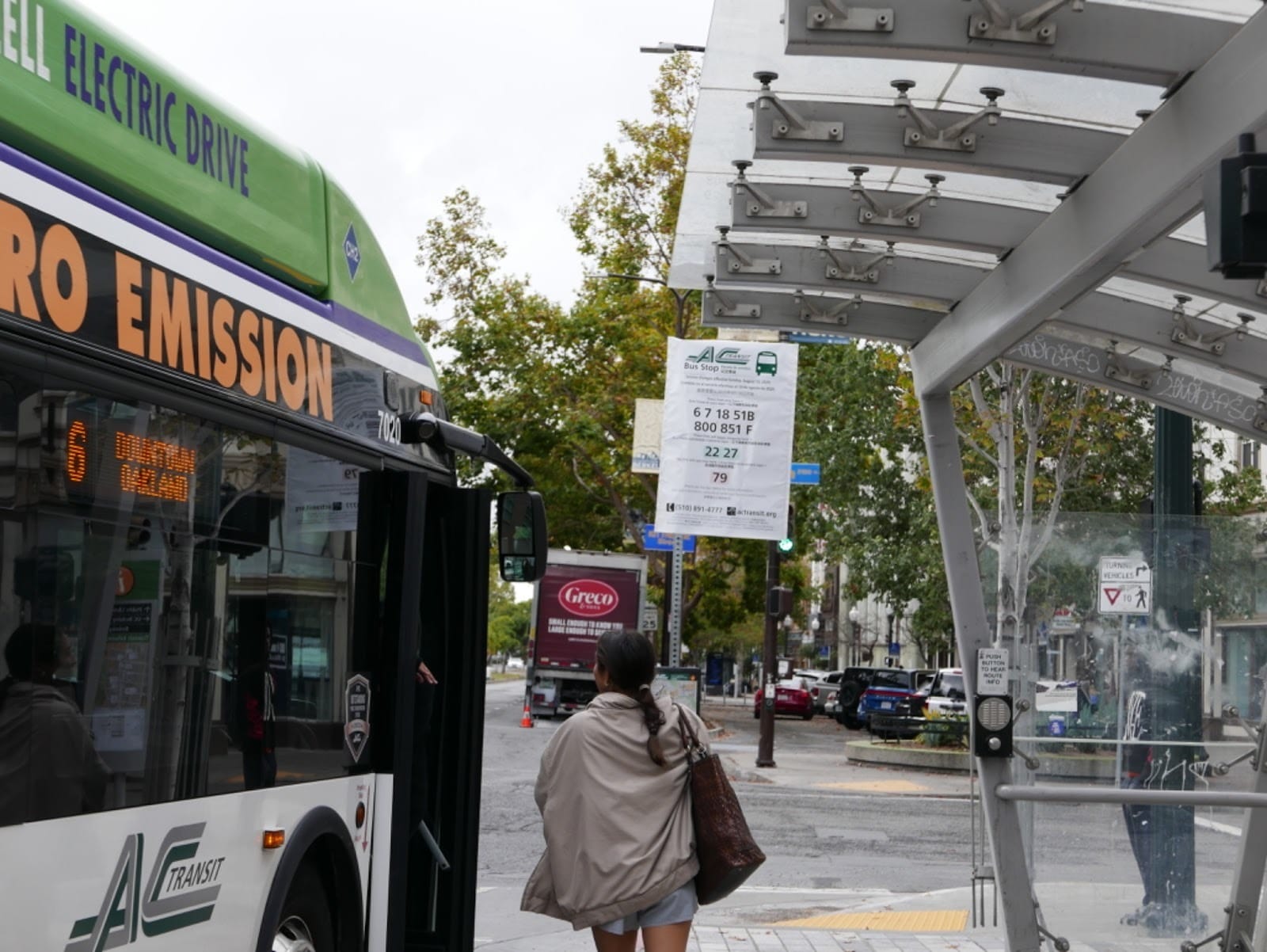
On a weekday morning in Downtown Oakland, Nisha, who wanted to solely use her first name, and her toddler, waited for the 51A on Broadway. Several other commuters waited for the next bus to show up. “I grew up on AC Transit,” she says. Nisha relies on public transit to go everywhere. For her, the entire realignment was mainly inconvenient to her day-to-day routine.
Like most riders we spoke to, Nisha was unaware of the route and schedule changes until they arrived. “I saw the temporary white signs at my bus stop, saying that it wouldn’t stop here anymore.”
As her bus finally rolls in, she and a woman next to her cheer — sometimes, it’s a miracle when the bus arrives.
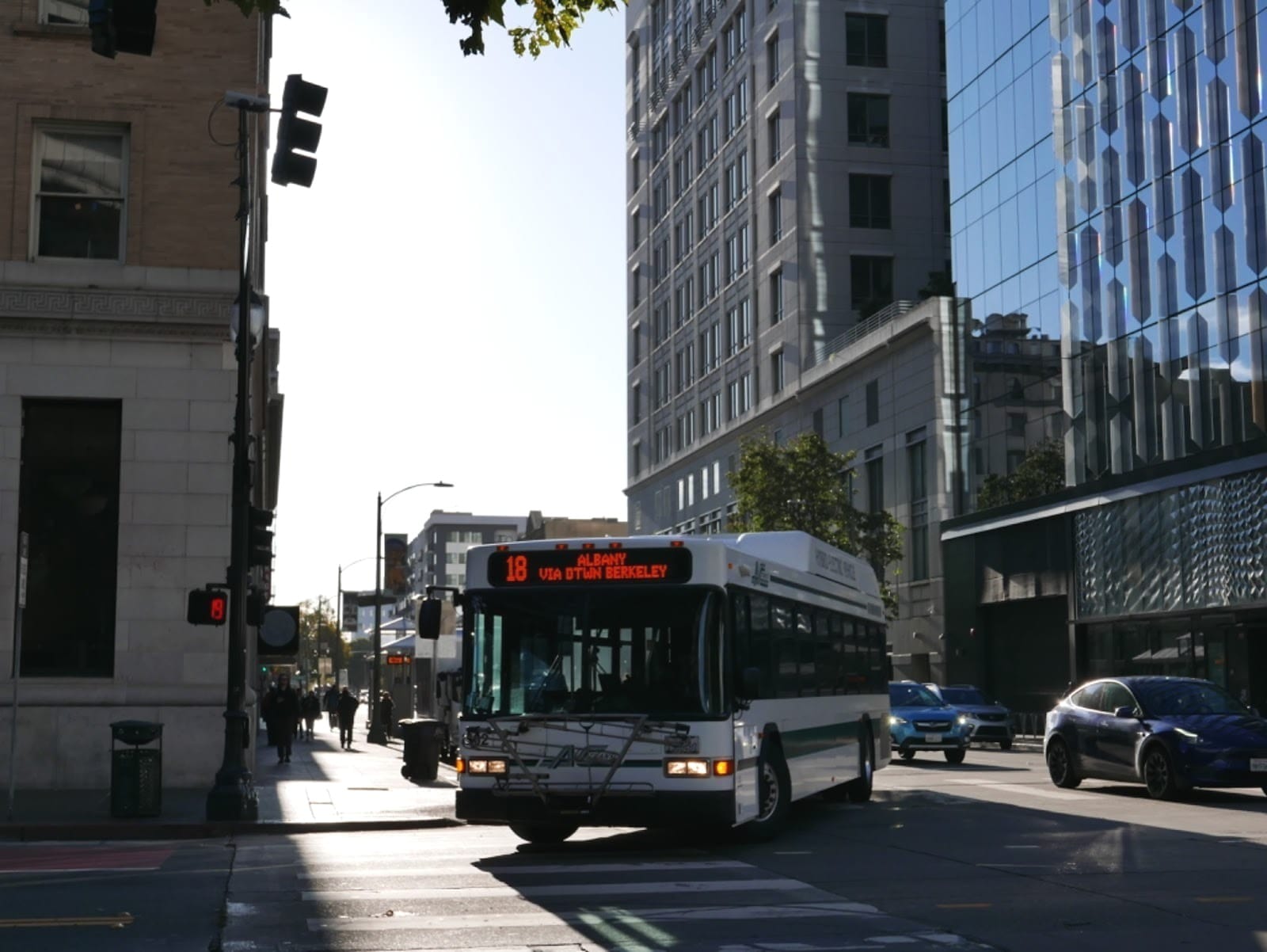
Patrick Gallagher frequently takes the 7, F, and 88 routes along with BART to music gigs and classes at both Laney Community College and Berkeley Community College. A strong supporter of public transit, Gallagher was aware of the upcoming changes, even participating in the preparatory survey last year. Even as someone who considers himself in-the-know, he admitted that the Realign rollout left him “totally discombobulated.”
Gallagher used to depend on the 7, which saw significant changes in route and timing, to get himself to practice with his heavy instruments. Now, he says, it runs every hour instead of every thirty minutes. “It's almost like the bus might as well not exist if that's it.” AC Transit says that Realign was meant to “match how the East Bay travels today.” At the same time, many East Bay riders are without cars, disposable income for ride-shares, or backup-plans when the bus doesn’t run.
Now, riders must adapt to new routes with fewer services, longer wait times, and pay even more for it, with a 25-cent fare hike implemented in July of 2025.
Stephanie Duarte-Bui, a textile technician working in Emeryville, has a 90-minute commute each way from her home in the Outer Richmond to her full-time job in Emeryville. Like most of the people we talked to, Duarte-Bui admitted that figuring out what to do was difficult after the realignment.
“I can’t take AC Transit anymore because the stops aren’t available.” Previously, Duarte-Bui got on an SFMTA bus to BART, commuted into Oakland, then took the 29. This commute would be daunting for anyone, and unfortunately, Realignment did not make it any easier. The 29 was replaced with the 22, which removed the only stops close to Stephanie’s job. The “Emeryville Go-Round,” a free shuttle run by the city funded in large part through its real estate and business owners’ “self-tax,” helped Duarte-Bui bounce back from Realignment changes. “It’s free and reliable, and the transition from BART is seamless.”
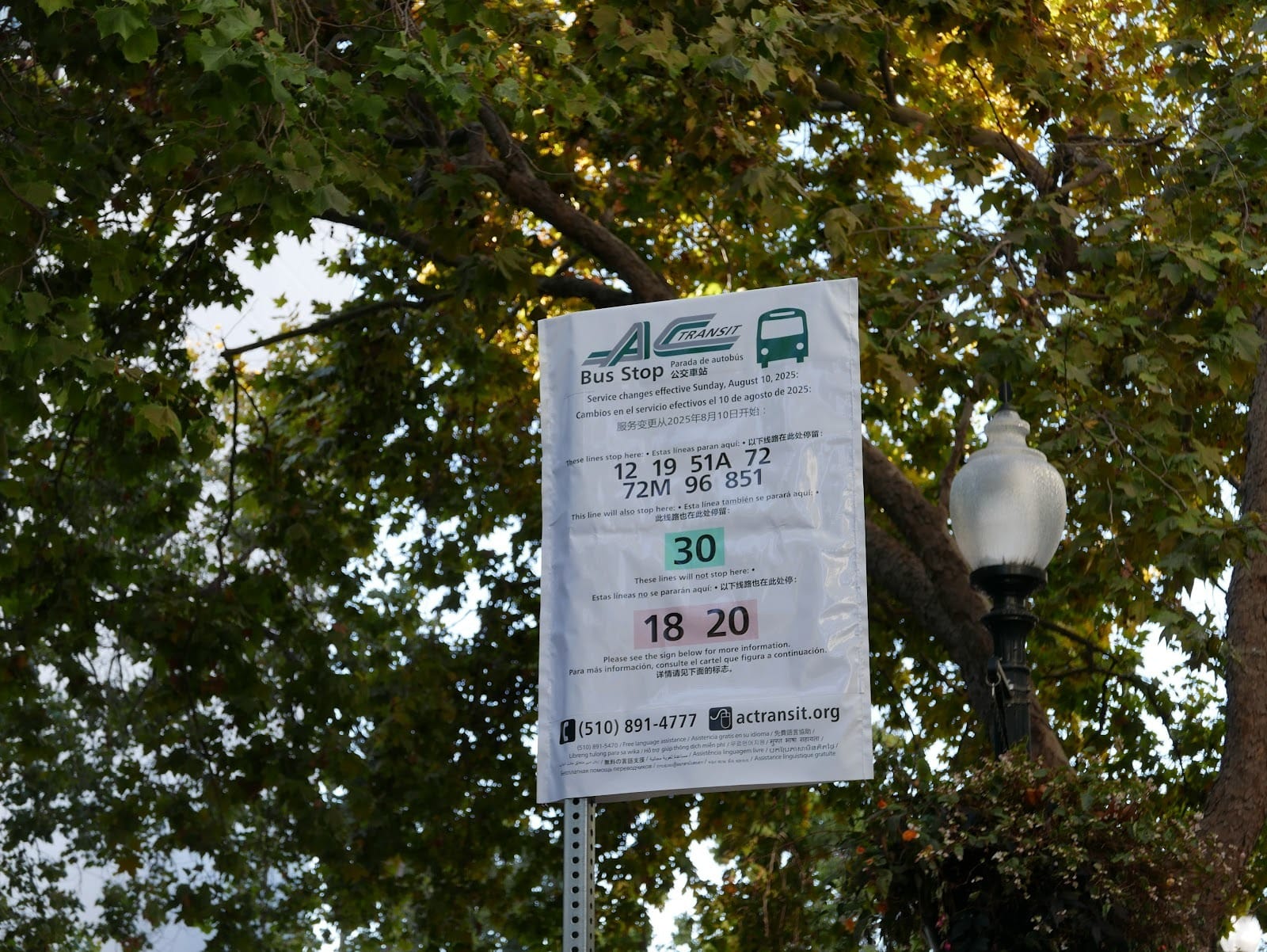
For Christian Lockmann, an assistant archeologist for Caltrans who moved to the East Bay earlier this year, the Realign Plan was a “massive shift” to his commute routine. Lockmann didn’t stress too much over his morning journey from Emeryville to Oakland before August 10th:
“Before, it was easy just to get on the bus nearest to me and head over to the San Pablo and take whatever next 72R came through… to now just like oh, shoot. I have to again plan to make sure that I don't accidentally get in a window where there's not a next bus for another 20 minutes.”
With a sigh, he says that Realignment significantly re-shaped his mornings. Now, a lot of his daily energy goes to avoiding being late to work.
Gallagher points out that transit rollbacks and reroutes affect working people differently, exacerbating or creating transit deserts. He has observed cuts to lines that working-class people in particular rely on, such as the 88 bus, while lines routed to more affluent neighborhoods like the P: Piedmont line remain untouched.
“Piedmont's obviously a predominantly white area – and it’s not that those people don't need to ride the buses – but cutting the 88 through Chinatown to Lake Merritt BART, where it connects to the 62 and the 96. Service here is getting shafted, and so many people here rely on that.”
In public statements on the Realign Plan, AC Transit executives paint a picture of equitable transit. But the truth isn’t clear — is it equity or simply efficiency? Public statements emphasize that two years of outreach and planning went into the plan.
AC Transit claims they surveyed more than 15,000 community members to inform their decisions. However, some riders see it as simply the trimming of more fat in a stretched-thin transportation system. The question remains how Realign has improved the East Bay’s working class ability to get around.
Most riders Current interviewed felt ambivalent towards or shut out of local transit decision processes that shape their everyday lives. To Nisha, it doesn’t seem like “[AC Transit] thinks about people who really use it.”
Since speaking with riders, AC Transit has announced another round of schedule changes, which roll out on February 1st and affect most routes. While the agency claims that these additional shifts are meant to “address overcrowding and further increase reliability,” many riders are caught in a continuous game of catch-up.
At the moment, the Bay Area and California’s public transit funding streams only grow more tenuous. The state subsidizes private transportation and eases regulations on Silicon Valley alternatives like Waymos, while MUNI and bus lines are consolidated. With this reality, it’s hard to see how AC’s continuous Realign Plan isn’t just a bandaid on a bullet hole.

“It’s a matter of life-and-death that we continue to organize.”

San Francisco special education teachers tell us why they’re striking.


We wanted to hear directly from the elite-lovers at their “March for Billionaires” in San Francisco — here’s what they said.

Current takes a look at two key issues for bus drivers, and maybe explains why the bus is often late…